
The Uyghur Reader: Stories We’re Following (Issue 15)
Issue 15: December 11, 2025 – January 7, 2026
Happy New Year and welcome to the fifteenth issue of the Uyghur Reader, a biweekly content roundup curated by the staff of the Uyghur Human Rights Project.
Each issue features carefully selected articles, reports, and publications from media outlets, academic institutions, NGOs, and government sources. While we highlight urgent human rights issues, we also aim to reflect the breadth of the Uyghur experience, including politics, economics, history, and culture.
🧠 This week’s selections come from Associate Director for Research and Advocacy Peter Irwin, Director of Research Henryk Szadziewski, Chinese Outreach Coordinator Zubayra Shamseden, and Director of Global Advocacy Louisa Greve.
📌 Arslan Hidayat and Nuriman Abdureshid write that in Kashgar, Chinese authorities are systematically replacing longstanding Uyghur street and alley names with generic Chinese ones like “Friendship Road” and “Red Flag Road,” stripping the city’s signs of local history and meaning. These re-namings erase Uyghur language and memory from everyday life in one of their most historic urban centers. Kashgar Times, “Uyghur Streets, Chinese Names: Kashgar Being Erased One Sign at a Time,“ December 29, 2025.
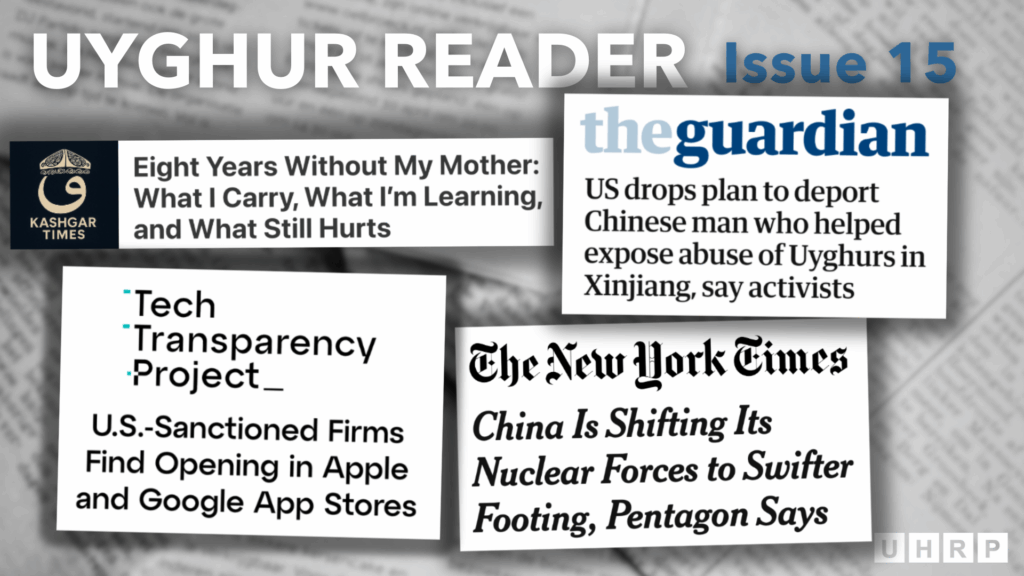
📌 A new Pentagon report says China is shifting its nuclear forces toward a faster “launch-on-warning” posture, even as warhead production slows, raising the risk of rapid retaliation in a crisis. The Uyghur Region plays a central role in this buildup, with the PLA Rocket Force installing large numbers of intercontinental ballistic missile silos in the region’s deserts, including near Qumul, alongside expanded early-warning radars and satellites. Analysts warn that turning the Uyghur Region into a core nuclear infrastructure zone deepens militarization of the region and increases the danger of miscalculation. Chris Buckley, “China Is Shifting Its Nuclear Forces to Swifter Footing, Pentagon Says,” The New York Times, December 24, 2025.
📌 In a new “Genocide Emergency” briefing, Genocide Watch issued its 2025 findings on the Uyghurs, including extermination and denial, based on its 10 criteria for genocide. The CCP’s repression of freedom of movement and religion, and surveillance of Uyghurs, are part of Stage 3: Discrimination. The CCP’s torture and imprisonment of Uyghurs in “re-education camps” fulfills Stage 8: Persecution. Sexual violence against women inside and outside these camps and removal of Uyghur children constitute Stage 9: Extermination. The CCP’s propaganda constitutes Stage 10: Denial. “Genocide Emergency: Xinjiang, China 2025,“ December 23, 2025.
📌 The U.S. Department of Homeland Security has dropped its plan to deport Guan Heng, the Chinese national who risked his life secretly filming the Uyghur Region’s detention camps and helped expose Beijing’s mass repression. Rights advocates say this reversal, after widespread public and congressional support, means his asylum case is now more likely to move forward. AP (via The Guardian), “US drops plan to deport Chinese man who helped expose abuse of Uyghurs in Xinjiang, say activists,“ December 22, 2025.
📌 In an opinion article for Austin American-Statesman, Samir Goswami, Director of Forced Labor Programs at Global Rights Compliance (GRC), writes on the decision of Texas Attorney General Ken Paxton to investigate Shein for potential violations related to unethical labor practices and unsafe products. Goswami argues that investigating Shein is merely the “tip of the iceberg” in addressing a broader problem of forced labor goods produced in China. GRC released a report in June which showed how critical minerals mined and processed in the Uyghur Region go into the products that Americans use every day. “Ken Paxton is right. Texas needs to investigate Shein.” December 12, 2025.
📌 In Kashgar Times, Akida Pulat reflects on eight years without her mother, renowned Uyghur anthropologist Rahile Dawut, who was disappeared and later sentenced to life in prison simply for preserving Uyghur culture. She describes how her mother’s kindness and scholarship shaped her, and how the detention pushed her into advocacy as she works to protect Uyghur identity and fight for her mother’s freedom. Akida urges the world to keep speaking Rahile Dawut’s name, insisting that every voice matters in breaking the silence surrounding China’s abuses. “Eight Years Without My Mother: What I Carry, What I’m Learning, and What Still Hurts,” December 11, 2025.
📌 The U.S. Congressional Executive Commission on China (CECC) released its annual report on human rights conditions and legal developments in China on December 10, 2025, examining the last year under the framework of “Promises Made, Promises Broken.” The report details how the Chinese government invokes the language of “rule of law” while practicing “rule by law,” that is, “using courts, police, and regulations as political weapons to preserve one-party rule at home and bend rules abroad.” The report includes a detailed section on Uyghurs, including forced labor, cultural and religious repression, the criminalization of dissent, as well as transnational repression beyond China’s borders. “Release of 2025 Annual Report Highlighting PRC’s Broken Human Rights Promises.” See also coverage in Sourcing Journal.
📌 A report from the Tech Transparency Project identified 52 apps in the App Store with direct connections to Russian, Chinese, and other companies under U.S. economic sanctions enforced by the Treasury Department, including apps associated with the Xinjiang Production and Construction Corps (XPCC). The XPCC is a Chinese paramilitary organization sanctioned by the U.S. and other governments for its role in human rights abuses in the Uyghur Region. See also coverage in The Washington Post. “U.S.-Sanctioned Firms Find Opening in Apple and Google App Stores,” December 10, 2025.
📖 Keep reading
- 2UrbanGirls, December 31, 2025: How a Uyghur Founder immigrated to US and Built a Startup Now Used by 97,000+ Engineers
- Rune Steenberg, Bitter Winter, December 31, 2025: China, Kazakhstan, and the ‘Chinese Flag Burning’ Trial
- Xinlu Liang, South China Morning Post, December 30, 2025: China unveils new ethnic unity and language laws with ‘national security perspective’
- Simina Mistreanu, Associated Press, December 29, 2025: China threatens detention in Xinjiang over banned Uyghur songs
- Ruth Ingram, Bitter Winter, December 26, 2025: “Imprisoned Souls” by Aziz Isa Elkun: A Review
- Dilnur Reyhan, Public Humanities, December 23, 2025: Minoritization of the Uyghur Nation under Chinese Colonialism
- Alessia Orazzo and Alessandra Cappelletti, Journal of Contemporary China, December 22, 2025: Digital Mediation and the Reshaping of Interethnic Relations in Contemporary China: AI Surveillance and Grid Governance in Xinjiang
- Chris Rickleton, The Diplomat, December 21, 2025: Burning Xi Jinping: Is Kazakh Rights Group Facing Its Final Days?
- Michal Zelcer-Lavid, Modern China, December 16, 2025: ‘Green-Colored Uyghur Poet’: Religion, Nostalgia, and Identity in Contemporary Uyghur Poetry
- Cherie Blair and Eleanor Lyons, The Telegraph, December 16, 2025: Britain risks becoming a dumping ground for goods tainted by forced labour
- Mahire Yakup and Rebecca Clothey, Journal of Multilingual and Multicultural Development, December 15, 2025: Examination of family language policy among the Uyghur diaspora in the United States
- Yalkun Uluyol, The Globe and Mail, December 15, 2025: Many Uyghurs found asylum in Turkey, but are now seeing that safety threatened
- International Federation for Human Rights (FIDH) and the International Commission of Jurists (ICJ), December 15, 2025: Thailand/Cambodia: Suspend trial of Uyghur detainees and implement UN request to redress multiple human rights violations
- Khaleel Rahman, Zeteo, December 9, 2025: ‘Treated Like an Animal’: How China Is Preventing Uyghur Muslim Women From Giving Birth
In Chinese
- 方子齐, DW, 2025年12月29日: 独家专访关恒:在中国没有免于恐惧的自由
- 韩连潮, IPK Media, 2025年12月17日: 告别人权口炮外交——以“新疆模式”救黎智英
- 储百亮, 纽约时报中文网, 2025年12月16日: 他拍下了新疆再教育营,如今美国要将他驱逐
- 辜泳秝, CNA, 2025年12月13日: 台灣人權工作者瑞典公開短講 籲重視中國威脅民主