
The Uyghur Reader: Stories We’re Following (Issue 16)
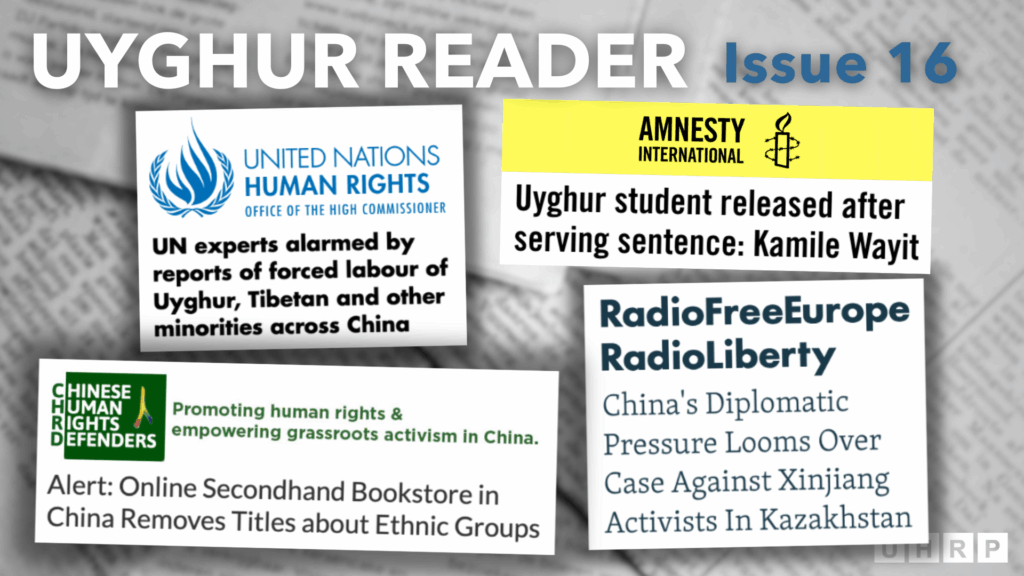
Issue 16: January 8, 2026 – January 22, 2026
Welcome to the sixteenth issue of the Uyghur Reader, a biweekly content roundup curated by the staff of the Uyghur Human Rights Project.
Each issue features carefully selected articles, reports, and publications from media outlets, academic institutions, NGOs, and government sources. While we highlight urgent human rights issues, we also aim to reflect the breadth of the Uyghur experience, including politics, economics, history, and culture.
🧠 This week’s selections come from Director of Research Henryk Szadziewski, Associate Director for Research and Advocacy Peter Irwin, and Chinese Outreach Coordinator Zubayra Shamseden.
📌 A group of UN experts as well as the Working Group on business and human rights released a joint statement expressing “deep concern” over “persistent allegations of forced labour” affecting Uyghurs, Kazakhs, and Kyrgyz, as well as Tibetans across China. The experts note that: “In many cases, the coercive elements are so severe that they may amount to forcible transfer and/or enslavement as a crime against humanity.” The experts also expressed “serious concern” over goods produced with forced labor entering global supply chains indirectly through third countries, noting the potential lack of effectiveness of targeted trade restrictions and human rights due diligence. “UN experts alarmed by reports of forced labour of Uyghur, Tibetan and other minorities across China,” Office of the UN High Commissioner for Human Rights, January 22.
📌 RFE/RL reporting shows that Chinese diplomatic pressure underpins the prosecution of 19 activists in Kazakhstan who protested Beijing’s mass detention of Kazakhs, Uyghurs and other Turkic peoples in the Uyghur Region. Kazakh authorities relied on a diplomatic note from China’s consulate to charge members of Naghyz Atazhurt with “inciting ethnic discord,” a vague offense carrying up to 10 years in prison. Rights groups say the case is politically motivated, criminalizes peaceful protest against Chinese state policies, and highlights Beijing’s growing influence and a tightening crackdown on Xinjiang-related dissent in Kazakhstan. Maqpal Mukankyzy, Merhat Sharipzhan, and Reid Standish, RFE/RL, January 19. Read about Guldaria Sherizat, one of the 19 activists, in Felix Corley’s article “Wife to be jailed for advocating for husband jailed in Xinjiang?” Forum 18, January 20.
📌 Catherine Putz of The Diplomat interviews Sayragul Sauytbay, an ethnic Kazakh survivor of China’s internment camps. Sayragul recounts how she was forced to work inside a camp before fleeing to Kazakhstan in 2018 and later gaining asylum in Sweden. Her testimony was among the first to expose the reality behind China’s so-called “vocational training centers,” which she says never closed but were transformed into prisons, factories, and boarding schools to hide ongoing repression. She urges the international community to move beyond statements of concern, hold China accountable under international law, and support the right of Turkic peoples in East Turkestan to self-determination. “Sayragul Sauytbay Speaks: Xinjiang, China, and Fighting for Justice,” January 20.
📌 Uyghur human rights activist Rahima Mahmut warns that the Chinese “super-embassy” in London would endanger Uyghurs and other political exiles who fled repression in China. Drawing on her own experience, she says Chinese embassies are central to transnational repression, used to monitor, intimidate, and silence critics abroad, while threatening families back in the Uyghur Region. Allowing the largest Chinese diplomatic and surveillance complex in Europe, she argues, would legitimize a government accused of genocide against Uyghurs and expand its reach into British society. For survivors of China’s abuses, the decision is not technical or economic, but a moral test of whether the UK will prioritize human rights and safety over convenience. “As a Uyghur, I had to flee China – don’t let them build a ‘super-embassy’ here,” The Independent, January 18.
📌 In China, a major online secondhand bookstore, Confucius Old Books, has quietly removed older Chinese-language titles about Tibet, Southern Mongolia and the Uyghur Region, including memoirs by Uyghur and other minoritized authors, limiting access to cultural and historical works. Rights groups say this reflects broader censorship and erasure of non-Han histories and voices, as even rare or imported books that once circulated freely are disappearing from the market. “Online Secondhand Bookstore in China Removes Titles about Ethnic Groups,” Chinese Human Rights Defenders, January 16.
📖 Keep reading
- Muslim Network TV, January 19: Documentary exposes China’s mass surveillance and detention of Uyghurs
- James Lynch, National Review, January 19: This Refugee Witnessed Atrocities in a Chinese Internment Camp. Years Later, She’s Still Demanding Justice
- Kurniawan Arif Maspul, Eurasia Review, January 16: Remembering Urumqi, A Test The World Is Still Failing
- Human Rights Watch, January 15: Kazakhstan/China: Drop Charges against Activists for Xinjiang Protests
- Amnesty International, January 13: Uyghur student released after serving sentence: Kamile Wayit
In Chinese
- 伊利夏提, 议报, 2025年01月21日: 似乎,我们又回到了偷听歌曲的时代