
Uyghur Reader: Stories We’re Following (Issue 30)
Issue 30: August 6, 2026 – August 19, 2026
Welcome to the thirtieth issue of the Uyghur Reader, a biweekly content roundup curated by the staff of the Uyghur Human Rights Project.
Each issue features carefully selected articles, reports, and publications from media outlets, academic institutions, NGOs, and government sources. While we highlight urgent human rights issues, we also aim to reflect the breadth of the Uyghur experience, including politics, economics, history, and culture.
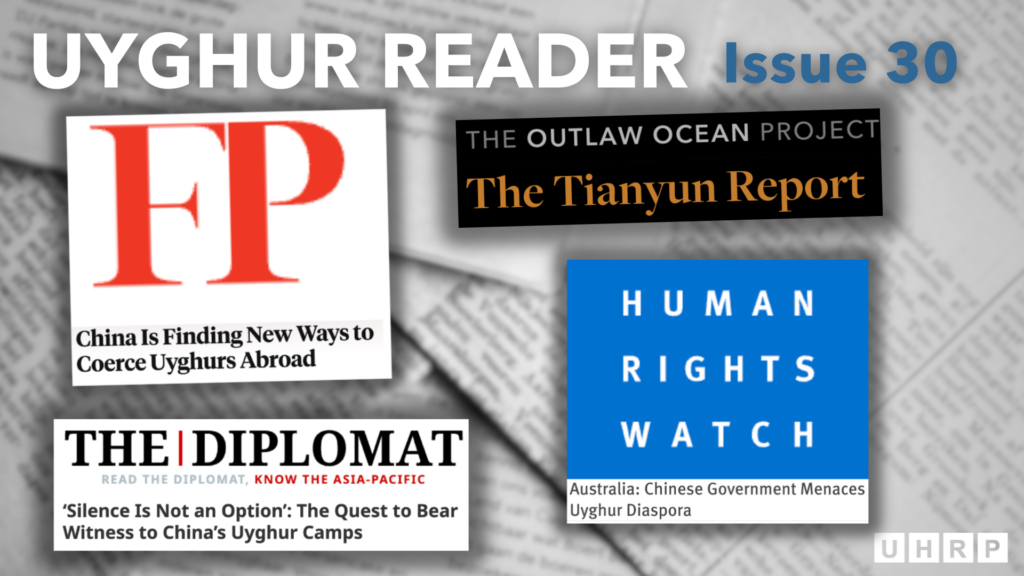
📌 Yalkun Uluyol of Human Rights Watch reports that Chinese authorities have interrogated Uyghur Australians visiting East Turkistan and pressured some to collect information on activists, community organizations, and Uyghur language schools in Australia. Based on interviews with 11 Uyghur Australians, the report describes how Beijing uses family separation and controlled visits to the Uyghur Region as leverage, creating fear that peaceful activities in Australia could result in retaliation against relatives in China. The pressure has contributed to a chilling effect on Uyghur community life in Australia, including participation in protests, social gatherings, and language education. “Australia: Chinese Government Menaces Uyghur Diaspora,” August 16.
📌 A new study by Adrian Zenz and Muetter Tohti examines how Beijing is increasingly using what appear as benign measures, particularly conditional access to the Uyghur Region, to influence and silence Uyghurs abroad. Since 2023, Uyghurs living overseas have been permitted to return to East Turkistan to visit relatives, but some have faced interrogation, pressure to provide information, or demands to promote positive narratives about the region. Zenz and Muetter argue that these “restorative inducements” exploit the family separation created by China’s earlier repression, while contributing to declining activism and growing mistrust within Uyghur diaspora communities. “China Is Finding New Ways to Coerce Uyghurs Abroad,” Foreign Policy, August 12.
📌 In a review of Heart Full of Light, a new book by Kalbinur Sidik, Ruth Ingram describes Kalbinur’s experiences teaching detainees in camps in East Turkistan, witnessing overcrowding, poor conditions, forced sterilization, interrogation, torture, and the pervasive surveillance of prisoners. After escaping to the Netherlands in 2019, Kalbinur struggled with trauma and initially found that people were unwilling to listen to her accounts of the camps, while Chinese authorities threatened and coerced her family and sought to discredit her testimony. Despite these pressures, Sidik has spent the past seven years testifying before governments, parliaments, and international audiences about what she witnessed. “‘Silence Is Not an Option’: The Quest to Bear Witness to China’s Uyghur Camps,” The Diplomat, August 12.
📌 The Outlaw Ocean Project’s investigation, “The Tianyun Report,” examines the rapid expansion of aquaculture in East Turkistan, focusing on Xinjiang Tianyun Organic Agriculture, a major producer of farmed salmon and a flagship of China’s “Blue Miracle” initiative. The investigation finds that Tianyun has links to government-sponsored labor-transfer programs involving Uyghurs, Kazakhs, and Kyrgyz people, and that its seafood has entered international supply chains, including those connected to U.S. food-service giant Sysco. In August 2026, the U.S. Department of Homeland Security added Tianyun to the Uyghur Forced Labor Prevention Act Entity List, citing concerns over sourcing from the Uyghur Region and participation in government labor programs.
📖 Keep reading/watching
- U.S. Customs and Border Protection, August 17, Uyghur Forced Labor Prevention Act Enforcement Statistics | U.S. Customs and Border Protection
- Zamira Eshanova, RFE/RL, August 14, China’s New ‘Ethnic Unity’ Law Looms Over Closed-Door Trial Of Kazakh Writer
- Luminihsan, August 14, “The Uyghur Story: Preserving Faith, Identity and Hope” with Abdureşid Eminhaci.
- Amnesty International, August 11, China: Further information: Uyghur musician released after completing sentence: Yashar
- Uyghur Times, August 9, Uyghur Poet and Journalist Tahir Talip Dies at 80 in Kashgar
- Zilala Mamat, The Diplomat, August 8, The Murder of a Uyghur in America Spotlights the Dangers for the Diaspora
- Ruth Ingram, Bitter Winter, August 6, China’s Ethnic Unity Law: Uyghurs in the Diaspora Already See Its Effects
📚 Research Papers and Reports
- Dragan Trailović, in Handbook on Diasporas and Migration, Edited by Ayhan Kaya and Nilay Kılınç, August 18, Uyghur diaspora: a case study of political mobilization and transnational activism
- Serdar Yurtcicek, Efe Can Gürcan, and Zhang Xu Ye, Central Asian Survey, August 11, From Xinjiang to Türkiye: İsa Yusuf Alptekin’s leading role in twentieth-century Uyghur nationalism