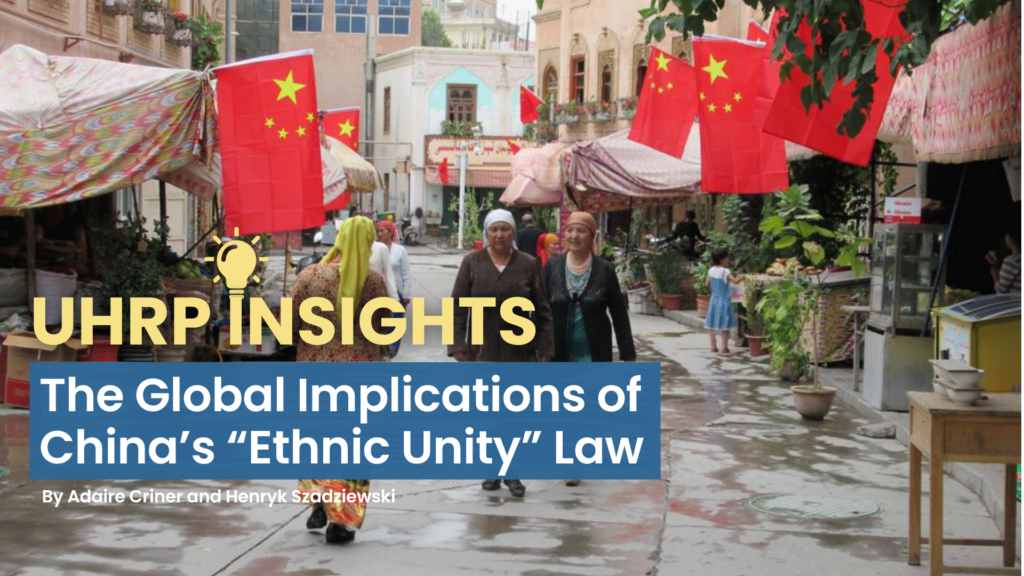
The Global Implications of China’s “Ethnic Unity” Law
April 14, 2026
A UHRP Insights column by Adaire Criner, Program Assistant, and Dr. Henryk Szadziewski, Director of Research
In 2019, Chinese diplomat Jiang Duan told UNHCR delegates in Geneva that “the experience in Xinjiang in this field can be introduced to other countries.” While “this field” referred to management of minoritized peoples, the “experience” he touted was China’s vast system of internment camps, so-called “vocational training centers,” targeting Uyghurs and other Turkic peoples. Survivor testimony has implicated the camps in a systematic campaign of forced labor, cultural assimilation, political indoctrination, torture, and forced sterilization. The Uyghur Tribunal determined these abuses to constitute genocide, while the very body Jiang Duan addressed, UNHCR, found they may amount to crimes against humanity.
Yet rather than retreating from campaigns of forced assimilation, Chinese officials have doubled down on so-called “ethnic unity” in both rhetoric and policy. The Uyghur Region, also known as East Turkistan, is presented not as a site of atrocities but as a success story, a conclusion amplified by some naive overseas actors. During a 2025 state-managed tour of the region, the leadership of Princeton University Press told state media that China’s approach to local ethnic relations is “a story that will help the rest of the world learn how to live.”
However, it is the newly adopted Law on Promoting Ethnic Unity and Progress, also known as the Ethnic Unity Law, that is the clearest legal expression of China’s assimilationist approach. Instead of protecting diversity, the law institutionalizes at a national scale policies already imposed on Uyghurs, Tibetans, Southern Mongolians, and other non-Han peoples.
Furthermore, in an echo of China’s attempt to export a blueprint of “vocational training centers,” this legal model of state-enforced assimilation and the securitization of minoritized peoples is also being promoted as a standard the world should follow. As the international human rights system comes under increasing pressure in an era of power politics, Beijing is using this law to establish alternative standards of governance for other states to follow.
From “Autonomy” to Assimilation
Beijing has not always taken such an overt approach. The Regional Ethnic Autonomy Law, adopted in 1984, promised protections for diverse languages and cultures. In practice, however, these promises were undermined from the start. Even as the People’s Republic of China’s constitution nominally guaranteed the freedom to preserve traditions, provincial “ethnic unity” regulations in East Turkistan (2021), Tibet (2020), and Southern Mongolia (2022) eroded even those protections.
The new national law codifies and expands these local regulations into nationwide policy. It requires state institutions, schools, media outlets, and businesses to promote a shared national identity over distinct ethnic ones. It calls for expanded Mandarin-language education, increased “interethnic integration,” and public campaigns promoting national unity. While authorities present these measures as necessary for “national cohesion” and “economic development,” the law represents a decisive shift away from ethnic autonomy toward assimilation by further weakening protections for languages such as Uyghur and Tibetan and expanding state control over religion and identity.
The Pomegranate Seeds Metaphor
This shift has accelerated dramatically under Xi Jinping. Governance of regions with significant populations of minoritized ethnicities now seeks to reshape diverse peoples into a unified “Chinese nation” (中华民族), which is dominated by Han cultural knowledge and norms. Xi frequently invokes the metaphor of the pomegranate, whose indistinguishable, tightly packed seeds symbolize ethnic groups bound together into one cohesive whole. Within this framework, ethnic policy is treated as a matter of national security rather than human rights. Assimilation is argued to be a prerequisite for stability.
In East Turkistan, these policies are already a daily reality. “Bilingual education” has effectively replaced Uyghur language instruction with Mandarin; religious practices are strictly curtailed; and labor transfers and state-sponsored marriage campaigns encourage forced ethnic intermingling. The new law formalizes these regional measures at a national level, replacing “simulated” autonomy with the reality of a state-enforced unified identity.
A Global Model for Repression
Despite a focus on the domestic management of minoritized peoples, the implications of the Ethnic Unity Law do not end at China’s borders. Chinese state officials and amplifiers argue this approach is the optimal way to govern diverse ethnicities. Chen Xiaoyan, a member of the Chinese People’s Political Consultative Conference, a rubber-stamp advisory body, stated that the law “will not only benefit the people of China but also serve as a valuable model for other countries and regions grappling with ethnic relations.” In an article for CGTN, academic Bai Fan claimed the Ethnic Unity Law “represents a model approach to addressing ethnic issues internationally.”
If adopted overseas, the principles underlying the Ethnic Unity Law risk normalizing deeply troubling practices, including the framing of ethnic relations primarily as a national security issue and the promotion of state authority over cultural pluralism. For the Uyghur people, the consequences are already clear through the systemic and iterative dismantling of their cultural and religious heritage. Exporting this model globally risks a dramatic expansion of similar abuses against minoritized peoples and the further erosion of international human rights protections.
To prevent the normalization of the repressive framework represented in the Ethnic Unity Law, the multilateral system must move beyond statements and invoke formal accountability for the outcomes of China’s assimilationist policies and practices. In addition to the 2022 UN Committee on the Elimination of Racial Discrimination (CERD) call for an investigation, the UN Special Rapporteur on contemporary forms of racism and the Special Rapporteur on minority issues should issue a joint communication expressing grave concern over the law’s compatibility with international treaties.
Furthermore, China is overdue for reviews under both the Convention on the Elimination of All Forms of Racial Discrimination and the Convention on the Rights of the Child, making these upcoming review cycles a critical opportunity to challenge the Ethnic Unity Law. Global actors must challenge the narrative that this model is effective or desirable by reaffirming their own commitment to pluralism and urging China to uphold its own constitutional protections for ethnic diversity. Failure to act risks the expansion of state-led cultural erasure under the pretense of national progress.
This article was updated on April 23, 2026.