
The Uyghur Reader: Stories We’re Following (Issue 14)
Issue 14: November 27 – December 10, 2025
Welcome to the fourteenth issue of the Uyghur Reader, a biweekly content roundup curated by the staff of the Uyghur Human Rights Project.
Each issue features carefully selected articles, reports, and publications from media outlets, academic institutions, NGOs, and government sources. While we highlight urgent human rights issues, we also aim to reflect the breadth of the Uyghur experience, including politics, economics, history, and culture.
🧠 This week’s selections come from Associate Director for Research and Advocacy Peter Irwin, Director of Research Henryk Szadziewski, and Chinese Outreach Coordinator Zubayra Shamseden.
The Uyghur Reader is taking a break over the winter holidays and will return on January 8. Happy holidays to those who celebrate!
📌 Khaleel Rahman writes about Zumrat Dawut, a Uyghur mother of three, who recounts how she was detained in a camp and later forcibly sterilized. The procedure was so brutal that U.S. doctors later told her she had been “treated like an animal.” Her story highlights how forced sterilization, forced birth control, and fines on Uyghur families are central tools in China’s campaign to suppress Uyghur births, a practice recognized internationally as part of the ongoing genocide. “‘Treated Like an Animal‘: How China Is Preventing Uyghur Muslim Women From Giving Birth,” Zeteo, December 9.
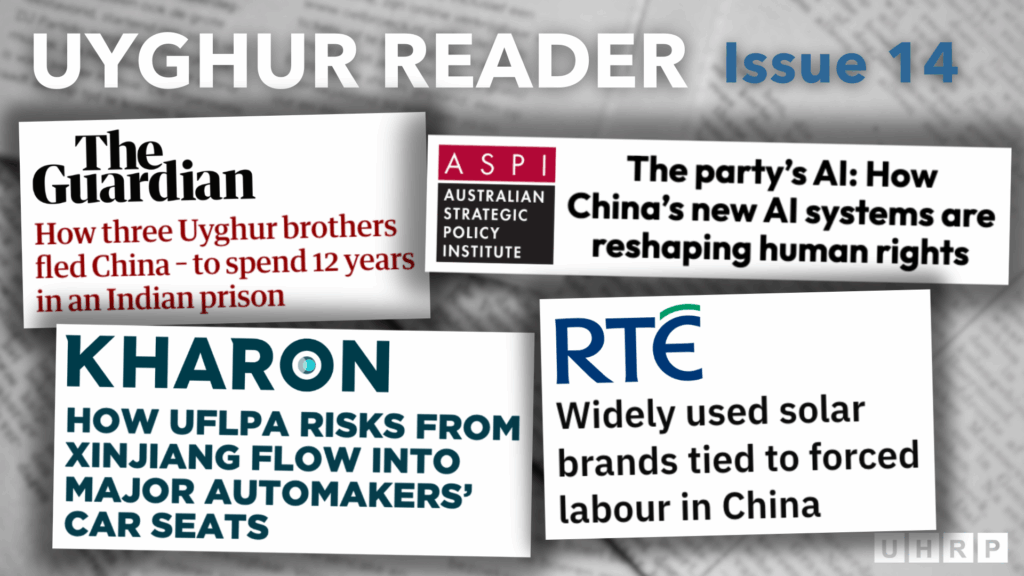
📌 Reporting for RTÉ, Joe Glavin finds that solar panels used across Ireland including in large solar farms, at airports, and on government buildings, were sourced from Chinese companies linked to Uyghur forced labor. The investigation also revealed that large volumes of coal has been mined in order to process and purify polysilicon, one of the essential ingredients in the manufacture of solar panels. “Widely used solar brands tied to forced labour in China,” December 9.
📢 “Three Years of the Uyghur Forced Labor Prevention Act: Assessing the Impact,” an event hosted by the Center for Strategic and International Studies on December 9. Following a presentation, Dr. Laura Murphy, Jewher Ilham, Anasuya Syam, Thea Lee, and Andrew Friedman discussed the current and future impact of the the Uyghur Forced Labor Prevention Act.
📌 In The Guardian, Aakash Hassan writes about how three Uyghur brothers, Adil Tursun, Abdul Khaliq Tursun and Salamu Tursun, fled repression in East Turkistan and crossed into India in 2013, hoping to escape persecution. Instead of safety, they were arrested for illegal border-crossing, jailed for 18 months, and then held indefinitely under India’s Public Safety Act, a detention that denies them asylum and leaves their fate unclear. “How three Uyghur brothers fled China – to spend 12 years in an Indian prison,” December 5.
📌 China’s attempt to “normalize” the Uyghur genocide in Europe faltered again when a Beijing-organized “Xinjiang Delegation” delivered a sparsely attended propaganda lecture in Paris, which was met outside by Uyghur activists who directly confronted the officials. In the Kashgar Times, Dilnur Reyhan argues that despite China’s vast resources, its influence campaign is failing in Europe, while a small but determined Uyghur diaspora continues to successfully challenge Beijing’s narrative. “China’s Propaganda Tour Hits Resistance in Paris,” December 5. Also, read a report from Intelligence Online on the delegation’s visit to Paris.
📌 The National Human Rights Commission of Thailand has declared the February 27, 2025 deportation of 40 Uyghur refugees back to China “unlawful,” finding that the Thai Immigration Office and the government violated both Thai and international law by sending people to a place where serious risks of torture, disappearance, and ill-treatment were well documented. The deportation spotlights how states may betray refuge-seekers to foreign pressure, eroding global trust and exposing Uyghurs to grave danger even after years of refuge abroad. “Thai Human Rights Commission: Uyghur Deportation Unlawful,” Safeguard Defenders, December 4.
📌 Gregory Castillo reports for Axios that Turan Uyghur Kitchen in Plano is introducing North Texas diners to Uyghur cuisine through handmade halal dishes shaped by centuries of cultural exchange. Opened in 2023 by Abdulla Yunus, the family restaurant brings Uyghur flavors and traditions to Texas with dishes like 100-inch hand-pulled laghman noodles, lamb gosh naan, and honey cake, helping raise the profile of Uyghur culinary heritage across the state. “Plano’s Uyghur Kitchen introduces Xinjiang cuisine to North Texas,” December 2. Also watch a report by Vladimir Duthiers of CBS Morning’s The Dish on Bughra Arkin, the owner of Dolan’s Uyghur Cuisine in the Los Angeles area. “Restaurant owner shines light on Uyghur culture amid atrocities facing his family,” December 2.
📌 Jun Kit Man writes for Resonate about filmmaker Bing Liu’s new film, Preparation for the Next Life, a feature centered on the story of a young Uyghur woman and an American veteran. Liu draws on years in the camera department and documentary practice to shape authentic performances from leads Sebiye Behtiyar and Fred Hechinger, focusing on specificity rather than attempting to represent an entire community. “Bing Liu on Directing Preparation for the Next Life and Telling Uyghur Stories,” December 2. Read Peter Bradshaw’s review of Preparation for the Next Life in The Guardian.
📌 A new report from the Australian Strategic Policy Institute (ASPI) shows that Chinese authorities are now building and deploying AI-powered surveillance and censorship tools specifically designed to monitor Uyghurs, Tibetans, Mongolians and others. The tools enable text, audio, video and image monitoring in Uyghur, and give the state new capacity to track, censor, and suppress Uyghur speech and communications. What began as mass-detention and physical repression in the Uyghur Region is now being transformed into a digital machinery that criminalizes Uyghur identity, speech, and dissent wherever AI can reach. “The party’s AI: How China’s new AI systems are reshaping human rights,” December 1. Read an article in Chinese/中文 from VOA Mandarin on the new report.
📌 Kharon reports that forced labor risks may be entering global automakers’ supply chains through Wuhan Boqi Technology, a Chinese car-interior supplier whose shareholder network links back to Xinjiang cotton subsidies, XPCC-controlled industrial zones, and “Xinjiang Aid” programs. Their briefing shows how textiles and materials tied to forced labor could be flowing from Wuhan Yudahua’s Xinjiang operations into Boqi products shipped to major U.S., European and Japanese manufacturers, underscoring the need for heightened scrutiny of auto imports. “How UFLPA Risks from Xinjiang Flow into Major Automakers’ Car Seats,” November 26.
📖 Keep reading
- Andrew Mark Miller, Fox News, December 9: Elite US colleges linked to Chinese surveillance labs driving Uyghur ‘genocide,’ study warns
- Salome Mamuladze, McCain Institute, December 9: Beyond Xinjiang: How China’s Repression Reaches Across Borders
- Alex Kliment, GZERO, December 5: The genocide no one talks about any more
- Reporters Without Borders, December 5: Kasim Abdurehim Kashgar, former VOA journalist, discusses the dismantling of RFA’s Uyghur service
- Global Rights Compliance, December 1: Forced Labour in the Uyghur Region: NGOs at UNBHR Call for Coordinated Global Response
- Uyghur Rights Monitor, December 1: November 2025 Review
- Mazoe Ford, Australian Broadcasting Corporation (ABC), December 1: Fears of spying and interrogation as ‘mega’ Chinese embassy in London looks set for approval
- Zhao Ziwen, South China Morning Post, November 30: Why Xinjiang casts a long shadow over China and Syria’s efforts to build better relations
- The Polis Project, November 29: Technologies of Genocide: Suchitra Vijayan in Conversation with Abduweli Ayup
- Aziz Isa Elkun, November 27: New Book Release – Imprisoned Souls: Poems of Uyghur Prisoners in China
- Diego Benning Wang, Eurasianet, November 25-26: “Kazakhstan: Uighurs striving to preserve culture amid Digital Age pressures” Part I, Part II