The Uyghur Reader: Stories We’re Following (Issue 17)
Issue 17: January 22, 2026 – February 18, 2026
Welcome to the seventeenth issue of the Uyghur Reader, a biweekly content roundup curated by the staff of the Uyghur Human Rights Project.
Each issue features carefully selected articles, reports, and publications from media outlets, academic institutions, NGOs, and government sources. While we highlight urgent human rights issues, we also aim to reflect the breadth of the Uyghur experience, including politics, economics, history, and culture.
🧠 This week’s selections come from Director of Research Henryk Szadziewski, Associate Director for Research and Advocacy Peter Irwin, Chinese Outreach Coordinator Zubayra Shamseden, and Program Assistant Adaire Criner.
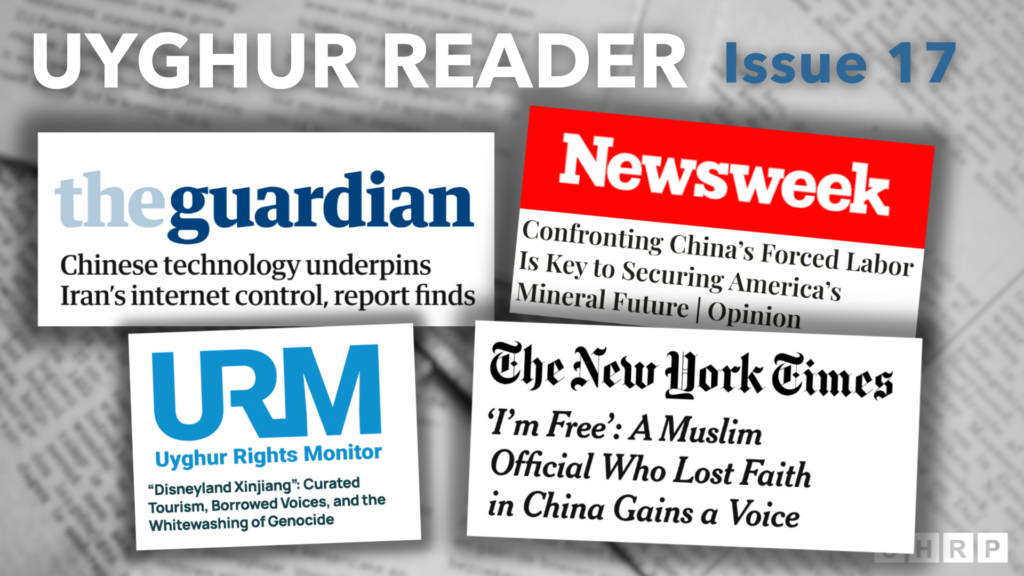
📌 Chinese surveillance and internet-control technology, including tools first used to monitor Uyghurs in East Turkistan, now underpins Iran’s highly restrictive online censorship regime, helping Tehran cut its 93 million people off from the global internet during mass protests. Experts say Beijing’s export of facial recognition systems and digital control tools has shaped Iran’s ability to monitor, block, and suppress dissent, showing how China’s model of digital repression is being adopted abroad. Aisha Down, The Guardian, “Chinese technology underpins Iran’s internet control, report finds,” February 9.
📌 In Newsweek, Martha Newton and Samir Goswami argue that China’s dominance in critical mineral supply chains, including minerals extracted and processed in the Uyghur Region, is deeply tied to state-imposed forced labor of Uyghurs and other minorities, a practice that undermines both human rights and U.S. economic security. The authors say enforcing the Uyghur Forced Labor Prevention Act (UFLPA) and using better data and allied cooperation are essential to keep minerals produced with coercion out of Western supply chains and reduce reliance on China’s repressive systems. “Confronting China’s Forced Labor Is Key to Securing America’s Mineral Future”, February 2.
📌 In a new report for Uyghur Rights Monitor, Ablet Turdi reveals how China is now promoting a curated “Disneyland-like” version of the Uyghur Region to tourists and influencers, with scripted itineraries and staged heritage sites designed to show a false image of “normal life” while denying independent access to the truth of ongoing repression. Authorities tightly control what visitors see and amplify selected foreign voices to whitewash nearly a decade of documented atrocities against Uyghurs and other Turkic peoples, turning tourism into a propaganda tool rather than genuine cultural exchange. “‘Disneyland Xinjiang’: Curated Tourism, Borrowed Voices, and the Whitewashing of Genocide,” February 1.
📌 For The New York Times, Li Yuan tells the story of Ma Ruilin, a Muslim official in China who quit the Communist Party and left the country because he could no longer support the state’s repression of religious life, including surveillance and control targeting Muslims. The article highlights how even some inside the system see China’s policies toward Muslims, especially in East Turkistan where Uyghurs and other Turkic peoples face arbitrary detention and harsh restrictions, as unjust and unsustainable. “‘I’m Free’: A Muslim Official Who Lost Faith in China Gains a Voice,” February 1.
📌 A new European Parliament report on transnational repression documents how authoritarian states, including China, extend their reach beyond their borders to intimidate, surveil, and silence critics and diaspora communities inside the EU. China’s activities target Uyghurs who speak out about abuses in the Uyghur Region, with tactics like digital surveillance, threats to family members back home, and pressure campaigns that seek to undermine Uyghur activists in Europe. The study highlights how these global repression networks work alongside other forms of influence and coercion, making it difficult for Uyghurs in exile to live, organise, or advocate freely. It calls for stronger legal definitions and coordinated EU policies to protect victims of such repression and counter the methods used by Beijing and similar regimes. Nate Schenkkan, Zselyke Csaky, Emile Dirks, Alexander Dukalskis, “Perpetrators and methods of transnational repression and possible counter strategies,” January 2026.
📌 United Nations experts warn that forced labor of Uyghurs, other Turkic peoples, and Tibetan continues across China, even as mass detention camps have largely closed. They say state-run “labor transfer” programs in East Turkistan and Tibet rely on coercion, surveillance, and fear of punishment, practices that may amount to crimes against humanity. The findings come as US lawmakers raise alarm over weakened enforcement of the Uyghur Forced Labor Prevention Act (UFLPA), citing a sharp drop in stopped shipments despite no evidence that forced-labor goods have declined. Jasmin Malik Chua, Sourcing Journal, “Is Combating the ‘Persistent Pattern’ of China-Imposed Forced Labor Still a US Priority?” January 28. Read the statement from the UN here.
📌 In Domino Theory, Harry Saunders examines why China shut down its “reeducation” camps in the Uyghur Region and whether international pressure changed Beijing’s course. Researchers found that global exposure of these camps through satellite imagery, survivor testimony, and human rights reporting coincided with China’s announcement in 2019 that the system was being “completed,” though experts disagree on how much foreign scrutiny truly forced that change. The article shows that even as visible detention centers shrink, the Chinese state’s broader apparatus of control over Uyghurs remains deeply entrenched. “Why the Xinjiang Camps Closed,” January 26. Read the original research paper by Jan Švec in Modern China, as well as additional coverage from Fergus Shiel for the International Consortium of Investigative Journalists.
📖 Keep reading/listening
February
- Ben Butler and Annie Guest, Australian Broadcasting Corporation, February 16: Push for stronger slavery laws
- USCIRF, Vicky Hartzler with Jewher Ilham and Adrian Zenz, February 13: U.S. Policy Addressing China’s FoRB Abuses against Uyghurs
- Jemimah Steinfeld, Index on Censorship, February 10: Former Pussy Riot member and Uyghur activist say encryption keeps them safe
- Abdurehim Gheni Uyghur, Bitter Winter, February 10: Amsterdam’s Lonely Uyghur vs Uyghur Restaurants–Or in Favor of Them?
- Human Rights Law Centre, February 10: Kmart challenge heard in the Federal Court today
- Ruth Ingram, Bitter Winter, February 10: Why Uyghurs Remembered February 5, 1997, 29 Years On
- Pablo Bueno, Modaes, February 9: The Uyghur Dilemma: Forced Labor and Xinjiang Cotton Under Global Fashion’s Microscope
- Anwesha Divya Charan and Hargun Dang, Völkerrechtsblog, February 9: The Xinjiang Cotton Conundrum
- Human Rights: Conversations Across Generations, February 7: Jewher Ilham – Uyghur Rights and Her Father, Professor Ilham Tohti
- Ruth Ingram, Bitter Winter, February 6: Uyghurs Are “Protected No More” in Türkiye
- Kim Seungwook, The Asia Business Daily, February 2: “Magna Carta, Symbol of Democracy, Guarded by Chinese CCTV?”… Uyghur Group Outraged
- Dr. Nadia Helmy, Modern Diplomacy, February 1: China Eyes Turkey’s Ethnic Outreach Warily as Ankara Courts Lebanese Turkmens
January
- Arslan Hidayat and Nur Iman, Kashgar Times, January 31: Chinese Officer Offers Uyghur A Way Out
- Pippa Crerar, The Guardian, January 30: China has lifted sanctions from six serving British MPs and peers, Starmer says
- Aldo Zammit Borda, The Conversation, January 30: How reproductive violence is being used in conflicts to deny people’s future
- Luke Alsford, Metro, January 29: Uyghurs in UK feel ‘betrayed’ by Starmer’s ‘cosy visit’ to China
- James T. Arredy, The Wall Street Journal, January 28: Chinese Man Who Documented Uyghur Population Is Granted U.S. Asylum. Read in Chinese/中文
- Amy Qin, The New York Times, January 28: Dissident Who Daringly Documented Uyghurs’ Repression Wins Asylum. Read in Chinese/中文.
- Lopsang Gurung, Bitter Winter, January 27: The Denial Has Collapsed: UN Confirms Forced Labor in Tibet and Xinjiang
- Samdol Sichoe, Brown Political Review, January 27: No Ummah for Uyghurs
- Alisha Rahaman Sarkar, The Independent, January 27: Chinese company on US forced labour watchlist to buy Canadian gold mining firm
- Citizen Portal, January 22: House committee advances bill tying state incentives to Uyghur forced-labor rules
- Hanh Vu, Human Rights Research Center, January 21: Persecution of Uyghurs in Xinjiang:Torture, Crimes Against Humanity, and Genocide
📚 Research Papers and Reports
- Phil Gurski and Marie Lamensch, Montreal Institute for Global Security, February 17: Transnational Repression in Canada: A Threat to Democracy and Public Safety
- Michel Harb and Arne F. Wackenhut, Ethnic and Racial Studies, February 12: Transnational repression in an age of global authoritarianism: experiences of Uyghur diaspora activists in Sweden
- Zhe Zhang and Wenhui Yang, Journal of Contemporary China, February 5: Xinjianger, Muslim, and Chinese Nation: Identity Transformation of Uyghur Students in Xinjiang Class
- Human Rights Watch, February 4: China: Repression Deepens, Extends Abroad. Also see Human Rights Watch, World Report 2026
- Committee to Protect Journalists, January 21: 2025 journalist jailings remain stubbornly high; harsh prison conditions pervasive
📢 Event announcement
March 23, 2026, 12:00–1:00 p.m. EST, The Hidden Cost: Uyghur Forced Labour in Critical Mineral Supply Chains, Stop Uyghur Genocide
- This webinar presents new research showing how critical mineral supply chains are tied to state-imposed forced labour in the Uyghur Region, creating serious legal and ethical risks for global industries. Drawing on findings from a report by Global Rights Compliance, Samir Goswami and Sian Lea discuss practical steps to stop industries central to the global economy from being built on Uyghur forced labour.
- 🀄 In Chinese
周子馨, 美联社 (DW), 2026年01月29日: 揭露新疆再教育营 美国法官批准关恒庇护申请 - 斯洋, 美国之音中文网, 2026年01月24日: 联合国专家对维吾尔人、藏人等少数族群在中国遭受系统性强迫劳动发出警告
- 王松莲, Christina Abdulahad, 人权观察, 2026年01月23日: 芬兰总理访华应正视中国镇压行径