The Uyghur Reader: Stories We’re Following (Issue 18)
Issue 18: February 19, 2026 – March 4, 2026
Welcome to the eighteenth issue of the Uyghur Reader, a biweekly content roundup curated by the staff of the Uyghur Human Rights Project.
Each issue features carefully selected articles, reports, and publications from media outlets, academic institutions, NGOs, and government sources. While we highlight urgent human rights issues, we also aim to reflect the breadth of the Uyghur experience, including politics, economics, history, and culture.
🧠 This week’s selections come from Director of Research Henryk Szadziewski, Program Assistant Adaire Criner, and Executive Director Omer Kanat.
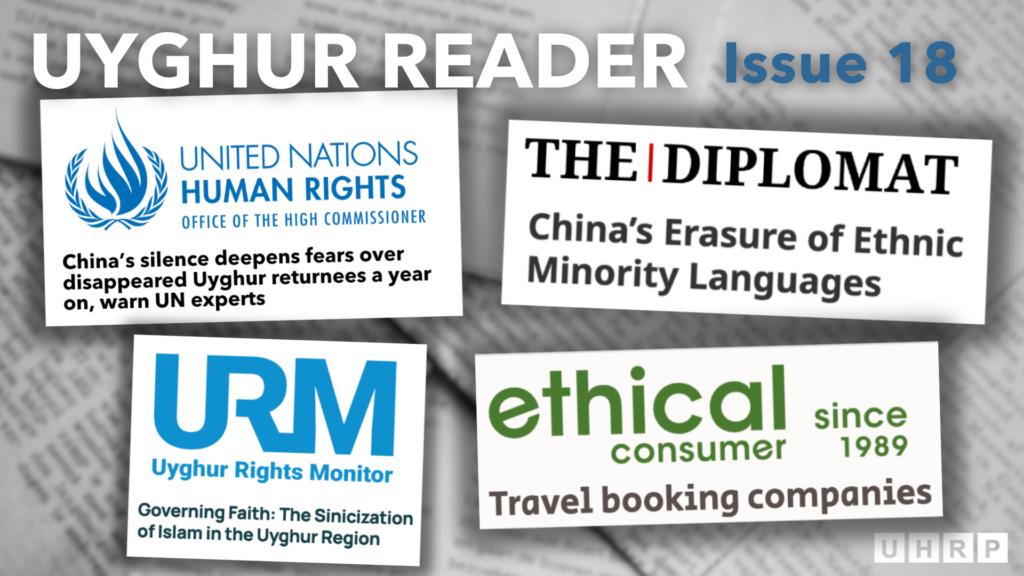
📌 For Uyghur Rights Monitor, Erk Altay writes how Chinese authorities are aggressively Sinicizing Islam in the Uyghur Region, reshaping mosques, sermons, religious education, and daily practice to fit state-approved norms while stripping them of traditional Uyghur linguistic and cultural meaning. Religious leaders and believers are pushed into government-run structures, face surveillance and punishment, and are forced to adopt a version of Islam engineered to dilute their heritage rather than reflect their faith. “Governing Faith: The Sinicization of Islam in the Uyghur Region,” March 2.
📌 On the one year anniversary of the forcible return of 40 Uyghurs from Thailand to China, United Nations human rights experts warn that China’s refusal to account for the fate of Uyghurs and other Turkic Muslims deported from abroad deepens fears that they have disappeared into detention or worse. They call Beijing’s silence “deeply troubling,” urging transparent information on returnees’ whereabouts and respect for human rights, including access by independent monitors. OHCHR, China’s silence deepens fears over disappeared Uyghur returnees a year on, warn UN experts, February 27. Read Yalkun Uluyol’s analysis for Human Rights Watch and a statement from Wild Pigeon Collective on the anniversary.
📌 In The Diplomat, Sophie Richardson explains how China has revised its Law on the Standard Spoken and Written Chinese Language to remove protections for minority-language instruction, formally ending Mongolian-, Tibetan-, and Uyghur-medium education in favor of Mandarin-only schooling. This legal shift codifies a long-running assimilation campaign that marginalizes mother tongues, erodes cultural identity, and may violate both China’s own laws and international human rights obligations. For Uyghurs, already subjected to mass detention and cultural repression, the replacement of Uyghur-language textbooks and punishment of language advocates signals a deepening effort to sever language, memory, and heritage from the next generation. “China’s Erasure of Ethnic Minority Languages,” February 21. Read more coverage of the revised law in the Financial Times.
📌An ethical travel guide from Ethical Consumer, warns that tourism in China, particularly in the Uyghur Region, risks enabling state propaganda and human rights abuses if companies fail to conduct serious due diligence. It highlights concerns, based on UHRP research, that organized tours to East Turkistan can whitewash repression of Uyghurs by presenting tightly curated narratives while ignoring evidence of mass detention, forced labour, and cultural erasure. The guide urges travelers to scrutinize travel companies’ human rights policies and avoid operators that may contribute to the normalization of abuses against Uyghurs. Shanta Bhavnani, “Travel booking companies,” February 11.
📖 Keep reading/watching
- Mamatjan Juma, Uyghur News Network, March 4, Uyghurs Detained During Ramadan Home Inspections in Xinjiang; One Faces Charges
- Meiirim Baqytzhan and Merhat Sharipzhan, RFE/RL, March 3, Activist Once Detained In China Faces Trial In Kazakhstan As Family Battles Closed-Door Case
- Uyghur Rights Monitor, March 3, February 2026 Review
- Phoebe Zhang, South China Morning Post, March 1, Chinese social media bans female Uygur comic over marriage jokes – sparks backlash
- Teppei Kasai, Human Rights Watch, February 27, Japan Should Adopt Regulation to Counter Uyghur Forced Labor
- Maya Burnand, Anti-Slavery International, February 26, Made in Italy (video)
- Stockholm Center for Freedom, February 26, Uyghur man detained in Turkey faces possible deportation to China
- Alva Robinson, Edgu Bilig, February 25, Uyghur Children Carry Language Across Generations In Honor of International Mother Language Day
- Liam Scott, Columbia Journalism Review, February 24, The Voice of the Uyghur Post
- Human Rights Watch, February 18, “China: Officials Pressuring Uyghurs in France”
- Reuters, February 17, Radio Free Asia says it resumes broadcasts to China
- Arslan Hidayat and Nur Iman, Kashgar Times, February 17, Ramadan is HARAM For Uyghur Muslims, But Chinese New Year is HALAL
📚 Research Papers and Reports
- Vanessa Frangville and Sonia Imin, Central Asian Survey, February 2, Decolonizing Uyghur visual art: Uyghur diasporic responses to China’s cultural engineering
- Timothy A. Grose, China Leadership Monitor, March 1, “The Patient Labor of Assimilation”: China’s Strategies to Create a New “New Territory”
- Coalition to End Forced Labour in the Uyghur Region, February 27, Submission for the 2026 Trafficking in Persons Report