
The Uyghur Reader: Stories We’re Following (Issue 19)
Issue 19: March 5, 2026 – March 18, 2026
Welcome to the nineteenth issue of the Uyghur Reader, a biweekly content roundup curated by the staff of the Uyghur Human Rights Project.
Each issue features carefully selected articles, reports, and publications from media outlets, academic institutions, NGOs, and government sources. While we highlight urgent human rights issues, we also aim to reflect the breadth of the Uyghur experience, including politics, economics, history, and culture.
🧠 This week’s selections come from Director of Research Henryk Szadziewski and Program Assistant Adaire Criner.
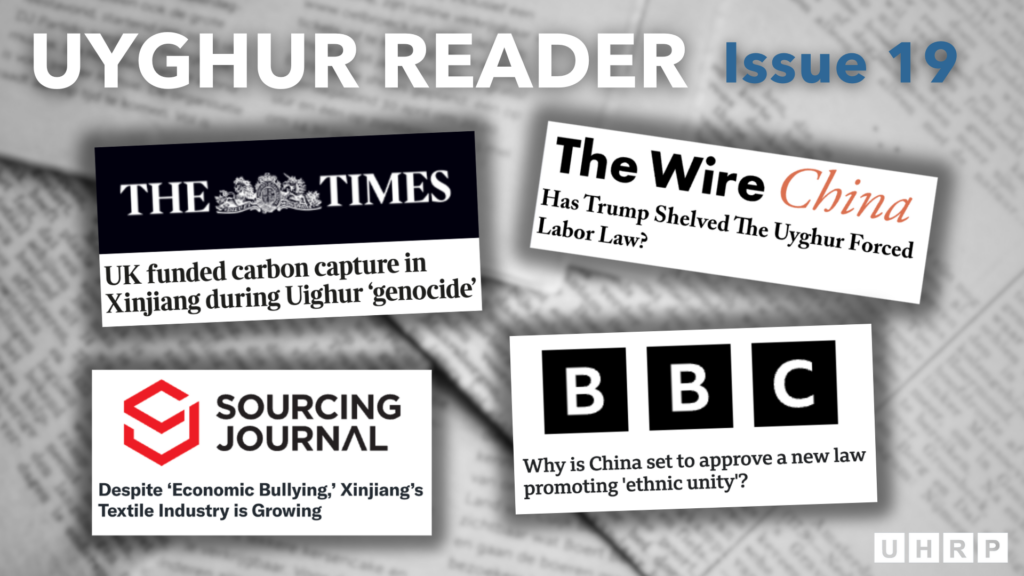
📌 The UK government funded carbon capture projects in the Uyghur Region between 2016 and 2018, even as mass detention of Uyghurs was being reported, raising serious ethical concerns about supporting projects linked to the region. Critics warn that some of this technology may have supported oil extraction, while Uyghurs were subjected to forced labor, surveillance, and abuses that the UN says may amount to crimes against humanity. Bertie Harrison-Broninski and Ben Cooke, The Times (UK), March 16, “UK funded carbon capture in Xinjiang during Uighur ‘genocide’“
📌 In The Wire China, Noah Berman writes that enforcement of the Uyghur Forced Labor Prevention Act appears to have slowed under the Trump administration, with no new companies added to the law’s blacklist and the value of detained imports suspected of links to the forced labor of Uyghurs dropping sharply. Lawmakers and researchers warn that reduced inspections and shifting enforcement priorities could weaken a key tool meant to block goods tied to forced labor in the Uyghur Region. “Has Trump Shelved The Uyghur Forced Labor Law?” March 15.
📌 Chinese officials say the Uyghur Region’s textile industry expanded in 2025, reporting rising yarn and fabric production and nearly 47,000 new jobs despite international sanctions targeting products linked to forced labor. Critics say the growth may reflect intensified labor transfer programs involving Uyghurs, which researchers argue are used to supply labor to cotton and garment industries under coercive conditions. The debate highlights a continuing contradiction; that is, while global brands try to remove Xinjiang cotton from supply chains under the Uyghur Forced Labor Prevention Act, China is deepening the region’s role in its domestic textile economy. Jasmin Malik Chua, Sourcing Journal, March 12, “Despite ‘Economic Bullying,’ Xinjiang’s Textile Industry is Growing.”
📌 For the BBC, Stephen McDonell reports on how a new law promoting “ethnic unity” is expected to strengthen Beijing’s efforts to assimilate minoritized peoples by prioritizing Mandarin, encouraging interethnic integration, and punishing actions seen as undermining national unity. Critics warn the legislation could further erode the cultural and linguistic rights of Uyghurs, Tibetans, and Mongolians, whose languages and traditions have already been restricted. “Why is China set to approve a new law promoting ‘ethnic unity’?” March 9. 中文. More coverage on the “ethnic unity” law:
- Lily Kuo, The New York Times, March 12, China Wants Its Ethnic Minorities to Blend In. Now It’s the Law.
- Amy Hawkins, The Guardian, March 12, China’s rubber-stamp parliament set to approve ‘ethnic unity’ law
- Jianli Yang, The Diplomat, March 12, Beijing Is Legalizing the Assimilation of Tibetans and Other Ethnic Minorities
- The Economist, March 9, There are 56 ethnicities in China—and 55 are getting squashed
📖 Keep reading/watching
- Abdurehim Gheni Uyghur, Bitter Winter, March 18, Police Investigates the Aggressors of Amsterdam’s Lonely Uyghur
- Uyghur Times, March 13, Chinese Authorities Force Uyghur Villagers to Eat and Check Homes During Ramadan
- Asiye Uyghur, Global Voices, March 11, The normalization of Uyghur repression in the name of ’social governance’ in China
- Laura Zhou, South China Morning Post, March 10, How China plans to project more power in Xinjiang and Tibet over the next 5 years
- Serikzhan Bilash, Bitter Winter, March 9, Kazakh Scholar Sentenced in Xinjiang for “Misinterpreting” a Poet
- Cindy Carter, China Digital Times, March 7, Netizen Voices: Why Did Comedian Xiao Pa Lose Her Weibo Account? “Oh, I See … She Just Wrote the Truth.”
- Kenji Kawase, Nikkei Asia, March 7, Uyghur leader looks to Japan’s Takaichi to help counter China pressure
- Musa Igrek, Freemuse, March 6, Lucky Star: When a Uyghur Rapper’s Voice Became a Crime
📢 Event announcements
March 21, 2026, 12:00–6:00 p.m. EDT, Nowruz at the Crossroads: Uyghur Culture, Renewal, and Belonging, Uyghur American Association and George Washington University
- A festival celebrating Nowruz and Eid al-Fitr through Uyghur culture, featuring talks, performances, and dialogue on identity, diaspora, and resilience, alongside a Central Asian bazaar.
March 25, 2026, 4:00–5:00 p.m. EDT, Against Erasure: Uyghur Poems, Imprisoned Souls, and the Act of Resistance, Council on East Asian Studies, MacMillan Center for International and Area Studies at Yale
- An event highlighting the poetry anthologies Uyghur Poems and Imprisoned Souls with Aziz Isa Elkun, showcasing Uyghur literature as a powerful form of cultural preservation and resistance against repression.
🀄 中文
- 顾远, 自由亚洲电台, 2026年03月11日: 旅德艺术家称拍到新疆“再教育营”劳动场景
- 中国数字时代, 2026年03月04日: 【网络民议】和田籍维吾尔大学生办护照,后续来了