The Uyghur Reader: Stories We’re Following (Issue 20)
Issue 20: March 19, 2026 – April 1, 2026
Welcome to the twentieth issue of the Uyghur Reader, a biweekly content roundup curated by the staff of the Uyghur Human Rights Project.
Each issue features carefully selected articles, reports, and publications from media outlets, academic institutions, NGOs, and government sources. While we highlight urgent human rights issues, we also aim to reflect the breadth of the Uyghur experience, including politics, economics, history, and culture.
🧠 This week’s selections come from Director of Research Henryk Szadziewski and Executive Director Omer Kanat.
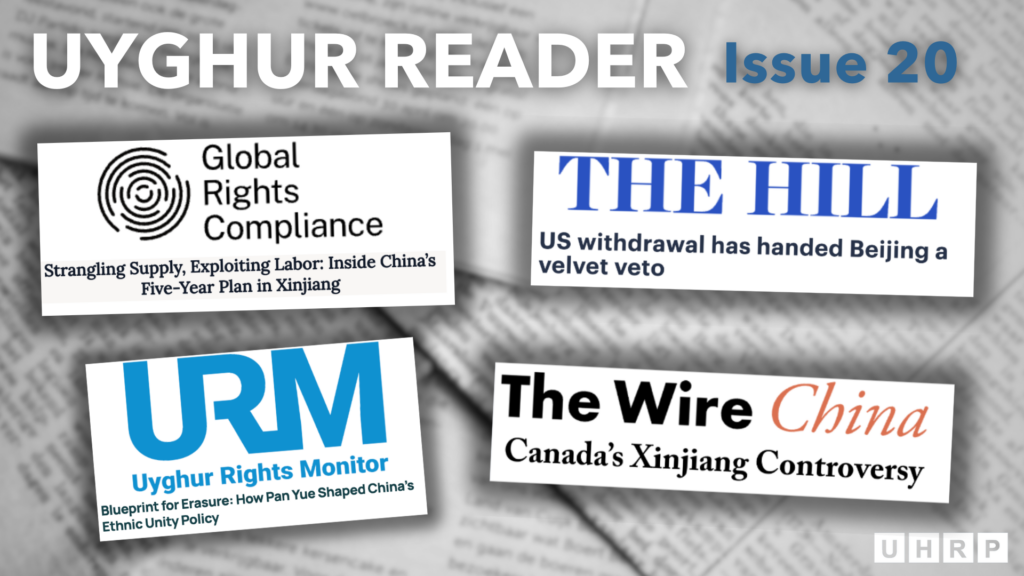
📌 An analysis by Global Rights Compliance finds that China’s 15th Five-Year Plan (2026–2030) deepens reliance on the Uyghur Region’s resources to drive technological self-sufficiency, particularly in semiconductors, clean energy, and advanced manufacturing. The report concludes that this strategy depends on expanding coercive labor programs targeting Uyghurs, reinforced by low-cost coal power, data-driven surveillance, and policies that embed forced labor into long-term state planning. “Strangling Supply, Exploiting Labor: Inside China’s Five-Year Plan in Xinjiang,” March 30.
📌 For the Uyghur Rights Monitor, Ablet Turdi argues that the new “ethnic unity” law codifies a long-developed assimilationist agenda shaped by Pan Yue, embedding a Han-centric national identity into China’s legal system. It highlights how the policy reframes ethnic diversity as a security problem and promotes state-led migration, cultural erasure, and ideological control over Uyghurs and other minorities. “Blueprint for Erasure: How Pan Yue Shaped China’s Ethnic Unity Policy,” March 27.
📌 Eliot Chen writes that Canadian MP Michael Ma’s public questioning of well-documented forced labor in the Uyghur Region has triggered controversy, exposing gaps between Canada’s stated human rights stance and its weak enforcement against imports linked to abuses. The exchange during a parliamentary committee hearing demonstrates how political messaging, trade interests, and limited oversight continue to undermine accountability, even as evidence of Uyghur forced labor remains widely reported. “Canada’s Xinjiang Controversy,” The Wire China, March 27.
📌 In The Hill, Allison Lombardo argues that reduced U.S. engagement at the United Nations has allowed China to expand its influence, including blocking scrutiny of its human rights record. It highlights that Beijing has even prevented accreditation for groups like the Uyghur Human Rights Project, limiting their ability to raise Uyghur issues internationally. Lombardo warns that this growing power enables China to silence civil society voices and weaken global accountability for human rights abuses. “US withdrawal has handed Beijing a velvet veto,” March 24.
📌 Yalkun Uluyol, China Researcher at Human Rights Watch, shares how Chinese government repression continues to affect Uyghurs abroad, who remain separated from detained family members and live with fear, surveillance, and pressure. Many Uyghurs report losing contact with relatives in the homeland and facing ongoing intimidation, showing that repression extends beyond borders. Despite global attention, abuses against Uyghurs persist and continue to shape the lives of diaspora communities. “China’s Repression Still Haunts Uyghur Exiles,” March 18.
📖 Keep reading/listening
- Sam Cooper, The Bureau, April 1, ‘I Am the Living Proof’: The Uyghur Survivor, the Slave Compound, and the Forced Labor System Carney Cannot Escape
- Uyghur Rights Monitor, April 1, March 2026 Review
- Rahima Mahmut, Bitter Winter, March 31, Women’s History Month Must Not Forget Uyghur Women
- ISHR, March 27, New tools to engage with UN Special Procedures in English, Chinese, Uyghur, and Tibetan
- Kate McKenna, CBC, March 26, Floor-crossing Liberal MP apologizes for behaviour in committee meeting about Chinese EVs
- Raoul Wallenberg Centre for Human Rights, March 26, 20 Years Behind Bars: Bring Abducted Canadian Huseyin Celil Home from China
- Amnesty International, March 26, Health Concerns For Uyghur Detained For Decade
- Kongkon Karmaker, Borderlens, March 26, China’s Eid gesture in Bangladesh rings hollow where Uyghurs live
- Alp, Uyghur Times, March 26, The Politics Behind Beijing’s “Xinjiang Cultural Exchange” in Seoul
- Made in China Journal, March 24, Being Muslim in China
- AFP, March 22, Amid separation and hardship, Uyghurs in Pakistan celebrate Eid while longing for loved ones back home in China
📢 Event announcements
April 7, 2026, 10:30–11:30 a.m. EDT, Against Erasure: Uyghur Poems, Imprisoned Souls, and the Act of Resistance, Elliott School of International Affairs, The George Washington University
- An event highlighting the poetry anthologies Uyghur Poems and Imprisoned Souls with Aziz Isa Elkun, showcasing Uyghur literature as a powerful form of cultural preservation and resistance against repression.
🀄 中文
- 顾远, 自由亚洲电台, 2026年03月25日: 新疆伊犁传限制哈萨克族处置财产 移民受阻
- 法新社, 2026年03月22日: 巴基斯坦维吾尔社区的现实困境:与故土失联、教育受限
- WOMEN我们, 2026年03月16日: 热依拉·达吾提永远失去了她的田野