The Uyghur Reader: Stories We’re Following (Issue 21)
Issue 21: April 2, 2026 – April 15, 2026
Welcome to the twenty-first issue of the Uyghur Reader, a biweekly content roundup curated by the staff of the Uyghur Human Rights Project.
Each issue features carefully selected articles, reports, and publications from media outlets, academic institutions, NGOs, and government sources. While we highlight urgent human rights issues, we also aim to reflect the breadth of the Uyghur experience, including politics, economics, history, and culture.
🧠 This week’s selections come from Director of Research Henryk Szadziewski, Executive Director Omer Kanat, and Program Assistant Adaire Criner.
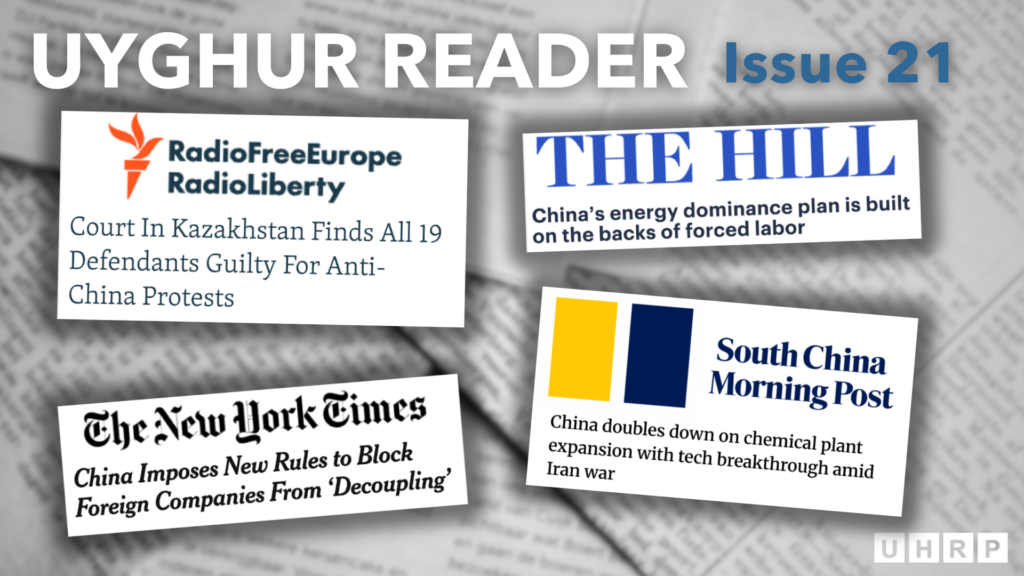
📌 China has introduced new regulations allowing authorities to investigate and punish foreign companies that shift supply chains away from China under political pressure, writes Keith Bradsher in The New York Times. Further, the measures reinforce Beijing’s efforts to prevent companies from avoiding goods linked to the Uyghur Region, where Uyghurs face state-sponsored forced labor and mass detention. By penalizing firms that cut ties with Uyghur Region suppliers, such as rejecting Uyghur cotton, the policy tightens pressure on global businesses and risks entrenching Uyghur forced labor within international supply chains. “China Imposes New Rules to Block Foreign Companies From ‘Decoupling,’” April 14.
📌 A court in Kazakhstan convicted all 19 activists involved in a 2025 anti-China protest, sentencing some to prison and others to restricted freedom on charges of “inciting interethnic discord.” The case, linked to calls for the release of a detainee in the Uyghur Region, reflects growing pressure on cross-border activism, with evidence suggesting the prosecution followed complaints from Beijing. Zamira Eshanova, RFE/RL, “Court In Kazakhstan Finds All 19 Defendants Guilty For Anti-China Protests,” April 13. Read statements from Human Rights Watch and Amnesty International about the convictions.
📌 Samir Goswami and Nyrola Elimä in The Hill argue that Beijing’s latest Five-Year Plan embeds and expands a system of state-imposed forced labor, particularly targeting Uyghurs, as a core driver of industrial growth and global supply chain dominance. It contends that this model relies on coercive labor transfers, surveillance, and assimilation policies to secure cheap resources and manufacturing capacity in the Uyghur Region. The authors call on Western governments and businesses to recognize these links and take stronger action, such as trade restrictions, supply chain scrutiny, and policy responses. “China’s energy dominance plan is built on the backs of forced labor,” April 11.
📌 For the South China Morning Post, Victoria Bela writes that China is accelerating the construction of massive chemical plants in the Uyghur Region’s Turpan prefecture, including the world’s largest coal‑to‑ethylene glycol project, as global supply chains are disrupted by the Iran war and tensions over energy and raw materials. These expansions, backed by state investment, aim to secure critical industrial chemicals and reduce reliance on foreign supplies. “China doubles down on chemical plant expansion with tech breakthrough amid Iran war,” April 1.
📖 Keep reading/watching
- Massimo Introvigne, Bitter Winter, April 13, Sayragul Sauytbay: China Is Escalating Repression of Uyghurs and Kazakhs
- Meredith Chen, South China Morning Post, April 11, China has mapped out a third new county in Xinjiang. Why?
- Hebibulla Izchi, Uyghur Times, April 10, Uyghur Diaspora Marks 36th Anniversary of the Barin Uprising Across the Globe
- Amnesty International, April 7, Ten years stolen: sister of detained Uyghur entrepreneur Ekpar Asat. Read statements from the Raoul Wallenberg Centre for Human Rights and the US Senate Foreign Relations Committee about the detention of Ekpar Asat
- Jens Kastner, Nikkei Asia, April 4, Uyghurs, Tibetans taught to fend off Chinese reach by Swiss rights group
- Reuters, April 3, Chinese Politburo member Ma Xingrui under investigation by anti-graft watchdog
- Arslan Hidayat and Nur Iman, Kashgar Times, April 3, “I’m Uyghur, my religion is the Chinese Communist Party”
- ISHRGlobal, April 2, Human Rights Defender’s story: Rizwangul NurMuhammad
- Rahima Mahmut, Committee for Freedom in Hong Kong Foundation, April 2, China’s Ethnic Unity Law: A Legal Blueprint for Erasing Uyghurs
- Jim Wormington and Yalkun Uluyol, Human Rights Watch, April 1, Canada Should Speak Out on Uyghur Forced Labor in China
- Jonah Reisboard, China Brief, March 27, Ethnic Unity Law Codifies ‘Chinese’ Identity