
The Uyghur Reader: Stories We’re Following (Issue 22)
Issue 22: April 16, 2026 – April 29, 2026
Welcome to the twenty-second issue of the Uyghur Reader, a biweekly content roundup curated by the staff of the Uyghur Human Rights Project.
Each issue features carefully selected articles, reports, and publications from media outlets, academic institutions, NGOs, and government sources. While we highlight urgent human rights issues, we also aim to reflect the breadth of the Uyghur experience, including politics, economics, history, and culture.
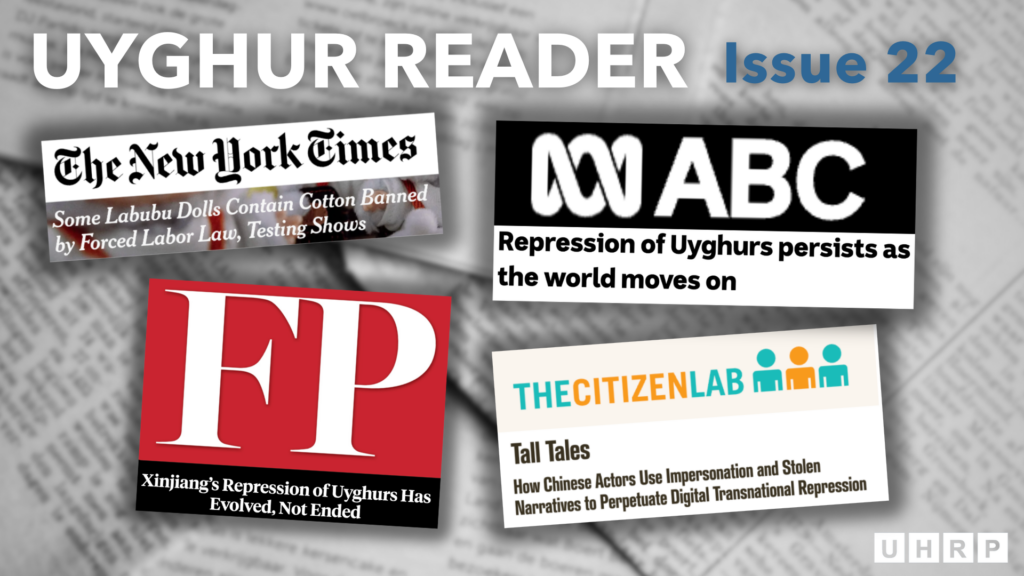
📌 A new report from The Citizen Lab, Tall Tales, documents how Chinese state-aligned actors target Uyghur, Tibetan, Taiwanese, and Hong Kong diaspora activists through digital transnational repression, including impersonation, phishing, and disinformation campaigns designed to infiltrate and surveil diaspora networks. These operations often weaponize trusted Uyghur narratives, organizations, and communication channels to deceive activists, reflecting a deep understanding of the community and amplifying fear and mistrust. Rebekah Brown, Maia Scott, Marcus Michaelsen, Emile Dirks, and Francesca Thaler, April 27.
📌 Acting on information supplied by the Campaign for Uyghurs, The New York Times found testing of popular Labubu dolls uncovered cotton sourced from the Uyghur Region, linking a global consumer brand to supply chains implicated in state-imposed forced labor. Despite U.S. restrictions under the Uyghur Forced Labor Prevention Act, the findings highlight ongoing challenges in enforcement and transparency, as companies continue to rely on opaque manufacturing networks. Ana Swanson, Sapna Maheshwari, and Meaghan Tobin, April 23, Some Labubu Dolls Contain Cotton Banned by Forced Labor Law, Testing Shows.
📌 Zilala Mamat is one of three Cornell undergraduates to receive this year’s Robinson-Appel Humanitarian Awards, recognizing students for their commitment to community-engaged work addressing urgent social challenges. Zilala has led international advocacy for Uyghurs in exile, founding United Uyghur Youth and co-founding Rawan Mentorship to support diaspora youth and expand access to education, while also engaging in advocacy through the Uyghur American Association. Olivia Hall, Cornell Chronicle, April 22, Robinson-Appel awards honor student-led community work.
📌 For the Australian Broadcasting Corporation (ABC), Yalkun Uluyol, China Researcher at Human Rights Watch, highlights that, despite fading global attention, Uyghurs continue to face arbitrary detention, surveillance, and forced labor, with many families still separated and without information about detained relatives. As such, Beijing has successfully deflected international scrutiny through pressure, propaganda, and influence, while governments increasingly sideline human rights concerns in favor of political and economic interests. Repression of Uyghurs persists as the world moves on, April 19.
📌 A rare insider testimony underscores that repression in East Turkistan has not ended but evolved into a more concealed and systematized form. While mass internment has receded from view, authorities now rely on short-term detentions, pervasive surveillance, and coercive labor transfers to enforce total submission and sustain a climate of fear. The whistleblower, police officer Zhang Yabo, details ongoing abuses, including torture, forced labor, and the continued erasure of Uyghur cultural and religious life reflecting a transition from overt mass campaigns to deeply embedded, everyday mechanisms of control. Adrian Zenz, Foreign Policy, April 16, Xinjiang’s Repression of Uyghurs Has Evolved, Not Ended. More coverage of the whistleblower testimony in The Spectator, Der Spiegel, The Bureau and Sourcing Journal.
📖 Keep reading
- Brian Hioe, New Bloom, April 28, The Logic of “Solidarity for Me, But Not For You” in Xinjiang Denialism
- Uyghur Human Rights Project, April 28, UHRP Files Amicus Brief with U.S. Supreme Court: Human Rights Groups Back Effort to Prevent Corporate Complicity with the Chinese Communist Party Abuses
- Robert Schmad, Washington Examiner, April 26, Top lobbying firm does bidding of entity linked to Uyghur repression
- Erika Nguyen, PEN America, April 24, “Freedom to write, freedom of soul”: Aziz Isa Elkun, Uyghur PEN Centre President, on Poetry as Resistance
- Neil Moss, Hill Times, April 22, Plan to bring 10,000 Uyghur refugees to Canada has little progress amid China détente
- Rushan Abbas and Dean Baxendale, The Bureau, April 22, Made In Xinjiang: How Forced Labour Will Dictate Ottawa & Beijing’s Relationship
- Nithin Coca, Nikkei Asia, April 21, China’s coal conversion boom underpins security in Iran war’s shadow
- Ruth Ingram, Bitter Winter, April 20, The Unhealthy China-Kazakh Rapprochement: Mass Imprisonment of Anti-China Protesters. See also a statement from Article 19 on the conviction of activists in Kazakhstan
- Musapir and Rune Steenberg, Critical Asian Studies, April 19, Where is my Family? Contemporary Uyghur Activism in the Transnational Diaspora
- Alex Croft, Independent, April 19, ‘I was tortured in a Chinese detention camp for Uyghurs. Starmer’s approval of a new embassy is a betrayal’
- David Brophy, Tempest Magazine, April 17, Dismissing China’s repression in Xinjiang
- Rayhan Asat, Atlantic Council Dispatches, April 16, Dispatch from Geneva: Uyghur communities need cross-border protection from China’s ongoing atrocities
- Arslan Hidayat and Nur Iman, Kashgar Times, April 14, “I am Uyghur. I eat pork.”
- Vincent Shaw, pv magazine, April 13, World’s largest PV-CSP plant under construction in China