
The Uyghur Reader: Stories We’re Following (Issue 24)
Issue 24: May 14, 2026 – May 27, 2026
Welcome to the twenty-fourth issue of the Uyghur Reader, a biweekly content roundup curated by the staff of the Uyghur Human Rights Project.
Each issue features carefully selected articles, reports, and publications from media outlets, academic institutions, NGOs, and government sources. While we highlight urgent human rights issues, we also aim to reflect the breadth of the Uyghur experience, including politics, economics, history, and culture.
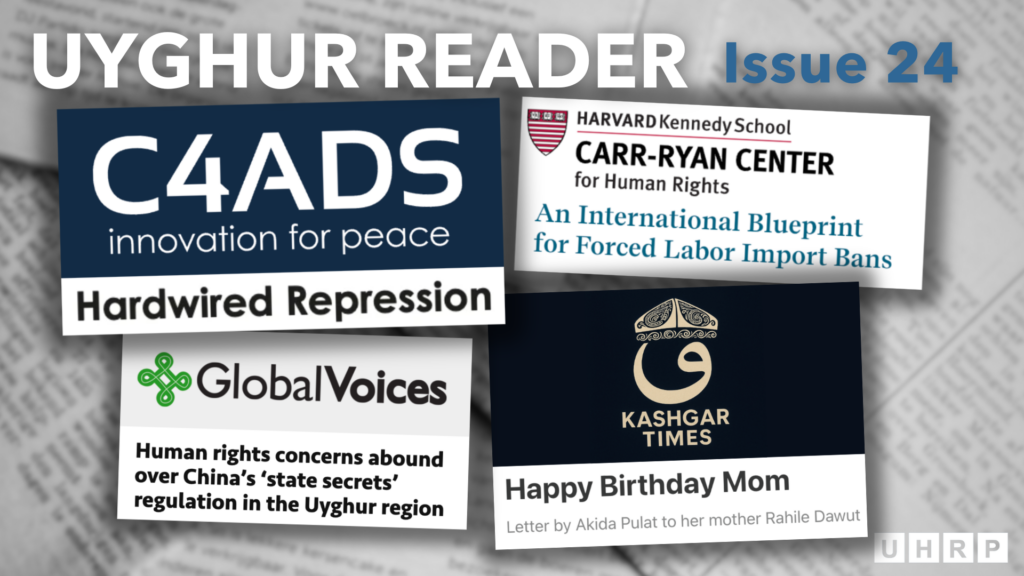
📌 In a new report from C4ADS, Mishel Kondi warns that data centers, a foundational component of the Chinese government’s mass surveillance of Uyghurs, have received little international scrutiny despite China’s initiatives to develop and export data infrastructure. The report finds that U.S. and Taiwanese technology appears in data center projects tied to surveillance and coercive labor systems in the Uyghur region, and calls for stronger export controls and adding corporations identified in the report to the Commerce Department’s Entity List. Hardwired Repression: Data Centers, Global Technology, and China’s Surveillance Infrastructure in the Uyghur Region, May 27.
📌 In a letter marking her mother’s birthday, Akida Pulat reflects on nearly nine years of separation from renowned Uyghur scholar Rahile Dawut, who disappeared in 2017 amid the Chinese government’s mass detention campaign against Uyghurs. Akida describes the enduring pain of learning her mother had been sentenced to life in prison, while emphasizing Rahile’s lifelong dedication to preserving Uyghur culture and supporting her students, friends, and family. Happy Birthday Mom, Kashgar Times, May 20.
📌 For Global Voices, Asiye Uyghur explains how new regulations in East Turkistan broaden the definition of “state secrets,” further restricting access to information in a region already marked by pervasive surveillance and repression. The measures raise concerns among rights advocates that ordinary communication, documentation, and contact with people abroad could increasingly be criminalized under the guise of national security, deepening fear and isolation for Uyghurs. Human rights concerns abound over China’s ‘state secrets’ regulation in the Uyghur region, May 18.
📌 A new policy brief from Laura Murphy and the Carr-Ryan Center for Human Rights at the Harvard Kennedy School outlines how governments can strengthen forced labor import bans to prevent goods linked to state-imposed forced labor, including abuses targeting Uyghurs, from entering global markets. The report argues that measures such as rebuttable presumptions, stronger enforcement mechanisms, supply chain traceability, and international coordination are essential to addressing the continued presence of Uyghur forced labor in global supply chains. An International Blueprint for Forced Labor Import Bans, April 29.
📌 Adrian Zenz told Simon Ferrigno of Ecotextile News that the transfer of Uyghur laborers from the Uyghur Region to factories across China has increased since the end of China’s zero-COVID policies, heightening concerns over forced labor in global supply chains. The report notes that expanding labor transfer schemes and growing logistical links between the Uyghur Region and eastern manufacturing hubs are making it more difficult for international brands to conduct meaningful due diligence and avoid products tied to state-imposed forced labor. Xinjiang labour transfers test brand due diligence, May 18.
📖 Keep reading and listening
- Abdurehim Gheni Uyghur, Bitter Winter, May 26, When the Camera Turns Away: Carol Guzy and Amsterdam’s Lonely Uyghur
- Australian Strategic Policy Institute, May 26, Getting human rights back on the agenda, with China researcher Yalkun Uluyol
- Tahir Imin, Uyghur Times, May 25, Prominent Uyghur Religious Scholar Abdushukur Rahmatulla Hajim Reportedly Detained by Chinese Authorities
- Haberler, May 23, Yusuf Kaplan rebelled, Minister Çiftçi intervened saying “I’ll look into it, Hocam”
- Dannie Peng, South China Morning Post, May 22, China is replacing Middle East oil with Xinjiang coal. What does it mean for the world?
- Asiye Uyghur, Bitter Winter, May 21, When Uyghur Culture Becomes “Extremism”: From Doppa to Hijab
- Ruth Ingram, Bitter Winter, May 20, Meshrep in London: Young Uyghurs Refuse to Let Their Identity Die
- Abdurehim Gheni Uyghur, Bitter Winter, May 19, The Netherlands Vows to Protect Uyghurs Against China’s Transnational Harassment
- Emily Feng, NPR, May 17, The foreign fighters who helped topple Assad — and why China worries about them. Read and listen to Part 2 and Emily Feng on All Things Considered.
- Rahima Mahmut, The Independent, May 17, Trump once stood up for the Uyghurs – now he has abandoned them
- Human Rights Committee of Sweden’s Scientific and Literary Academies, May 13, New appeal for the release of Ilham Tohti
📚 Research Papers and Reports
- Kapildev Ray et al., National Identities, May 18, Othering, assimilation, and violence: the Uyghur experience in Xinjiang
- Tenha Seher, Asian Ethnicity, May 17, Love as a commodity in a time of political crisis: an American-Uyghur wedding in rural southern Xinjiang
- Kalyani Rajendra Yeola, Citizenship Studies, May 13, Citizenship as compromise? Strategic statelessness and youth activism in Tibetan, Uyghur, and Baloch exile communities
📢 Event Announcements
June 3, 2026, 10 – 11 p.m. EDT, Online, Uyghur Forced Labour: Inside China’s Five-Year Plan in the Uyghur Region, Stop Uyghur Genocide
- Join Rahima Mahmut, Nyrola Elimä, and Samir Goswami for a webinar on Global Rights Compliance’s report, Strangling Supply, Exploiting Labour: Inside China’s Five-Year Plan in Xinjiang. The report examines how China’s Five-Year Plans in the Uyghur Region integrate state-led labor transfer programs and systemic Uyghur forced labor into industrial development and global supply chains, raising major concerns for human rights due diligence and corporate compliance.