The Uyghur Reader: Stories We’re Following (Issue 25)
Issue 25: May 28, 2026 – June 10, 2026
Welcome to the twenty-fifth issue of the Uyghur Reader, a biweekly content roundup curated by the staff of the Uyghur Human Rights Project.
Each issue features carefully selected articles, reports, and publications from media outlets, academic institutions, NGOs, and government sources. While we highlight urgent human rights issues, we also aim to reflect the breadth of the Uyghur experience, including politics, economics, history, and culture.
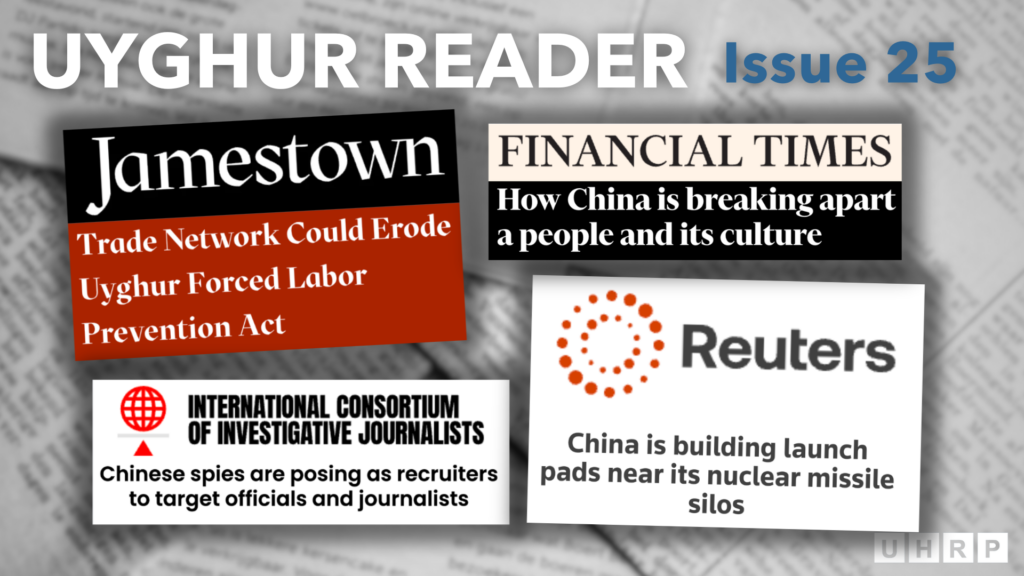
📌 In a report for Jamestown, Jonah Reisboard warns that an expanding network of Chinese-controlled digital trade and logistics platforms could undermine enforcement of the Uyghur Forced Labor Prevention Act by obscuring supply-chain data and facilitating the transshipment of goods linked to forced labor. It argues that Beijing’s growing control over trade information, combined with logistics hubs in third countries, may make it increasingly difficult for U.S. authorities and independent investigators to verify the origins of products entering global markets. June 5, Trade Network Could Erode Uyghur Forced Labor Prevention Act.
📌 Scilla Alecci reports that Chinese intelligence-linked actors have used fake recruiters, consulting firms, and professional networking platforms to target journalists, researchers, and government officials for sensitive information. Of particular concern to Uyghurs, the report links these tactics to broader campaigns of digital transnational repression that have targeted Uyghur activists, organizations, and diaspora communities through impersonation, phishing, and surveillance operations. International Consortium of Investigative Journalists, June 5, Chinese spies are posing as recruiters to target officials and journalists.
📌 In the second part of the Financial Times’ reporting on the Uyghur Region, Edward White, Nassos Stylianou, Jana Tauschinski, Caroline Nevitt, Dan Clark, and Emma Lewis examine Beijing’s effort to more deeply integrate East Turkistan and Tibet into China’s economy through large-scale investments in infrastructure, tourism, energy, and manufacturing. While authorities present these initiatives as economic development, human rights researchers warn that they are occurring alongside ongoing surveillance, forced labor programs, and policies aimed at assimilating Uyghurs. The report highlights growing international business involvement in the region, including tourism and hospitality projects, raising concerns that economic engagement may normalize repression and increase corporate exposure to human rights abuses. May 31, Xi’s last frontier: China’s plan to transform its west.
📌 In the Financial Times, Alison Killing writes that despite the closure of many internment camps, the Chinese government continues to reshape Uyghur society through mass incarceration, pervasive surveillance, forced labor transfers, and cultural assimilation policies. Drawing on satellite imagery, official documents, and witness testimony, Killing concludes that the Uyghur Region maintains the world’s highest prison detention capacity relative to its population, while boarding schools, labor transfer programs, and restrictions on language, religion, and family life continue to erode Uyghur identity. The investigation also highlights the expansion of state-directed labor programs that move Uyghurs across China under conditions that U.N. experts say may constitute forced labor. May 28, How China is breaking apart a people and its culture. Listen to Alison Killing speak about her article on NPR.
📌 A Reuters investigation based on satellite imagery found that China is constructing a vast network of military infrastructure in the Uyghur Region, including launch pads, bunkers, communications nodes, and support facilities near nuclear missile silo fields. Analysts cited in the report assess that the expansion is designed to strengthen China’s nuclear deterrent and ensure its ability to launch a retaliatory strike in the event of an attack. The findings further highlight the strategic importance of the Uyghur Region to Beijing, where major military and security projects continue to be developed with limited transparency. Greg Torode, Laurie Chen, and Vijdan Mohammad Kawoosa, May 29, China is building launch pads near its nuclear missile silos.
📖 Keep reading
- Associated Press, June 10, China touts Xinjiang at trade forum, spotlighting a region once marked by detention centers
- Bloomberg, June 10, Xinjiang Chief Touts Trade, Diplomacy as Hormuz Disruption Bites
- Harry Saunders and Kris Lih, Domino Theory, June 9, Stephen Curry’s $400 Million Shoe Deal Linked to Forced Labor
- Uyghur Rights Monitor, June 8, Monthly Review — May 2026
- Jennifer Scherer, SBS News, June 7, People keep disappearing in this region of China. Yalkun’s father is one of them
- Ihsan Umun, Uyghur Times, June 6, An Academic Breaking Point: Why Should the Uyghur Region Be Studied?
- Eugene Volokh, Reason Foundation, June 5, Plaintiffs Lack Standing to Sue over Notre Dame Law Clinic’s Filing Amicus Brief Condemning China’s Actions Towards Uyghurs
- Congressional-Executive Commission on China (CECC), June 4, Report on the PRC’s Transnational Repression and Malign Influence in 2025
- Kharon, June 4, Inside a Top Chinese Apple Juice Concentrate, Red Flags for Forced Labor
- Abdurehim Gheni Uyghur, Bitter Winter, June 1, The Hague City Council Bans Pro-Chinese Lantern Festival
- Coalition to End Forced Labour in the Uyghur Region, May 28, Submission on the Modern Slavery Bill in New Zealand
- Ted Allen-Rawding in conversation with Tahir Hamut Izgil, China Governance Lab, Book Review: Waiting to Be Arrested at Night, A Uyghur Poet’s Memoir of China’s Genocide
📚 Research Papers and Reports
- Yalkun Uluyol, Asian Perspective, May 29, The Uyghur Factor in China-Turkey Relations: Insecurity, Transnational Repression, and Legitimacy
- Burak Gürel et al., Asian Perspective, May 29, Political Economy of Chinese Investment in Turkey: Recent Trajectory and Structural Constraints
- Lars Højer, The Cambridge Journal of Anthropology, May 25, Contagious Spy Regimes: ‘The Uyghur Question’ and the Proliferation of Totalitarian Dynamics