The Uyghur Reader: Stories We’re Following (Issue 26)
Issue 26: June 11, 2026 – June 24, 2026
Welcome to the twenty-sixth issue of the Uyghur Reader, a biweekly content roundup curated by the staff of the Uyghur Human Rights Project.
Each issue features carefully selected articles, reports, and publications from media outlets, academic institutions, NGOs, and government sources. While we highlight urgent human rights issues, we also aim to reflect the breadth of the Uyghur experience, including politics, economics, history, and culture.
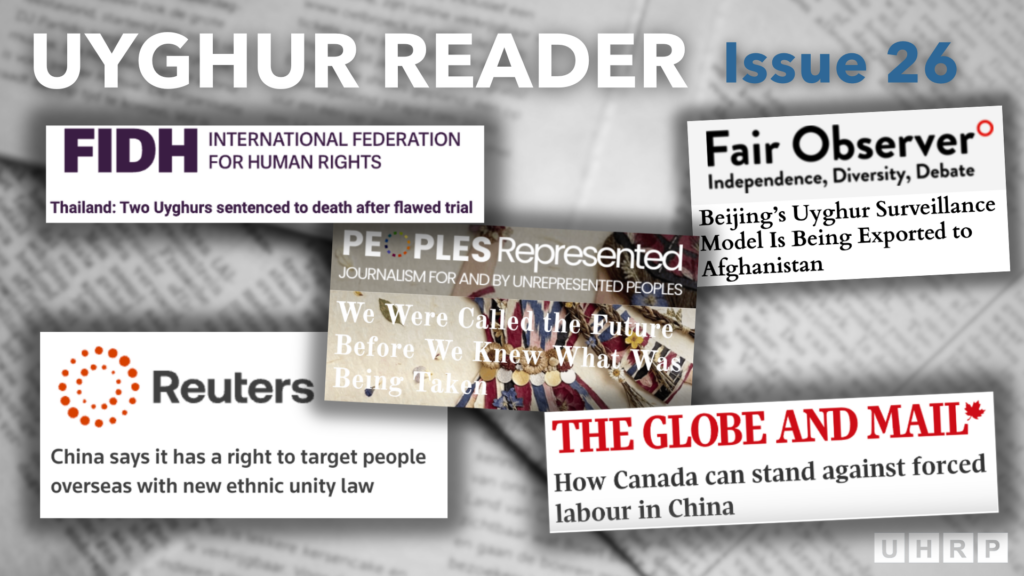
📌 Reuters reports that the Chinese government claims the right to target people abroad under its new Ethnic Unity Law. The law, which will go into effect on July 1, includes an overseas provision saying that individuals and groups outside of China can be held liable for undermining “ethnic unity.” At a press conference, Vice Justice Minister Hu Weilie defended the overseas provision as necessary to “guard against various unlawful acts involving ethnic affairs.” Rights groups warn that Beijing could use the law to expand transnational repression of Uyghurs, Tibetans, Taiwanese, and other diaspora communities and critics abroad. June 24, China says it has a right to target people overseas with new ethnic unity law.
📌 In an article for The Globe and Mail, Mehmet Tohti, Margaret McCuaig-Johnston, Sarah Teich, and Charles Burton argue that Canada has failed to adequately enforce existing measures against goods linked to Uyghur forced labor, allowing products connected to coercive labor programs in the Uyghur Region to continue entering Canadian markets. The authors welcome proposed legislation that would strengthen import restrictions and improve scrutiny of high-risk supply chains, while warning that effective enforcement will depend on political will and robust oversight. June 16, How Canada can stand against forced labour in China.
📌 The International Federation for Human Rights (FIDH) condemned the death sentences handed down by a Thai court to two Uyghur men convicted in connection with the 2015 Bangkok bombing, arguing that the case was marred by serious due process violations and nearly 11 years of arbitrary detention. FIDH noted that the defendants alleged ill-treatment, lacked adequate interpretation throughout parts of the proceedings, and were previously the subject of a U.N. Working Group opinion finding their detention arbitrary. June 11, Thailand: Two Uyghurs sentenced to death after flawed trial. Continue reading with articles from Radio Free Asia, Bitter Winter, and Bangkok Post.
📌 Tommaso Franco warns that surveillance technologies and security practices developed to monitor and control Uyghurs in the Uyghur Region are increasingly being exported abroad, including to Afghanistan. He argues that Beijing is leveraging its security partnerships and technological expertise to promote a model of governance centered on mass surveillance, data collection, and social control, particularly targeting Muslim populations. Fair Observer, June 11, Beijing’s Uyghur Surveillance Model Is Being Exported to Afghanistan.
📌 In a personal reflection, Rizwana Ilham recounts growing up as part of a generation of Uyghurs encouraged to pursue education and opportunity, only to later witness the systematic dismantling of the cultural and social world that shaped their identity. Her essay explores how policies targeting Uyghur language, religion, family life, and collective memory have transformed everyday experiences, leaving many in the diaspora grappling with loss and separation. Peoples Represented, June 1, We Were Called the Future Before We Knew What Was Being Taken.
📖 Keep reading/watching
- Nicole Cheah, The Diplomat, June 23, Uyghurs Wonder: Does the US Still Care About Human Rights in China?
- Jonathan Fulton, The China-MENA Newsletter, June 21, Uyghurs and the Middle East: The wedge issue that doesn’t wedge.
- Asiye Uyghur, Bitter Winter, June 19, Uyghurs Students as Dissidents: 40 Years of History
- Asian Economix, June 18, The Uyghur Cause, Diaspora Resilience and Transnational Repression | Işık Kuşçu-Bonenfant
- John Mowbray, Ecotextile, June 18, UFLPA crackdown fears as enforcement dips
- Fernando Fong, The Rakyat Post, June 17, In Kuala Lumpur, Uyghurs Made Their Case Against China — Quietly, And At Every Level
- Yangchen Dolma, The Tibet Post, June 16, UNHRC Chief calls on China to repeal the “Ethnic Unity Law”
- Representative Chris Smith & Miriam Lexmann MEP, Catholic Herald, June 15, Beijing’s new ethnic unity law threatens faith, culture and freedom
- The Bureau, June 10, A Uyghur Advocate’s Warning to Mark Carney: Canada Is on “a Suicide Mission,” and Beijing’s Hidden Hand Reaches Into Western Media
📚 Research Paper
- Crystal Whetstone and Murat Yılmaz, International Feminist Journal of Politics, June 9, Gendering internal colonialism: engaging reproductive justice and digital testimony of Uyghurs in diaspora