
The Uyghur Reader: Stories We’re Following (Issue 27)
Issue 27: June 15 – July 8, 2026
Welcome to the twenty-seventh issue of the Uyghur Reader, a biweekly content roundup curated by the staff of the Uyghur Human Rights Project.
Each issue features carefully selected articles, reports, and publications from media outlets, academic institutions, NGOs, and government sources. While we highlight urgent human rights issues, we also aim to reflect the breadth of the Uyghur experience, including politics, economics, history, and culture.
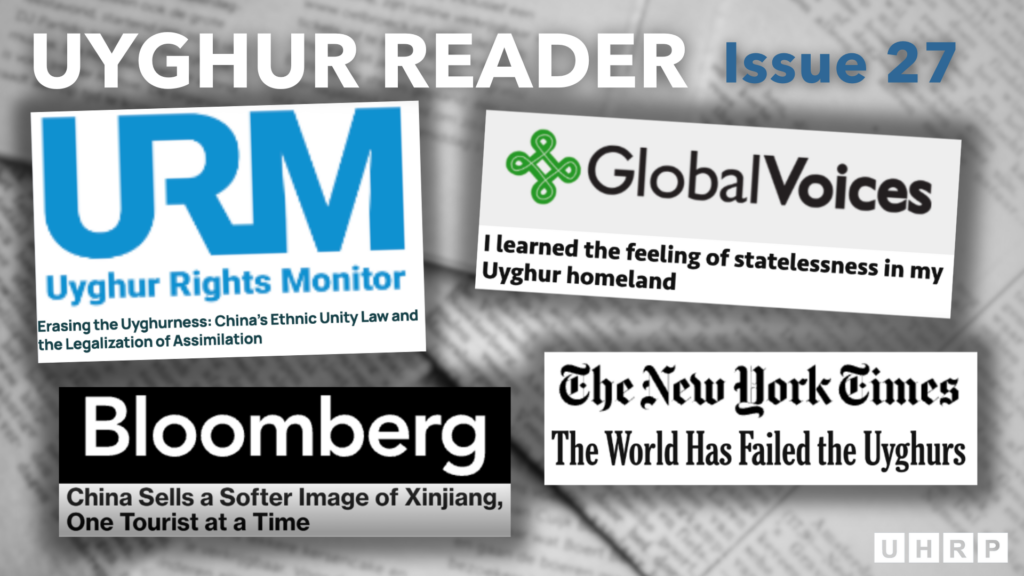
📌 For Bloomberg, Colum Murphy examines the rapid growth of tourism in Altay Prefecture, reporting that Beijing is using infrastructure investment, popular culture, and curated ethnic experiences to promote a positive image of the region and strengthen its integration into China’s national identity. While visitors are encouraged to experience Kazakh and Uyghur culture through performances, architecture, and cuisine, the article notes that the tourism boom unfolds alongside pervasive surveillance, heightened security, and policies, including China’s new Law on Promoting Ethnic Unity and Progress, that critics say further institutionalize the assimilation of non-Han communities. July 3, China Sells a Softer Image of Xinjiang, One Tourist at a Time.
📌 Ablet Turdi of the Uyghur Rights Monitor examines China’s Law on Promoting Ethnic Unity and Progress, arguing that it transforms decades of assimilation policies in the Uyghur Region into a permanent national legal framework. Focusing on the replacement of Uyghur-language education with Mandarin and the expansion of boarding schools that separate children from their families, the article contends that the law institutionalizes measures designed to weaken the intergenerational transmission of Uyghur language, culture, and identity. July 2, Erasing the Uyghurness: China’s Ethnic Unity Law and the Legalization of Assimilation.
📌 In a personal essay for Global Voices, Asiye Uyghur reflects on growing up in the Uyghur homeland and argues that statelessness can emerge through the gradual erosion of belonging rather than the loss of formal citizenship. Tracing her experiences from the July 5, 2009 unrest to the mass repression that intensified after 2017, she describes how discrimination, surveillance, family separation, and the suppression of Uyghur language and culture transformed everyday life and deepened feelings of alienation in her homeland. July 2, I learned the feeling of statelessness in my Uyghur homeland.
📌 Uyghur exile and Uyghur Post founder Tahir Imin argues in The New York Times that, as Beijing continues to dismantle Uyghur language, culture, and family life, the responsibility for preserving Uyghur identity increasingly falls to diaspora communities. Drawing on his own separation from his daughter, Imin describes efforts to sustain Uyghur language, literature, and cultural traditions in exile while warning that these initiatives face limited resources and ongoing transnational repression. July 2, The World Has Failed the Uyghurs.
📌 Kyinzom Dhongdue of Amnesty International Australia argues that China’s Law on Promoting Ethnic Unity and Progress, which took effect on July 1, 2026, transforms decades of assimilation policies targeting Tibetans, Uyghurs, and other non-Han peoples into national law. The article highlights concerns from UN officials and experts that the legislation further restricts language, religion, culture, and education while expanding state control over children and potentially providing a legal basis for increased transnational repression of diaspora communities through Article 63. June 30, Behind the language of “unity” and “progress,” China’s new law is about more control and assimilation in Tibet and Xinjiang. Read the Amnesty International statement on the Law on Promoting Ethnic Unity and Progress, as well as coverage from the BBC, The Guardian, The New York Times, and The Sydney Morning Herald.
📖 Keep reading/watching
- Asiye Uyghur, Bitter Winter, July 3, July 5: The Urumqi Massacre’s Unanswered Questions
- Bakchos Glass, Blak and Black, July 3, The Sand Remembers What the State Forgets: Uyghur Cultural Survival and the Architecture of Forgetting
- Lily Kuo, The New York Times, July 3, Tibetan Man Dies After Self-Immolation Protest in New York
- Uyghur Rights Monitor, July 1, Monthly Review – June 2026
- Ruth Ingram, Bitter Winter, July 1, Stop Uyghur Forced Labor: An Event in the UK Parliament
- Arslan Hidayat, Kashgar Times, June 29, “Uyghurs Are Not Turks”
- Richard Gere, The Wall Street Journal, June 28, China’s ‘Ethnic Unity’ Law Means Repression Without Borders
- Najmidin Qarluq, Eurasia Review, June 26, Beijing’s Vocabulary Trap: The Geopolitics Of Misnaming The Uyghur Genocide
- Arslan Hidayat, Kashgar Times, June 26, China Rewrites Islam
- Mukaddas Mijit and Gavin S. K. Lee, Countering Coloniality in Music and East Asia, June 25, Reclaiming Uyghur Agency Through Artistic Practices: A Conversation with Mukaddas Mijit
- International Christian Concern, June 24, Uyghur Christian Pastor Faces Church Closure Amid Intensifying Pressure in Xinjiang
🏛️ US Congressional Statements
- Select Committee on the Chinese Communist Party, July 1, Moolenaar, Khanna, Risch, Shaheen: Joint Statement on China’s “Ethnic Unity” Law
- U.S. Representative Jim McGovern, June 30, McGovern, Smith, Khanna lead Bipartisan Group of 14 House Lawmakers Asking State Department to Condemn Chinese Government’s harmful “Ethnic Unity Law”
📚 Research Papers and Reports
- Alexandra Colombier Vanjiaka, Recherches en communication, June 26, ‘Rules Were Followed, Allegations Are False’: The Spiral of Disinformation in Thailand’s Deportation of Uyghurs
- Stefan Brehm and Helena Magnusson, Globalworks Lund AB, June 2026, State-Imposed Forced Labour in the Solar Panel Sector in China: A Human Rights Due Diligence Analysis
- Reyhan Topal, Open Technology Fund and Uyghur Transitional Justice Database, May 2026, Digital Transnational Repression of Uyghurs: The Costs of Dissent Beyond Borders