The Uyghur Reader: Stories We’re Following (Issue 32)
Issue 32: September 3, 2026 – September 16, 2026
Welcome to the thirty-second issue of the Uyghur Reader, a biweekly content roundup curated by the staff of the Uyghur Human Rights Project.
Each issue features carefully selected articles, reports, and publications from media outlets, academic institutions, NGOs, and government sources. While we highlight urgent human rights issues, we also aim to reflect the breadth of the Uyghur experience, including politics, economics, history, and culture.
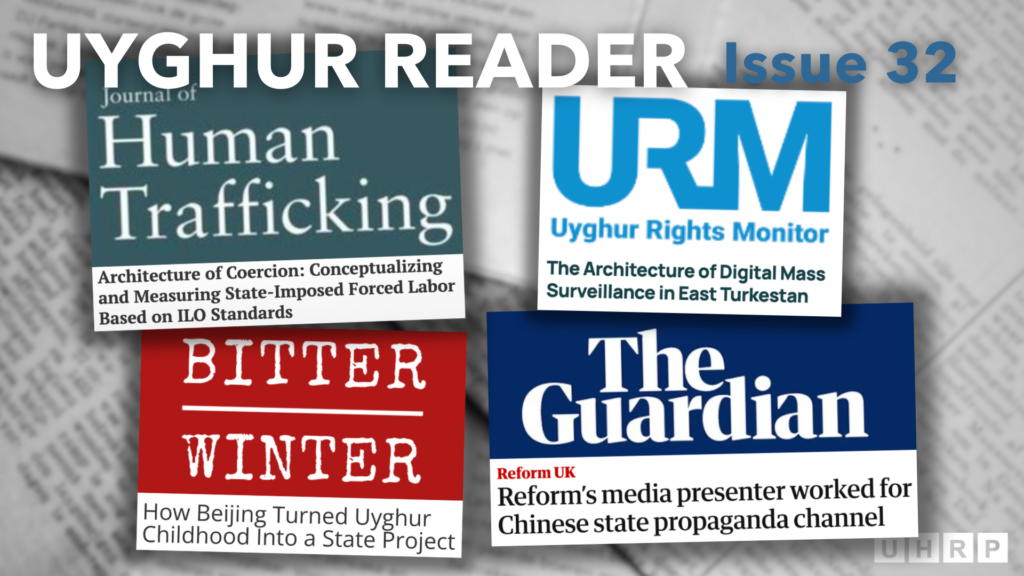
📌 Ablet Turdi and Erk Altay of Uyghur Rights Monitor examine five digital surveillance platforms that form an integrated system for monitoring and policing Uyghurs and other Turkic peoples in the Uyghur Region. The report finds that authorities combine household registration, biometric verification, mobile phone inspections, government services, and predictive policing to turn everyday activities into intelligence and indicators of suspicion. The authors detail how platforms including iTap and the Integrated Joint Operations Platform (IJOP) aggregate data and classify individuals for police attention, including based on ordinary religious and social behavior. The report also traces the network of state-owned, private, and foreign companies whose technologies support the surveillance system. September 15, “The Architecture of Digital Mass Surveillance in East Turkestan.”
📌 Anna Isaac and Ben Quinn of The Guardian report that Ray Addison, the top media presenter for Reform UK, a British political party, worked as a correspondent for Chinese state broadcaster CGTN in 2025, fronting a series titled Raymond’s Xinjiang Stories. The videos presented the Uyghur Region’s infrastructure and cotton industry in favorable terms, without addressing forced labor and other abuses against Uyghurs. The authors note that Addison’s work for CGTN contrasts with Reform UK leaders’ public criticism of the Chinese government; the party said it knew of Addison’s previous work before hiring him and defended his media career. September 3, “Reform’s media presenter worked for Chinese state propaganda channel.”
📌 Asiye Uyghur, writing for Bitter Winter, examines how Chinese education policy in the Uyghur Region has increasingly placed Uyghur children in centralized, state-run boarding schools while expanding Mandarin-centered instruction and political education. Drawing from official policy documents, the article highlights the contradiction between formal recognition of mother-tongue education rights and policies that portray non-Mandarin languages as an obstacle to development and “long-term stability.” It argues that school consolidation, boarding programs, mainland classes, and vocational education have progressively shifted children away from their families, local communities, and linguistic environments while linking education to broader state goals. September 3, “How Beijing Turned Uyghur Childhood Into a State Project.”
📌 Dr. Adrian Zenz, writing in the Journal of Human Trafficking, proposes a new methodology for identifying and measuring state-imposed forced labor (SIFL), arguing that existing International Labour Organization frameworks do not adequately distinguish between the mechanisms governments use to coerce labor and the purposes for which labor is imposed. The article introduces a SIFL Categorization Matrix and a three-pillar assessment framework centered on coercion, structural coercion, and “structurally engineered involuntariness.” Zenz argues that the approach could strengthen comparative research and help regulators move beyond localized workplace audits toward assessments of the broader state systems that produce forced labor risk, with particular relevance for enforcement of the European Union Forced Labor Regulation. May 2026, Architecture of Coercion: Conceptualizing and Measuring State-Imposed Forced Labor Based on ILO Standards.
📖 Keep reading
- Massimo Introvigne, Bitter Winter, September 14, Anthropic Reveals Massive Chinese Anti-Dissident AI-Generated Slander
- Justin Wong, The Press, September 14, ICBC handled NZ cash for Chinese tech firm linked to Xinjiang repression
- Rahima Mahmut, Middle East Monitor, September 10, We must challenge the UAE’s role as a haven for hostile state activity – Middle East Monitor
- James Moules, Politics Home, September 9, Labour Government Did Not Pursue Legal Advice On Uyghur Genocide Despite Pre-Election Pledge
- Abdurehim Gheni Uyghur, Union of Catholic Asian News, September 9, A world that commemorates the dead but fails to save the living
- Amnesty International, September 8, Kazakhstan: Detained activists need urgent medical care
- Uyghur News Network, September 5, The Uyghur Story Missing From Zhu Rongji’s Obituaries
- Tahir Imin, Uyghur Times, September 4, First-Generation Uyghur Archaeologist Abduqeyum Khoja Dies at 85 in Urumqi