The Uyghur Reader: Stories We’re Following (Issue 33)
Issue 33: October 1 – 28, 2026
Welcome to the thirty-third issue of the Uyghur Reader, a biweekly content roundup curated by the staff of the Uyghur Human Rights Project.
Each issue features carefully selected articles, reports, and publications from media outlets, academic institutions, NGOs, and government sources. While we highlight urgent human rights issues, we also aim to reflect the breadth of the Uyghur experience, including politics, economics, history, and culture.
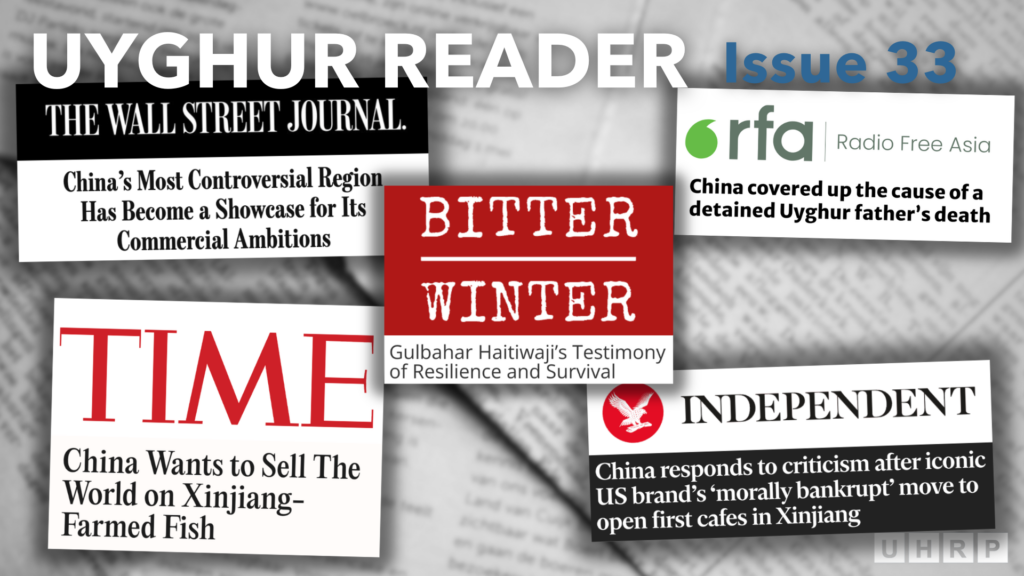
📌 Brian Spegele examines how the Chinese government is transforming the Uyghur Region into a major hub for trade, energy production, tourism, and manufacturing, despite international condemnation of ongoing human rights abuses. Drawing on observations from a visit to the region, the article describes Beijing’s massive infrastructure investments, including expanded transportation networks, industrial facilities, and tourism developments, as part of Xi Jinping’s broader ambitions to strengthen China’s economy and expand international trade. The article highlights how Western brands and hotel chains are expanding their presence in the region, even as evidence of forced labor, mass surveillance, religious restrictions, and cultural repression persists. While some international companies previously withdrew from the region over human rights concerns, China has continued to attract commercial investment and develop trade links with Central Asia and Europe. The article also examines how extensive state subsidies and government control underpin this economic transformation, highlighting the contrast between Beijing’s narrative of prosperity and stability and the continued repression of Uyghurs. October 23, The Wall Street Journal, “China’s Most Controversial Region Has Become a Showcase for Its Commercial Ambitions.”
📌 Shohret Hoshur of Radio Free Asia Uyghur Service investigates the death of Yasinjan Toxti, an Uyghur bus driver from Aksu who died in Chinese police custody in 2018, revealing that authorities falsely told his family that he had been killed in a traffic accident. Through interviews with Yasinjan’s sister, Reyhangul, and phone calls with police officials in Aksu, RFA confirmed that he died while detained in a “re-education” facility, not in a traffic accident. Yasinjan had been detained four times between 2016 and 2018 on suspicion of “religious radicalism,” initially because he had sent his young son to study in Egypt, and later for stopping his bus to allow Muslim passengers to observe the call to prayer. The investigation also reveals that other members of his family were subsequently detained, including his sister for allegedly “leaking state secrets” and his mother for visiting Türkiye. Their whereabouts remain unknown. The article highlights the Chinese government’s efforts to conceal deaths in detention, the criminalization of ordinary religious practices, and the continuing suffering of Uyghur families seeking answers about their loved ones. October 15, “China covered up the cause of a detained Uyghur father’s death.”
📌 Ian Urbina examines how the Chinese government is promoting the Uyghur Region’s rapidly expanding fish-farming industry as a symbol of economic development while obscuring ongoing human rights abuses. Drawing on an investigation by the Outlaw Ocean Project, the article reports that at least 1,000 fish farms have been established in the region, with seafood products reaching international markets, including the United States, in violation of the Uyghur Forced Labor Prevention Act (UFLPA). Urbina highlights Beijing’s coordinated propaganda campaign promoting “Xinjiang seafood,” including state-organized media tours, social media messaging, and foreign influencers portraying the industry as evidence of prosperity and ethnic harmony. The article also highlights concerns about misleading product labeling, food safety, and supply-chain transparency, arguing that Beijing’s promotion of the industry is part of a broader effort to reshape international perceptions of the Uyghur Region and obscure ongoing repression. October 9, Time, “China Wants to Sell The World on Xinjiang-Farmed Fish.”
📌 In an article for The Independent, Maroosha Muzaffar reports on criticism of Starbucks following the opening of its first store in the Uyghur Region, despite ongoing concerns over human rights abuses. U.S. Representative John Moolenaar, chair of the House Select Committee on China, condemned the move and called on Starbucks to close the stores, while human rights advocates warned that the company’s presence risks legitimizing China’s repression of Uyghurs. The article also examines China’s dismissal of international criticism and highlights similar concerns surrounding other international companies operating in the region, citing UHRP research on the expansion of Western hotel chains and the risk that corporate activity could normalize or obscure ongoing human rights abuses. The new Ürümchi Starbucks raises broader questions about corporate responsibility and the role of international businesses in reinforcing China’s efforts to present the Uyghur Region as a thriving destination for tourism and investment. October 5, “China responds to criticism after iconic US brand’s ‘morally bankrupt’ move to open first cafes in Xinjiang.”
📌 In an article for Bitter Winter, Ruth Ingram profiles Uyghur camp survivor Gulbahar Haitiwaji, who recently spoke at an event in London about her three years in Chinese detention and her decision to publicly share her experiences. Drawing on Haitiwaji’s testimony and her memoir, How I Survived a Chinese Re-Education Camp, the article recounts the physical and psychological abuse she endured, including prolonged interrogations, political indoctrination, torture, and threats against her family. Haitiwaji also describes forced medical procedures, family separation, and the solidarity among women detained alongside her. Despite the personal risks and lasting trauma of speaking out, she continues to share her story to raise awareness of those who remain imprisoned and to challenge China’s efforts to suppress Uyghur identity and culture. October 8, “Gulbahar Haitiwaji’s Testimony of Resilience and Survival.”
📖 Keep reading
- Tahir Imin, Uyghur Times, October 24, Rubio’s Uzbekistan Visit Ends Without Public Mention of Uyghur Rights Despite Appeals From Uyghur Activists
- Asiye Uyghur, Bitter Winter, October 22, Salmons and Uyghur Labor: Traceable Fish, Unanswered Questions
- Peter Irwin and Zubayra Shamseden, ChinaFile, October 21, The Global Cost of Ignoring Xinjiang
- Robert P. George, The Washington Post, October 14, Opinion | Stop Forced Organ Harvesting Act: Pass it, U.S. Senate
- Emily Feng, Foreign Policy, October 12, From Xinjiang to the Front Lines of Syria
- Brent Crane, The Wire China, October 11, Emily Feng on the Uyghurs, Syria and Xinjiang
- Reporters Without Borders (RSF), October 10, Who is Gulchehra Hoja, the Uyghur journalist standing up to the Chinese regime?
- Shohret Hoshur, Radio Free Asia, October 10, Uyghur activists urge Rubio to raise rights concerns with Central Asian officials
- Jasmin Malik Chua, Sourcing Journal, October 7, Homeland Security Gets New Tool to Track China’s Forced Labor Risks
- Rebecca Bailey, The Guardian, October 2, ‘Stand on the right side of history’: Starbucks urged to close stores in China’s Xinjiang
- Asiye Uyghur, Bitter Winter, October 1, Who Owns “China”? A Geographic Name, a National Identity, and the Peoples Left Out
- Uyghur Rights Monitor, October 1, URM Monthly Review — September 2026