New UHRP Report Warns Uyghur Forced Labor Risks Are Shifting to Australia and Japan Amid Global Enforcement Gaps
For immediate release
June 23, 2026, 10:30 a.m. EDT
Contact: Omer Kanat, +1 (202) 790-1795; Adaire Criner, +1 (612) 720-1136
A new report released today by the Uyghur Human Rights Project (UHRP) finds that Australia and Japan remain vulnerable to imports linked to Uyghur forced labor, creating opportunities for high-risk goods to enter markets with weaker enforcement as the United States and European Union strengthen restrictions on forced labor-tainted products.
The report, Redirected Risk: Uyghur Forced Labor and the Enforcement Gap in Australia and Japan, authored by UHRP Research Associate Elijah Pockell-Wilson, analyzes 2024 trade data and supply chain policies in both countries. It finds that Australia imported approximately US$4.82 billion in goods from high-risk sectors associated with Uyghur forced labor, while Japan imported approximately US$6.71 billion. The sectors with the greatest exposure include cotton textiles and apparel, solar supply chain inputs, aluminum, and chemical products.
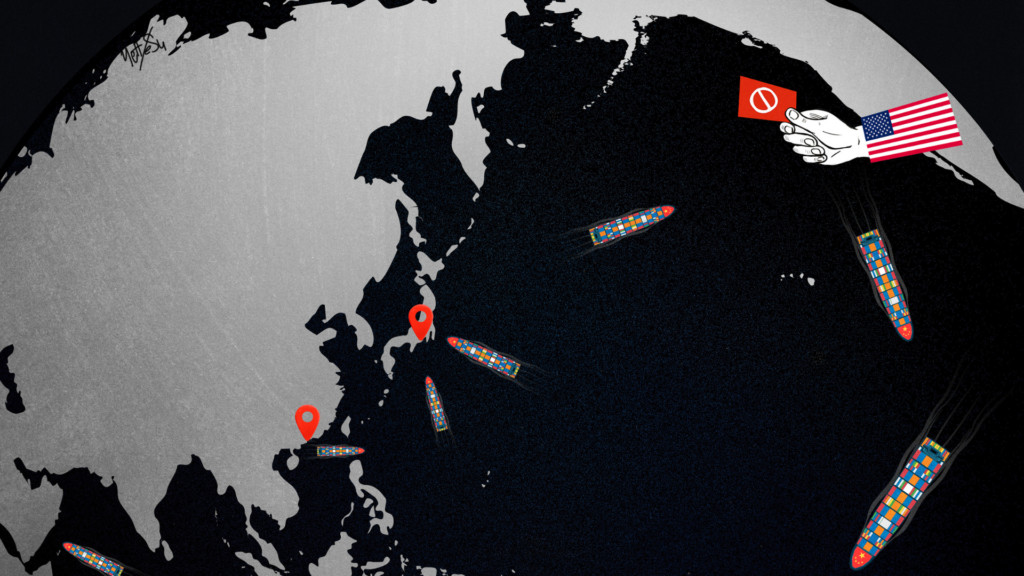
The report concludes that forced labor risks are not being eliminated from global supply chains but are instead being redistributed to markets that lack effective import controls. While the United States enforces the Uyghur Forced Labor Prevention Act (UFLPA) and the European Union prepares to implement its Forced Labor Regulation, Australia and Japan continue to rely primarily on transparency measures and voluntary corporate due diligence.
“Forced labor does not disappear when one market tries to close its doors,” said report author Elijah Pockell-Wilson. “Without stronger import controls, Australia and Japan risk becoming destination markets for goods made with Uyghur forced labor that other countries are working to block.”
Redirected Risk finds that neither Australia’s Modern Slavery Act nor Japan’s human rights supply chain guidelines require companies to demonstrate that imported goods are free from forced labor before entering the market. In both countries, enforcement mechanisms remain limited despite growing international concern over state-imposed forced labor in East Turkistan.
“Governments cannot rely on voluntary corporate compliance to address a system of state-imposed forced labor,” said UHRP Executive Director Omer Kanat. “Australia and Japan have committed themselves to international human rights standards, but those commitments must be backed by enforceable laws. Without stronger action, goods linked to the repression of Uyghurs can continue to reach consumers through markets that lack meaningful safeguards.”
To address these gaps, the report recommends that Australia and Japan adopt forced labor import bans modeled on the UFLPA, requiring importers to provide credible evidence that goods are not linked to forced labor. It also calls on both governments to establish mandatory human rights due diligence requirements, strengthen customs enforcement authorities, require greater supply chain traceability, and coordinate enforcement efforts with partners including the United States and European Union.
The report further recommends that policymakers formally incorporate civil society organizations and affected communities into enforcement processes, recognizing their critical role in identifying supply chain risks and documenting abuses.
As governments around the world seek to prevent products made with forced labor from entering global markets, Redirected Risk concludes that effective enforcement across both major and mid-sized economies will be essential to ensuring that forced labor cannot simply be rerouted to jurisdictions with weaker protections.