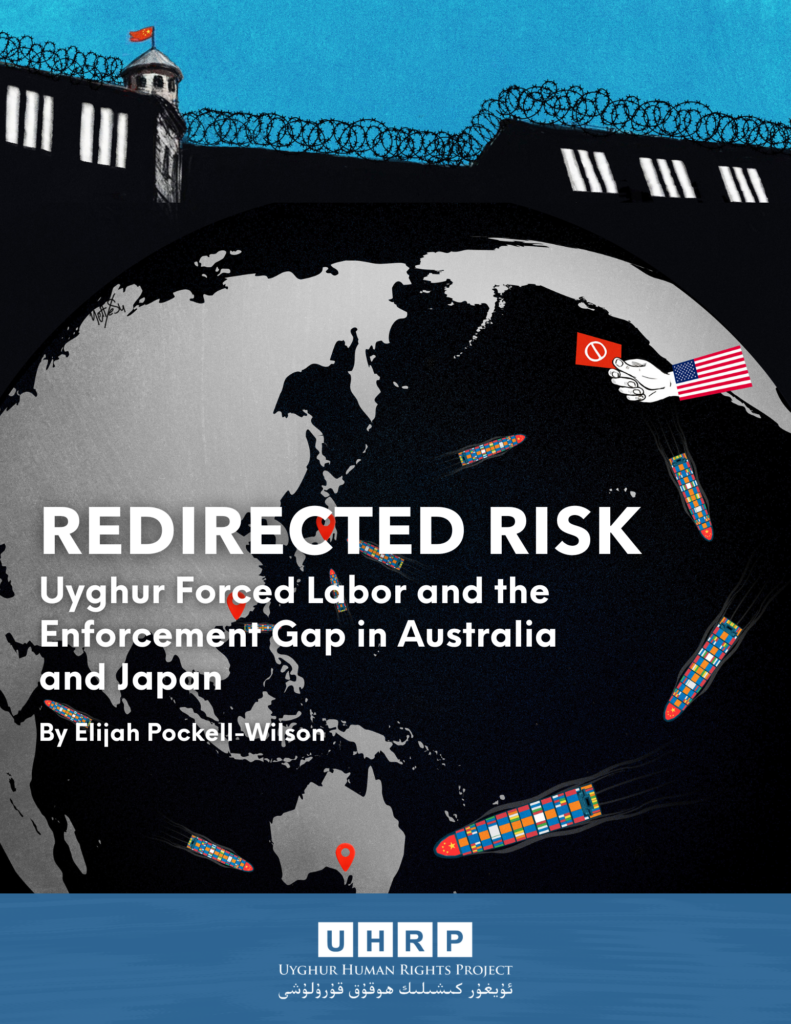
Redirected Risk: Uyghur Forced Labor and the Enforcement Gap in Australia and Japan
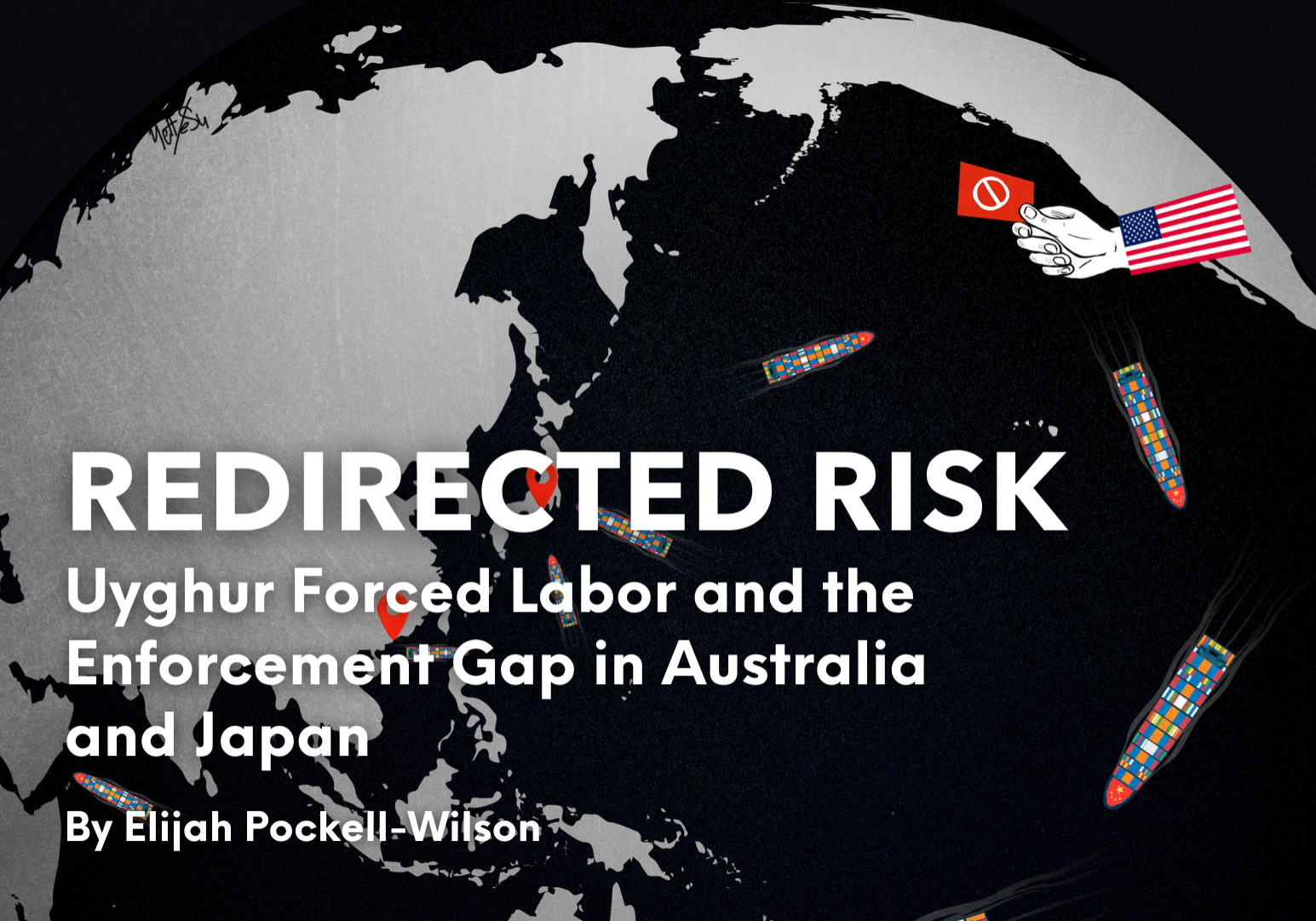
A Uyghur Human Rights Project report by Elijah Pockell-Wilson. Read our press statement on the report, download the full briefing in English, and read a printable, one-page summary of the report.
Read coverage of the report in the Australian Strategic Policy Institute, Sourcing Journal, China Global South Project, and Ecotextile News.

I. Key Takeaways
- Forced-labor risk is being redistributed, not eliminated. As the United States enforces the Uyghur Forced Labor Prevention Act (UFLPA) and the European Union (EU) prepares to apply its Forced Labor Regulation, high-risk goods may flow toward markets without comparable import controls.
- Mid-sized economies such as Australia and Japan remain exposed. In 2024, Australia imported roughly $4.82 billion in high-risk goods from China, while Japan imported roughly $6.71 billion.
- Risk is concentrated in strategic sectors. Cotton apparel and textiles, solar inputs, aluminum, and chemical products remain key channels through which Uyghur forced-labor risk can enter consumer and industrial supply chains.
- Transparency is not enforcement. Australia’s Modern Slavery Act and Japan’s human rights supply-chain guidelines promote disclosure and due diligence, but neither block high-risk goods at the border.
- Mid-sized economies need enforceable tools. Australia and Japan should adopt forced-labor import prohibitions, importer traceability requirements, customs enforcement authority, and mandatory human rights due diligence.
II. Forced-Labor Risk is Shifting to Markets With Weaker Enforcement
As the United States and European Union tighten restrictions on goods made with forced labor, mid-sized economies face a growing risk: high-risk imports may be redirected toward markets with weaker enforcement. This report examines the risk in Australia and Japan, two major economies deeply integrated into Chinese supply chains but lacking forced-labor import prohibitions.
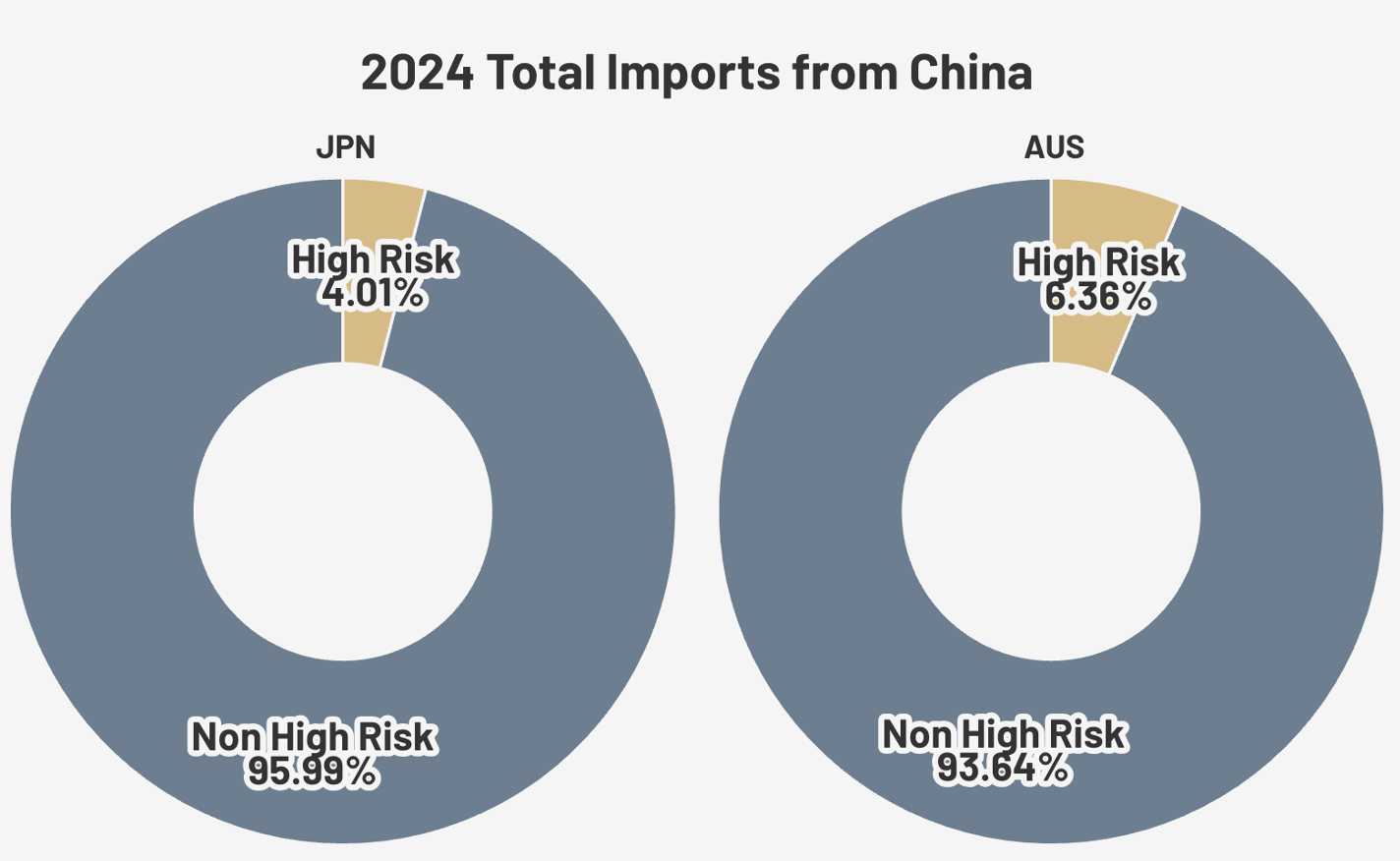
Using 2024 United Nations (UN) Comtrade data, sectoral risk mapping, and comparative policy analysis through a Critical Discourse Analysis (CDA), the report finds that Australia and Japan continue to import billions of dollars’ (U.S.) worth of goods from sectors associated with the risk of Uyghur forced labor. Australia imported approximately $4.82 billion in high-risk goods from China, equal to 6.36 percent of its total imports from China. Japan imported approximately $6.71 billion, equal to 4.01 percent. Exposure is concentrated in cotton apparel and textiles, solar inputs, aluminum, and chemical products.
These figures do not show that all goods in these categories were made with forced labor. They show exposure to sectors where forced-labor risk is well-documented and independent verification is difficult. East Turkistan, also known as the Uyghur Region, remains central to Chinese cotton, textile, solar, and industrial supply chains, while state imposed labor transfer programs, surveillance, and restrictions on independent investigation undermine conventional auditing models.1Laura T. Murphy and Charlotte Tate, “Assessing the Impact of the Uyghur Forced Labor Prevention Act After Three Years,” Center for Strategic and International Studies, 2025, https://www.csis.org/analysis/assessing-impact-uyghur-forced-labor-prevention-act-after-three-years The Office of the United Nations High Commissioner for Human Rights (OHCHR) has documented serious human rights concerns in the Uyghur Region, including patterns of arbitrary detention, coercive labor programs, and restrictions that impede independent assessment.2OHCHR, “OHCHR Assessment of Human Rights Concerns in the Xinjiang Uyghur Autonomous Region, People’s Republic of China,” August 31, 2022, https://www.ohchr.org/en/documents/country-reports/ohchr-assessment-human-rights-concerns-xinjiang-uyghur-autonomous-region
Australia and Japan formally align with international business and human rights standards, including the UN Guiding Principles (UNGPs), the Organisation for Economic Co-operation and Development (OECD) Guidelines, and International Labour Organization (ILO) forced labor conventions. But their domestic systems rely mainly on disclosure, guidance, and voluntary corporate due diligence. The ILO’s 2014 Protocol to the Forced Labor Convention calls for effective measures to identify, protect, and remedy harms from forced labor, while the OECD Guidelines call for risk-based corporate due diligence. Yet neither Australia nor Japan currently requires companies to prove that high-risk goods are free from forced labor before entering their markets.
The result is an enforcement gap. The Uyghur Forced Labor Prevention Act (UFLPA) shows how market- access restrictions can change corporate incentives by placing the burden on importers to demonstrate that goods are not linked to forced labor. But unilateral enforcement is not enough. Without comparable action by mid-sized economies, high-risk goods excluded from one market can continue circulating through others.
International standards matter, but they become effective only when translated into enforceable domestic law.
Australia and Japan should close this gap by adopting forced-labor import prohibitions, importer traceability requirements, stronger customs authority, and mandatory human rights due diligence. International standards matter, but they become effective only when translated into enforceable domestic law.
III. Mid-Sized Economies and the Forced-Labor Enforcement Gap
Mid-sized economies are increasingly exposed to forced-labor risks in Chinese supply chains. As major markets such as the United States and the European Union strengthen forced-labor laws and import-control measures, goods linked to state-imposed forced labor in East Turkistan may be redirected to jurisdictions with less robust enforcement systems, limited investigative capacity, and no forced-labor import prohibitions. This creates a governance gap: companies can continue sourcing from high-risk sectors while meeting formal disclosure or due diligence expectations.
This risk is especially difficult to address because forced labor in the Uyghur Region is embedded in a broader system of state control. Since 2017, more than one million Uyghurs and other Turkic Muslim peoples have been arbitrarily detained in reeducation camps, detention facilities, and prisons.3Lindsay Maizland, “China’s Repression of Uyghurs in Xinjiang,” Council on Foreign Relations, October 3, 2025, https://www.cfr.org/backgrounders/china-xinjiang-uyghurs-muslims-repression-genocide-human-rights This system operates alongside government-directed labor transfer programs that channel people into industrial and agricultural production under conditions that lack meaningful consent.4Adrian Zenz, “Coercive Labor and Forced Displacement in Xinjiang’s Cross-Regional Labor Transfers: A Process-Oriented Evaluation,” The Jamestown Foundation, March 2021, https://jamestown.org/wp-content/uploads/2022/08/Coercive-Labor-and-Forced-Displacement-in-Xinjiangs-Cross-Regional-Labor-Transfers-A-Process-Oriented-Evaluation_Updated-December-2021___.pdf Workers face pervasive monitoring and the risk of reprisal for speaking openly about labor conditions, refusing state-arranged work, or participating honestly in third-party audits, while independent investigators face severe restrictions on access, interviews, and verification.
These conditions undermine the core assumptions of conventional supply-chain auditing. Third-party due diligence depends on voluntary disclosure, credible worker interviews, and independent site inspections. In the Uyghur Region, surveillance, detention-linked employment, and state-directed labor transfers make those tools unreliable.5OHCHR “Assessment of Human Rights Concerns”; Nikos Tsafos, “Addressing Forced Labor Concerns in Polysilicon Produced in Xinjiang,” Center for Strategic and International Studies, June 7, 2021, https://www.csis.org/analysis/addressing-forced-labor-concerns-polysilicon-produced-xinjiang Where workers cannot speak freely, and investigators cannot operate independently, transparency-based compliance models cannot reliably determine whether goods are free from forced labor.
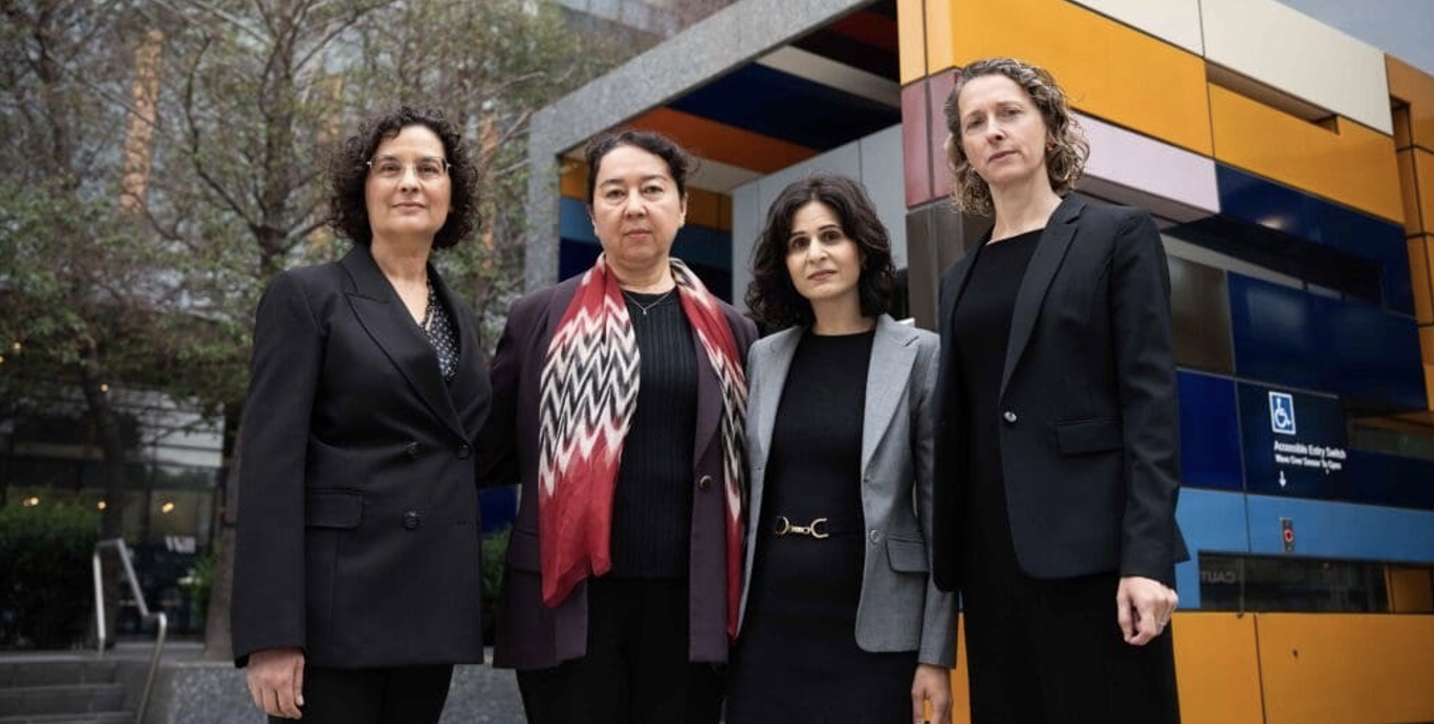
In Australia, this dynamic has come under growing scrutiny. In 2025, the Australian Uyghur Tangritagh Women’s Association (AUTWA) brought a case against Kmart Australia under consumer protection law, seeking disclosure of supply chain information. The organization alleges that Kmart may have misled consumers about its exposure to forced labor risks.6Freya Dinshaw, “Legal Action Filed Against Kmart,” Human Rights Law Center, August 5, 2025,” https://www.hrlc.org.au/updates/legal-action-filed-against-kmart The case highlights a central weakness in Australia’s Modern Slavery Act: the law requires disclosure but does not provide a direct mechanism to block goods linked to forced labor from entering the Australian market.
Japan faces similar challenges. It remains deeply integrated into Chinese manufacturing networks, including sectors linked to the state-imposed forced labor of Uyghurs. This risk is especially concentrated in textiles and solar inputs, where production ties to the Uyghur Region are widely documented.7Murphy and Tate, “Assessing the Impact.” Civil society groups have increasingly criticized Japan’s non-binding human rights due diligence guidelines for failing to create enforceable obligations, despite documented risks in sectors linked to the Uyghur Region.8Teppai Kasai, “Japan Should Adopt Regulation to Counter Uyghur Forced Labor,” Human Rights Watch, February 27, 2026, https://www.hrw.org/news/2026/02/27/japan-should-adopt-regulation-to-counter-uyghur-forced-labor
This report examines how these enforcement gaps shape import exposure in Australia and Japan. Using 2024 UN Comtrade data, sectoral risk mapping, and comparative policy analysis, it assesses how high-risk goods from China continue to enter mid-sized economies in the absence of border-level forced-labor controls.
IV. High-Risk Imports from China to Australia and Japan
According to a new Uyghur Human Rights Project (UHRP) analysis of 2024 UN Comtrade data, Japan and Australia import significant volumes of goods in sectors linked to Uyghur forced-labor risk. The analysis does not claim that all goods in these categories were made with forced labor. Rather, it estimates exposure by aggregating imports from China across Harmonized System (HS) categories. HS codes are standardized product codes used in international trade data to classify goods, allowing researchers to track imports and exports by sector across countries. This report identifies high-risk categories, including cotton apparel and textiles, caustic soda, polysilicon-linked solar products, and aluminum.9Murphy and Tate, “Assessing the Impact.” These sectors have documented links to the Uyghur Region’s state-imposed labor-transfer programs, state-linked companies, and coercive labor systems.10OHCHR “Assessment of Human Rights Concerns”; Tsafos, “Addressing Forced Labor Concerns”; Zenz, “Coercive Labor”; U.S. Department of Homeland Security Office of Strategy, Policy, and Plans, “Strategy to Prevent the Importation of Goods Mined, Produced, or Manufactured with Forced Labor in the People’s Republic of China” (United States, 2022) https://www.dhs.gov/sites/default/files/2022- 06/22_0617_fletf_uflpa-strategy.pdf
In 2024, Australia imported $4.82 billion in goods associated with an elevated risk of forced labor, representing 6.36 percent of total imports from China. Japan imported $6.71 billion, corresponding to 4.01 percent of total imports from China. While Japan’s total import volume is significantly larger, Australia exhibits higher relative exposure when measured as a share of total trade (see Figure 1).
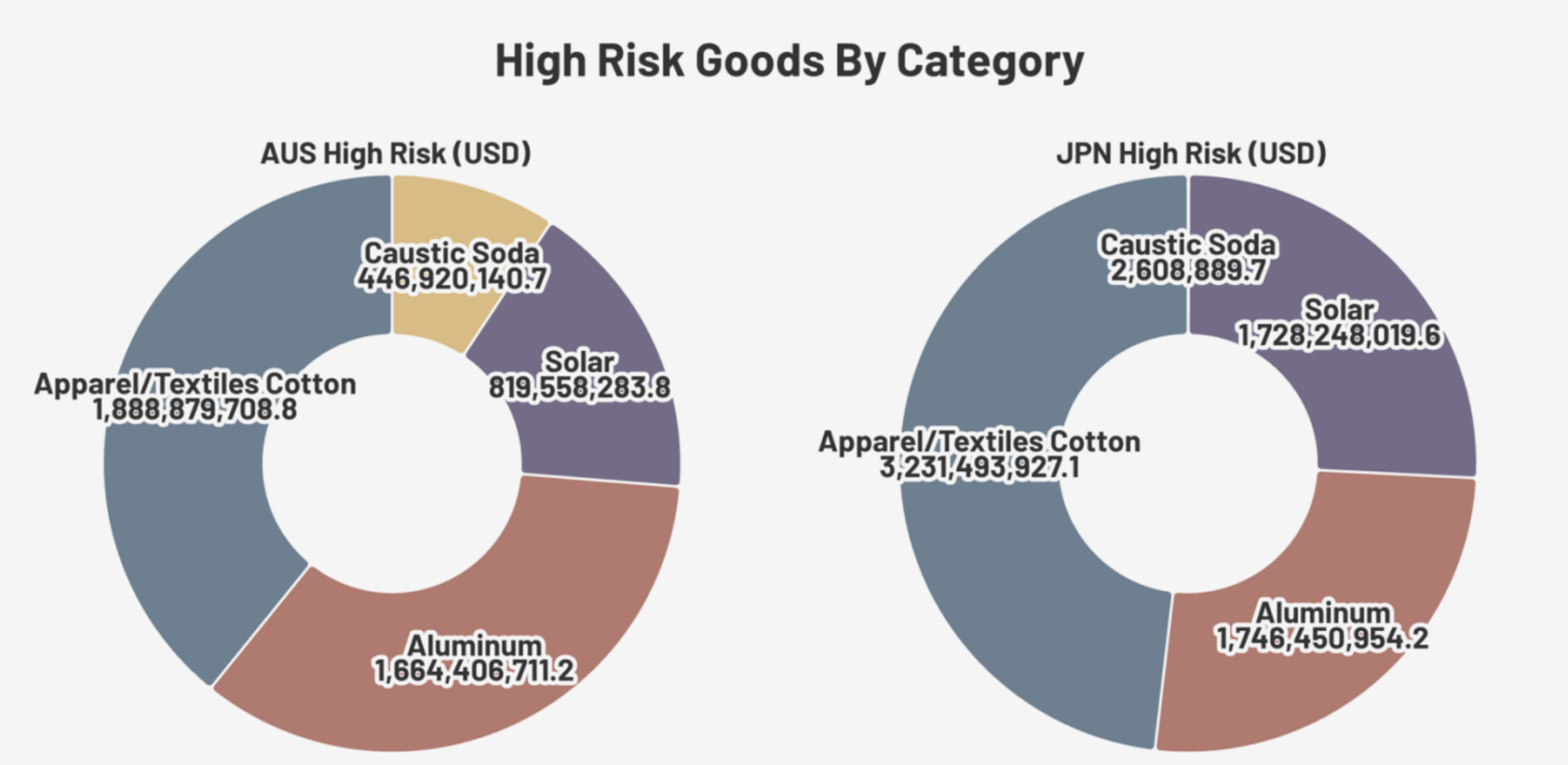
This exposure is concentrated in a small number of sectors (see Figure 2), with the risks of forced labor differing by sector. Solar supply chains are especially exposed because the Uyghur Region has played a major role in global polysilicon production, accounting for roughly 40–45 percent of global output around the time UFLPA enforcement began.11Laura T. Murphy and Nyrola Elimä, “In Broad Daylight, Uyghur Forced Labor and Global Solar Supply Chains,” Sheffield Hallam University Helena Kennedy Centre for International Justice, January 24, 2022, https://shura.shu.ac.uk/29640/; Tsafos, “Addressing Forced Labor Concerns.” Cotton and textiles carry similarly serious risks because the region produces about one-fifth of the world’s cotton and 90 percent of China’s cotton.12Murphy and Tate, “Assessing the Impact.” This means the risk of forced labor can enter clothing supply chains through raw cotton, yarn, fabric, or garments made in third countries.13Xu et al., “Uyghurs for Sale: “Re-Education,” Forced Labor and Surveillance beyond Xinjiang;” ASPI, March 1, 2020, https://www.aspi.org.au/report/uyghurs-sale/; Zenz, “Coercive Labor.”
According to our analysis, cotton textiles and apparel account for the largest share of high-risk imports from China, totaling approximately $1.89 billion in Australia and $3.23 billion in Japan. Textiles represent roughly 40 percent of Australia’s high-risk imports and nearly half of Japan’s, making these goods the primary channel through which forced labor risk enters both markets.
Textiles represent roughly 40 percent of Australia’s high-risk imports and nearly half of Japan’s, making these goods the primary channel through which forced labor risk enters both markets.
Solar-related products, including polysilicon and photovoltaic inputs, form the second largest category. Australia imported approximately $820 million in these goods, while Japan imported $1.73 billion. Japan’s higher exposure reflects its integration into upstream manufacturing processes, particularly in electronics and renewable energy supply chains, where inputs are more difficult to trace and verify.
Additional exposure is present in industrial materials, including aluminum and chemical compounds. While smaller in total value, these sectors represent upstream nodes in production, where the risk of forced labor is embedded earlier in supply chains, making traceability more challenging. Japan’s imports of high-purity silicon and related inputs further highlight the difficulty of identifying risk in intermediate goods that pass through multiple stages of processing before reaching final markets.
In both Japan and Australia, the share of high-risk imports in total trade remains consistent. This matters because the UFLPA creates strong incentives for firms to keep goods linked to the Uyghur Region out of the U.S. market through its rebuttable presumption and import restrictions.14U.S. Department of Homeland Security Office of Strategy, Policy, and Plans, “Strategy to Prevent;” U.S. Customs and Border Protection, “Uyghur Forced Labor Prevention Act Statistics,” (United States, 2024) https://www.cbp.gov/newsroom/stats/trade/uyghur-forced-labor-prevention-act-statistics. The rebuttable presumption mandates that goods produced in or sourced from the Uyghur Region, wholly or in part, are presumed to have been made with forced labor unless the importer can prove otherwise with clear supply chain evidence. If these incentives were reshaping sourcing practices globally, high-risk imports might decline in other major markets as well. Instead, Figure 3 shows that aluminum imports into Japan and Australia have remained relatively stable over time.
Consistent import rates of high-risk goods into Japan and Australia point to supply-chain bifurcation: firms may build lower-risk supply chains for the U.S. market while continuing to route higher-risk goods into jurisdictions without comparable import bans.15Murphy and Tate, “Assessing the Impact.” Rather than eliminating the risk of forced labor, uneven enforcement can shift where that risk appears. For mid-sized economies such as Japan and Australia, this creates a policy gap: they may remain exposed to high-risk imports even as U.S. enforcement reduces direct exposure in the U.S market.16U.S. Department of Homeland Security Office of Strategy, Policy, and Plans, “Strategy to Prevent;” Marti Flacks and Madeleine Songy, “The Uyghur Forced Labor Prevention Act Goes into Effect,” Center for Strategic and International Studies, June 27, 2022, https://www.csis.org/analysis/uyghur-forced-labor-prevention-act-goes-effect; Human Rights Watch, “‘Break Their Lineage, Break Their Roots’ China’s Crimes against Humanity Targeting Uyghurs and Other Turkic Muslims,” April 19, 2021, https://www.hrw.org/report/2021/04/19/break-their-lineage-break-their-roots/chinas-crimes-against-humanity-targeting
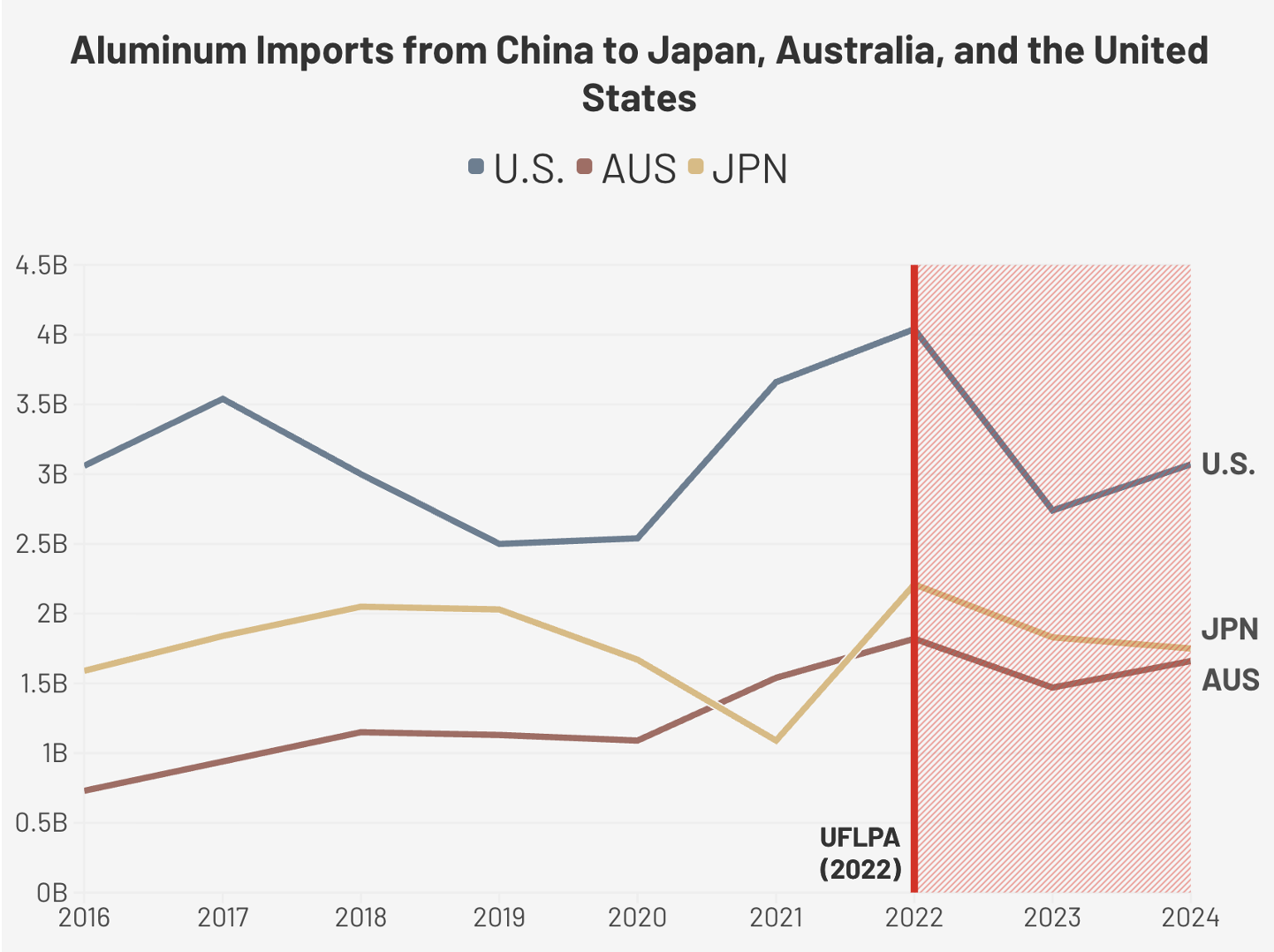
In contrast, the United States exhibits a sharper decline after 2022, consistent with the effects of enforcement-driven restrictions. While short-term fluctuations are evident, particularly a dip in 2023, import levels in Japan and Australia have recovered and remain broadly consistent with pre-enforcement levels, as highlighted in the post-UFLPA period. This divergence suggests that specific and enforceable mechanisms are central to altering sourcing behavior. Where forced-labor import prohibitions are enforced at the border, as in the United States under the UFLPA, trade flows adjust more visibly. Where such mechanisms are absent, as in Japan and Australia, exposure persists, as explored later in this report.
Where forced-labor import prohibitions are enforced at the border, as in the Unites States under the UFLPA, trade flows adjust more visibly.
V. Australia: Disclosure Without Import Controls
Australia’s Modern Slavery Act takes a transparency-based approach: it requires covered companies to report on supply chain risks. However, it does not mandate human rights due diligence, remediation, or restrictions on goods linked to forced labor. It therefore reflects the disclosure side of the business and human rights agenda, while falling short of the broader due diligence expectations set out in the UNGPs and the OECD Guidelines. The Modern Slavery Act requires firms with annual revenue above AUD $100 million (approximately USD $70.5 million) to report supply chain risks and mitigation efforts, but it imposes no penalties, import restrictions, or investigative authority.17Parliament of Australia, “Modern Slavery Act 2018” (Australia, 2018) https://www.legislation.gov.au/C2018A00153/latest/text; Australian Anti-Slavery Commissioner, “Recommendations to Strengthen Australia’s Modern Slavery Laws: Initial Position Paper” (Australia, 2026). Government oversight focuses primarily on improving disclosure rather than restricting market access, leaving enforcement largely dependent on corporate behavior and civil society scrutiny.18Attorney-General’s Department, “Official Modern Slavery Act Guidance” (Australia, 2023), https://www.modernslavery.gov.au/guidance-training- resources/resources/official-modern-slavery-act-guidance
In practice, these limitations have constrained the framework’s effectiveness. As Ramila Chanisheff, Chairperson of the Australian Uyghur Tangritagh Women’s Association, explains, “Australia’s Modern Slavery Act has been largely inactive and dependent on industries to be transparent and disclose their practices.”19Ramila Chaisheff, email message to author, March 29, 2026. The absence of binding enforcement mechanisms has required civil society actors to rely on alternative legal pathways, as demonstrated by the 2025 case brought against Kmart Australia under consumer protection law.
The Modern Slavery Act’s focus on disclosure rather than import prohibition creates a structural limitation: companies can comply with the law by reporting risks without changing sourcing behaviors.
Australia’s Modern Slavery Act was created as a disclosure framework, not as a forced-labor import ban. The act requires large companies to report on modern slavery risks in their operations and supply chains. However, the Act does not prohibit imports linked to forced labor, require companies to change suppliers, or impose direct penalties for failing to conduct adequate due diligence.20John McMillan, “Report of the Statutory Review of the Modern Slavery Act 2018 (Cth): The First Three Years,” (Attorney-General’s Department, Australia, 2023), https://www.ag.gov.au/sites/default/files/2023-05/Report%20-%20Statutory%20Review%20of%20the%20Modern%20Slavery%20Act%202018.PDF; Attorney-General’s Department (Australia), “Official Modern Slavery Act Guidance.” The Modern Slavery Act’s focus on disclosure rather than import prohibition creates a structural limitation: companies can comply with the law by reporting risks without changing sourcing behavior. Scholars and civil society groups have therefore argued that transparency laws must be paired with stronger enforcement tools, including mandatory human rights due diligence and prohibitions on forced-labor imports.21Fiona McGaughey, “Justine Nolan and Martijn Boersma, Addressing Modern Slavery,” Journal of Industrial Relations 63, no. 1 (2020): 100-101, https://journals.sagepub.com/doi/abs/10.1177/0022185620957471; Walk Free. “Overdue Diligence: Reforming Australia’s Modern Slavery Act,” February 17, 2026. https://cdn.walkfree.org/content/uploads/2026/02/17150535/GD432-AUMSA_finalRGB.pdf; Australian Council of Trade Unions, “Consultation: Strengthening the Modern Slavery Act” (Australia 2022).
VI. Japan: Guidance Without Binding Obligations
Japan differs from Australia in form but shares the same enforcement gap. Australia requires modern slavery reporting, while Japan provides voluntary due diligence guidance. Neither framework mandates human rights due diligence nor restricts imports linked to forced labor.22Inter-Ministerial Committee on Policy Promotion for the Implementation of Japan’s National Action Plan on Business and Human Rights, “Guidelines on Respecting Human Rights in Responsible Supply Chains” (Japan, 2022), https://www.meti.go.jp/policy/economy/businessjinken/guidelines/provisionalenglishtranslation.pdf Japan’s 2022 Guidelines on Respecting Human Rights in Responsible Supply Chains are best understood as a state-endorsed but non-binding guidance framework rather than a formal regulation.23Ibid. Japan’s Guidelines encourage companies to identify, prevent, and mitigate human rights risks but do not create legal obligations, penalties, or border-level restrictions on goods linked to forced labor. Enforcement mechanisms are therefore absent in legal form, leaving implementation dependent on voluntary corporate action and reputational pressure.
Japan’s Guidelines encourage companies to identify, prevent, and mitigate human rights risks but do not create legal obligations, penalties, or border-level restrictions on goods linked to forced labor.
The Guidelines may influence corporate behavior through government expectations, investor scrutiny, and reputational pressure, but implementation ultimately depends on voluntary corporate uptake.
Although Figure 3 shows a slight decline in aluminum imports after 2022, this pattern should not be read as clear evidence that the Guidelines changed sourcing behavior. Because the Guidelines do not impose penalties, import restrictions, or mandatory traceability requirements, any decline is more plausibly understood as suggestive rather than causal and may reflect broader market conditions, supplier substitution, price changes, or other shifts in Japan-China trade.
Together, Australia and Japan illustrate the limits of transparency and voluntary due diligence frameworks in addressing forced-labor risks. Australia’s Modern Slavery Act was designed as a disclosure law, requiring covered firms to report on modern slavery risks in their operations and supply chains. Japan’s 2022 Guidelines similarly reflect a state-endorsed but non-binding due diligence approach, encouraging firms to identify and mitigate human rights risks in line with international standards. In both cases, the goal is to shape corporate behavior through reporting, guidance, and reputational pressure rather than through direct import restrictions. Neither framework functions as a forced-labor import prohibition, nor does either require firms to prove that high-risk goods are free from forced labor before entering domestic markets.
As a result, disclosure and voluntary due diligence may increase awareness of risk while still allowing high-risk goods to enter Australia and Japan. The persistence of high-risk imports into Australia and Japan, particularly in sectors such as cotton textiles, solar inputs, and aluminum, suggests that transparency and guidance alone are insufficient when supply chains involve regions where independent verification is restricted or unreliable.
VII. International Standards and the Domestic Enforcement Gap
Australia and Japan both formally align with major international business and human rights frameworks. Both are ILO members, endorse the UN Guiding Principles on Business and Human Rights, and participate in the OECD system for responsible business conduct. Their domestic approaches reflect parts of these frameworks, especially corporate transparency, risk assessment, and human rights due diligence. Australia’s Modern Slavery Act requires covered entities to report on modern slavery risks and describe due diligence and remediation processes, while Japan’s Guidelines encourage companies to conduct human rights due diligence across their supply chains.24Japan, 2022; Australia, 2018. However, neither country currently has a mandatory human rights due diligence law or a forced-labor import prohibition.
International frameworks such as the ILO Forced Labor Convention, the UNGPs, and the OECD Guidelines establish clear expectations for preventing forced labor and conducting supply chain due diligence.25International Labour Organization, “Forced Labor Convention, 1930 (No. 29),” 1930, https://www.ilo.org/dyn/normlex/en/fp=NORMLEXPUB:12100:0::NO::P12100_ILO_CODE:C029; OECD, “OECD Guidelines for Multinational Enterprises, 2011 Edition,” 2011, https://www.oecd.org/en/publications/oecd-guidelines-for-multinational-enterprises_9789264115415-en.html Together, these instruments outline expectations for preventing forced labor, conducting corporate due diligence, and ensuring access to remedies for affected communities.
The ILO defines forced labor as work performed under threat of penalty and without voluntary consent, and obligates member states to suppress and eliminate such practices through legal and administrative measures. The Forced Labor Convention of 1930 (No. 29) provides the core definition and requires states to prohibit and suppress forced labor, while the Abolition of Forced Labour Convention of 1957 (No. 105) specifically prohibits state-imposed forced labor, including labor used as a means of political coercion, punishment for political views, labor discipline, or discrimination.26International Labor Organization, “Abolition of Forced Labour Convention, 1957 (No. 105),” 1957, https://www.ilo.org/media/21031/download The 2014 Protocol to Convention No. 29 further strengthens these obligations by calling on governments not only to prohibit forced labor but also to actively prevent it through enforcement mechanisms, labor inspection systems, and protections for victims. Together, these standards establish a clear expectation that states play a central role in identifying abuses, protecting victims, and restricting economic activity connected to forced labor.27ILO, “Forced Labor Convention, 1930”; International Labor Organization, “Protocol of 2014 to the Forced Labor Convention, 1930,” 2014, https://www.ilo.org/dyn/normlex/en/fp=NORMLEXPUB:12100:0::NO::P12100_ILO_CODE:P029
Similarly, the UNGPs articulate a framework built around three pillars: the state’s duty to protect human rights, the corporate responsibility to respect human rights, and access to remedy for victims of abuse.28OECD, “Guidelines 2011 Edition.” Under the UNGPs, governments are expected to adopt policies, legislation, and enforcement mechanisms to prevent human rights violations linked to business activity. While corporations are responsible for conducting human rights due diligence, this responsibility is intended to operate alongside, rather than in place of, state regulation.
The OECD Guidelines for Multinational Enterprises reinforce this expectation through a risk-based approach to supply chain due diligence.29OECD, “OECD Guidelines for Multinational Enterprises on Responsible Business Conduct,” 2023, https://www.oecd.org/en/publications/oecd-guidelines-for-multinational-enterprises-on-responsible-business-conduct_81f92357-en.html. The Guidelines encourage firms to identify, prevent, and mitigate human rights harms throughout their operations and supply chains, including risks of forced labor. They also require governments to establish National Contact Points (NCPs) to promote the Guidelines and facilitate mediation when companies are accused of violating them. However, these mechanisms primarily focus on dialogue and dispute resolution rather than binding enforcement.
Australia’s Modern Slavery Act requires covered companies to report on modern slavery risks in their operations and supply chains. Still, it does not require companies to eliminate those risks, conduct mandatory due diligence, or prove that goods are free from forced labor before entering the Australian market. Japan’s 2022 human rights supply chain guidelines clarify expectations for responsible corporate conduct, but remain non-binding guidance rather than enforceable law. These approaches show how international standards can shape domestic policy without creating binding enforcement.
This creates a gap between international commitments and domestic enforcement capacity. The ILO forced labor framework emphasizes the state’s role in preventing forced labor through law, enforcement, labor inspection, and cooperation, while the UNGPs call on states to protect against business-related abuses through effective policies, legislation, regulation, and adjudication.30International Labor Organization, “Protocol of 2014”; Office of the United Nations High Commissioner for Human Rights, “Guiding Principles on Business and Human Rights: Implementing the United Nations ‘Protect, Respect and Remedy’ Framework,” 2012, https://www.ohchr.org/en/publications/reference-publications/guiding-principles-business-and-human-rights. The OECD Guidelines also expect companies to conduct risk-based due diligence, but such due diligence is strongest when supported by clear legal duties and state enforcement.31OECD, “Guidelines for Multinational Enterprises.”
In Australia and Japan, responsibility for identifying and managing forced-labor risk is largely placed on companies, even though firms often lack the independence, leverage, or access needed to verify labor conditions in high-risk regions. This is especially problematic in the Uyghur Region, where surveillance, labor-transfer programs, and restrictions on independent investigation make credible auditing difficult. The issue is not that Australia’s Modern Slavery Act or Japan’s Guidelines fail to do what they were designed to do. Rather, these tools are not paired with the legal mechanisms needed to address Uyghur forced labor in supply chains.
Without mandatory human rights due diligence, state-led investigative authority, verification requirements, or forced-labor import prohibitions, high-risk goods can continue to enter markets that recognize the problem but lack mechanisms to stop it.
As a result, both countries formally endorse international human rights norms while lacking the domestic tools needed to make those commitments effective. Without mandatory human rights due diligence, state-led investigative authority, verification requirements, or forced-labor import prohibitions, high-risk goods can continue to enter markets that recognize the problem but lack mechanisms to stop it.
VIII. How Soft-Law Frameworks Limit Accountability
To understand why high-risk imports continue to enter Australia and Japan, it is not enough to examine trade data or formal legal authority. The language of each country’s forced-labor governance framework also matters. This language reveals how each government assigns responsibility, defines the role of the state, and signals whether forced labor is treated as an enforcement problem or a corporate risk-management issue. A critical discourse analysis (CDA) of laws, policy guidance, legal commentary, advocacy reports, and media coverage shows that both countries frame forced-labor risk primarily as a matter of corporate disclosure and voluntary risk management. Terms such as “report,” “disclose,” “guidance,” “encourage,” and “due diligence” dominate the policy vocabulary. In contrast, enforcement-oriented terms such as “prohibition,” “penalty,” “liability,” “seizure,” and “import restriction” appear far less often. This language reflects a broader governance model: responsibility is placed on companies to identify and manage risk, while the state retains limited authority to block high-risk goods from entering the market.
This language reflects a broader governance model: responsibility is placed on companies to identify and manage risk, while the state retains limited authority to block high-risk goods from entering the market.
In Australia, discussion of the Modern Slavery Act 2018 centers on reporting and disclosure. As Ramila Chanisheff, Chairperson of the Australian Uyghur Tangritagh Women’s Association, explains, “Australia’s Modern Slavery Act has been largely inactive and dependent on industries to be transparent and disclose their practices.”32Ramila Chaisheff, email message to author, March 29, 2026.
Japan’s supply-chain framework is described in similar terms, though through guidance rather than disclosure law. Legal and policy analyses commonly describe Japan’s 2022 Guidelines on Respecting Human Rights in Responsible Supply Chains as non-binding guidance that encourages firms to adopt human rights due diligence but does not create legal penalties or import restrictions. This language places responsibility on firms to identify and manage risk, while leaving the state with limited tools to investigate violations or restrict high-risk goods.
This discourse helps explain the trade patterns identified earlier in the report. Australia’s disclosure framework and Japan’s guidance model are not failing to do what they were designed to do. They were designed to promote reporting, risk awareness, and voluntary corporate due diligence. The problem is that these tools are not sufficient substitutes for enforcement mechanisms.
The CDA and trade data point to the same conclusion: Australia and Japan formally recognize forced-labor risks, but their domestic systems frame the response mainly through corporate reporting and voluntary compliance. Without stronger mechanisms to investigate violations, require credible verification, or block high-risk imports, the risk of forced labor can remain embedded in supply chains even in markets that endorse international human rights standards.
IX. Why Mid-Sized Economies Need Enforceable Standards
The patterns in Australia and Japan reveal a broader challenge for forced-labor governance. International standards help define expectations for governments and companies, but they do not prevent high-risk goods from entering domestic markets unless they are translated into enforceable domestic law. Australia and Japan formally align with global human rights norms and promote corporate due diligence. However, neither country requires companies to prove that high-risk goods are free from forced labor before importation.
The trade patterns identified in this report suggest that disclosure and voluntary due diligence are insufficient where forced-labor risk is tied to state-imposed labor systems. Australia’s Modern Slavery Act and Japan’s 2022 Guidelines were designed to promote reporting, risk identification, and responsible business conduct. They were not designed to restrict market access. As a result, they may raise awareness without preventing high-risk goods from entering domestic markets.
This is the central risk facing mid-sized economies: without comparable import prohibitions, traceability requirements, and customs enforcement, the risk of forced labor in global trade is not eliminated. It is redistributed.
The UFLPA offers one model for closing this gap by conditioning market access on importer evidence.33U.S. Department of Homeland Security Office of Strategy, Policy, and Plans, “Strategy to Prevent;” U.S. Customs and Border Protection, “Uyghur Forced Labor Prevention Act Statistics.” But unilateral enforcement is not enough. If only some markets restrict goods linked to forced labor, companies can reroute high-risk goods into jurisdictions with weaker rules. This is the central risk facing mid-sized economies: without comparable import prohibitions, traceability requirements, and customs enforcement, the risk of forced labor in global trade is not eliminated. It is redistributed.
This risk is most acute in the Uyghur Region, where forced labor is embedded in state-directed production. Since 2017, authorities have detained an estimated 1.5 million Uyghurs and other Turkic peoples, while labor transfer programs have brought Uyghur workers to factories and farms across China.34Ellie Bacon, “The Link between Trade and Human Rights: Combating Human Rights Abuses in Xinjiang,” Georgetown Law Journal, Vol. 112:1205 (2024), https://www.law.georgetown.edu/georgetownlawjournal/wpcontent/uploads/sites/26/2024/09/Bacon_TradeAndHumanRightsAbuses.pdf; Human Rights Watch, “Eradicating Ideological Viruses”; Henryk Szadziewski, “The Push for a Uyghur Human Rights Policy Act in the United States: Recent Developments in Uyghur Activism,” Asian Ethnicity 21, no. 2 (2020): 1–12, https://doi.org/10.1080/14631369.2019.1605497. These programs operate under coercion and surveillance, making labor exploitation inseparable from broader systems of state control.35Bacon, “Link between Trade and Human Rights”; Zenz 2021. The region’s role in cotton, textiles, polysilicon, and agricultural supply chains means that firms and consumers across North America, Europe, and Asia remain materially connected to the risk of forced labor.36Bacon, “Link between Trade and Human Rights;” Murphy and Tate, “Assessing the Impact.”
The Kmart case illustrates the gap between compliance and accountability. The issue is not that Kmart disclosed forced-labor risk under Australia’s Modern Slavery Act and the government failed to act. Rather, external actors raised concerns about potential links to Uyghur forced labor. Still, Australia lacks a forced-labor import prohibition that could block high-risk goods from entering or being sold in the domestic market. In that legal environment, AUTWA has had to rely on consumer law and allegations of misleading conduct as an indirect pathway to information and accountability.
This reinforces the report’s central argument: Australia’s Modern Slavery Act and Japan’s 2022 Guidelines may do what they were designed to do. Still, they are not designed to prevent the importation of goods linked to Uyghur forced labor. As such, Uyghur people are exposed to state-imposed forced labor, continuing the separations of Uyghur communities and families, as well as the ongoing repression of Uyghur culture and society. Both countries need legal tools that address that problem directly. Without forced-labor import prohibitions, mandatory traceability, customs enforcement, and coordinated international action, the risk of forced labor will continue to shift toward markets with weaker enforcement.
X. Recommendations for Closing the Enforcement Gap
- Adopt forced-labor import bans modeled on the UFLPA. Australia, Japan, and other mid-sized economies should adopt forced-labor import prohibitions that condition market access on credible supply-chain evidence. Like the UFLPA, these laws should shift the burden onto importers to demonstrate that goods are not linked to forced labor before they enter domestic markets. Import bans should apply especially to high-risk regions and sectors where state-imposed forced labor is documented, including cotton textiles, solar inputs, aluminum, and other industrial goods.
- Pair import bans with traceability, customs authority, and mandatory due diligence. Import prohibitions will be effective only if governments give customs agencies the authority, resources, and data needed to enforce them. Australia and Japan should require importers to map supply chains, document upstream inputs, and provide credible evidence for high-risk goods. These rules should be paired with mandatory human rights due diligence so companies identify, prevent, and address forced-labor risks before goods reach the border.
- Coordinate enforcement across major and mid-sized markets. Unilateral action can reduce exposure in one market while shifting high-risk goods to other markets. The United States, European Union, Australia, Japan, and other partners should align enforcement efforts through shared customs data, common risk indicators, public-entity lists, and coordinated approaches to high-risk sectors and regions. This would reduce opportunities for companies to reroute goods across jurisdictions and help prevent forced-labor risk from circulating through weaker markets. The Coalition to End Forced Labor in the Uyghur Region and the Human Trafficking Legal Center have emphasized the need for stronger enforcement of import bans and coordinated action to prevent goods excluded from one market from being redirected to another.37 Uyghur Human Rights Project, “Global Coalition Calls on Companies Not to Dump Forced Labor-Made Goods in Non-US Markets,” June 21, 2022, https://uhrp.org/statement/global-coalition-calls-on-companies-not-to-dump-forced-labour-made-goods-in-non-us-markets/; Human Trafficking Legal Center, “Civil Society Groups Urge Global Adoption of Import Bans Against Products Made Using Forced Labour,” December 11, 2023, https://htlegalcenter.org/wp-content/uploads/December-11-CSO-Statement-on-Import-Bans-Against-Forced-Labour.pdf; Human Trafficking Legal Center, “Tariff Act Advocates Group (TAAG) Policy Memo on Import Bans,” January 2025, https://htlegalcenter.org/sdm_downloads/taag-policy-memo-on-import-bans/
- Formally include civil society and affected communities in enforcement. Civil society organizations often identify risks before governments act. The Kmart case shows how groups such as the Australian Uyghur Tangritagh Women’s Association can expose supply-chain concerns, but also how limited legal tools force communities to rely on indirect pathways for accountability. Governments should strengthen whistleblower protections, establish evidence-sharing mechanisms, and provide affected communities with clearer legal avenues to initiate investigations or challenge high-risk imports.
XI. Methodology
This report uses a mixed-methods approach to assess exposure to forced labor in Australia and Japan. The methodology combines HS-6 trade data analysis with critical discourse analysis to compare which goods enter each market and how each country frames the policy problem.
The trade-data analysis used a manual HS-6 classification table to code 2024 UN Comtrade import lines from China into four high-risk sectors: aluminum, cotton apparel and textiles, caustic soda, and solar-related goods. Aluminum was coded using Chapter 76 products, while cotton apparel and textiles were coded using selected goods from Chapters 61, 62, and 63. Caustic soda was coded under HS 281511 and HS 281512. Solar-related exposure was coded using HS 280461, 280469, 381800, 854141, 854142, 854143, and 854149, covering silicon, doped chemical compounds, semiconductor devices, photovoltaic cells, photovoltaic modules, and LEDs. Each HS-6 line was assigned to a sector and subcategory, then aggregated in Excel pivot tables by country, sector, and product group. This produced sector-level exposure totals for Australia and Japan, showing approximately $4.82 billion in high-risk imports from China to Australia and $6.71 billion to Japan.
The critical discourse analysis examined how forced-labor governance is discussed in Australia and Japan. A manually coded Excel database organized sources by title, author, date, country focus, source type, perspective, stance, key quotes, and keywords. The CDA dataset included 17 sources in total: 7 focused on Japan and 10 on Australia. Sources included legal overviews, government statements, advocacy reports, press releases, op-eds, and news coverage. Each source was coded by perspective (e.g., legal analysis, primary legislation, news article, or civil society report) and by stance (e.g., neutral or critical). This coding made it possible to compare whether the forced-labor risk was framed in transparency-based language, such as reporting, guidance, and due diligence, or in enforcement-based language, such as penalties, import restrictions, and legal accountability.
XII. Appendix: Critical Discourse Analysis Dataset
| Country | Citation | Source Type |
| Japan | Inter-Ministerial Committee on Policy Promotion for the Implementation of Japan’s National Action Plan on Business and Human Rights, “Guidelines on Respecting Human Rights in Responsible Supply Chains” (Japan, 2022). | Primary Legislation |
| Japan | Kasai, Teppei, “Japan Should Adopt Regulation to Counter Uyghur Forced Labor,” Human Rights Watch, February 27, 2026. | Civil society report |
| Japan | Office of the United States Trade Representative, “United States and Japan Launch Task Force to Promote Human Rights and International Labor Standards in Supply Chains,” January 6, 2023. | Government policy document |
| Japan | The Asahi Shimbun, “Japan-U.S. Task Force to Grapple with Forced Labor in Supply Chains,” January 7, 2023. | News article |
| Japan | Ri, Airin, and Anasuya Syam, “Japan’s Moment to Act on Forced Labor in Supply Chains,” The Diplomat, April 9, 2022. | Civil society report |
| Japan | Saito, Koichi, Wataru Shimizu, Suguru Yokoi, Ai Tanaka, and Mai Kurano, “Japan: Law and Practice,” Business & Human Rights 2025, Chambers and Partners, June 12, 2025. | Legal analysis |
| Japan | Umetsu, Hideaki Roy, Aki Tanaka, Aritsune Miyoda, and Chihiro Tsukada, “Japan: Trends and Developments,” Business & Human Rights 2025, Chambers and Partners, June 12, 2025. | Legal analysis |
| Australia | Parliament of Australia, “Modern Slavery Act 2018” (Australia, 2018). | Primary legislation |
| Australia | Attorney-General’s Department, “Official Modern Slavery Act Guidance” (Australia, 2023). | Government policy document |
| Australia | McMillan, John, “Report of the Statutory Review of the Modern Slavery Act 2018 (Cth): The First Three Years” (Attorney-General’s Department, Australia, 2023). | Government policy document |
| Australia | Australian Anti-Slavery Commissioner, “Recommendations to Strengthen Australia’s Modern Slavery Laws: Initial Position Paper” (Australia, 2026). | Government policy document |
| Australia | Australian Council of Trade Unions, “Review of Australia’s Modern Slavery Act 2018” (Australia, 2022). | Institutional submission |
| Australia | Australian Human Rights Commission, “Review of Australia’s Modern Slavery Act 2018” (Australia, 2022). | Institutional submission |
| Australia | Walk Free, “Australia Spends Billions on Imports at Risk of Forced Labor, Driving Calls for Urgent Law Reform,” February 3, 2026. | Civil society report |
| Australia | Walk Free, “Overdue Diligence: Reforming Australia’s Modern Slavery Act,” February 17, 2026. | Civil society report |
| Australia | Dinshaw, Freya, “Legal Action Filed against Kmart,” Human Rights Law Centre, August 5, 2025. | Civil society report |
| Australia | Doherty, Ben. 2025. “Thousands of Imports Enter Australia from Firms Blacklisted by US over Alleged Uyghur Forced Labour Links,” The Guardian, January 20, 2025. | News article |
XIII. About the Author
Elijah Pockell-Wilson is a Research Associate at the Uyghur Human Rights Project, where his work focuses on forced-labor risk in global supply chains, international trade flows, and high-risk sectors including cotton textiles, solar inputs, aluminum, and agricultural products. His UHRP writing has appeared in The Trail, where he connects international political economy, trade, and Uyghur human rights concerns to public debate at the local scale. He is a recent graduate of the University of Puget Sound, where he earned a Bachelor of Science in Economics with a major in International Political Economy and a minor in Mathematics. His academic work examines international trade, global governance, and data-driven human rights policy.
XIIV. Acknowledgements
The author would like to thank Dr. Henryk Szadziewski, Director of Research at the Uyghur Human Rights Project for his guidance and support throughout the preparation of this report, as well as Adaire Criner, Program Assistant at UHRP for her careful edits, which strengthened the report’s clarity and presentation. The author is grateful to Ramila Chanisheff of the Australian Uyghur Tangritagh Women’s Association for her advocacy and insight into Australia’s modern slavery framework. The author would also like to thank two anonymous reviewers for their constructive feedback. Special thanks to Dr. Yoonseon Han and Dr. Lisa Nunn at the University of Puget Sound for their support and for helping the author work through the report’s ideas on mid-sized economies and supply-chain governance, as well as gaining access to UN Comtrade data through the World Integrated Trade Solution (WITS).
Cover art by YetteSu. © 2026 Uyghur Human Rights Project. Please share materials freely, with appropriate attribution, under Creative Commons Attribution 4.0 International (CC BY 4.0).
Redirected Risk: Uyghur Forced Labor and the Enforcement Gap in Australia and Japan
Whitewashing Winter Tourism: Global Sports and Leisure Industry Risks in the Uyghur Region
Fading Ties: Uyghur Family Separation as a Tool of Transnational Repression
Manifest Risk: New “Air Silk Road” Cargo Flights Carry Risk of Uyghur Forced Labor into Europe
FEATURED VIDEO
Atrocities Against Women in East Turkistan: Uyghur Women and Religious Persecution
Watch UHRP's event marking International Women’s Day with a discussion highlighting ongoing atrocities against Uyghur and other Turkic women in East Turkistan.