The Uyghur Reader: Stories We’re Following (Issue 28)
Issue 28: July 9, 2026 – July 22, 2026
Welcome to the twenty-eighth issue of the Uyghur Reader, a biweekly content round-up curated by the staff of the Uyghur Human Rights Project.
Each issue features carefully selected articles, reports, and publications from media outlets, academic institutions, NGOs, and government sources. While we highlight urgent human rights issues, we also aim to reflect the breadth of the Uyghur experience, including politics, economics, history, and culture.
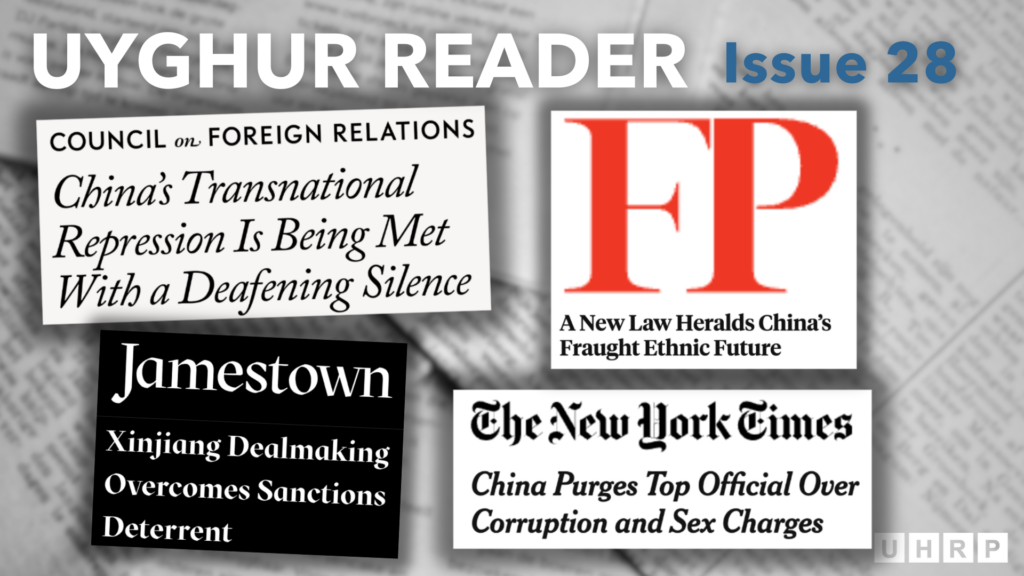
📌 Despite U.S. sanctions imposed in 2020, the Xinjiang Production and Construction Corps (XPCC) continues to attract substantial foreign investment through trade expos and Belt and Road-linked economic initiatives, writes Jonah Reisboard for the Jamestown Foundation. The article argues that recent events, including the 2026 China–Eurasia Expo in Urumchi, demonstrate the limited deterrent effect of sanctions, with foreign business leaders and politicians openly supporting investment in the XPCC and agreements with international partners reportedly exceeding US$1.5 billion since 2025. As a result, Beijing has successfully leveraged regional diplomacy and economic integration to normalize engagement with the XPCC, despite its central role in the repression, surveillance, and forced assimilation of Uyghurs. July 21, Xinjiang Dealmaking Overcomes Sanctions Deterrent.
📌 In “A New Law Heralds China’s Fraught Ethnic Future,” Foreign Policy, July 15, Aaron Glasserman argues that China’s new Law on Promoting Ethnic Unity and Progress represents the culmination of Xi Jinping’s assimilationist agenda by making the promotion of a unified Chinese national identity a core responsibility of the entire party-state. He contends that the legislation reinforces existing policies targeting language, education, religion, and culture in the Uyghur Region, Tibet, and other non-Han areas, while encouraging citizens to report conduct deemed harmful to “ethnic unity.” Glasserman concludes that, rather than resolving longstanding ethnic tensions, the law reflects Beijing’s anxieties over governing non-Han regions and is likely to intensify conflict.
📌 For The New York Times, Alexandra Stevenson reports on the expulsion of former Xinjiang Communist Party Secretary Ma Xingrui from the Chinese Communist Party over corruption, bribery, and abuse of power, making him the third Politburo member purged since 2022. Ma, who led the Uyghur Region from 2021 to 2025, oversaw Beijing’s ongoing campaign of repression, forced labor, and assimilation targeting Uyghurs, as well as the period that included the 2022 Ürümchi fire and the subsequent nationwide protests against China’s zero-COVID policies. July 14, China Purges Top Official Over Corruption and Sex Charges.
📌 Joshua Kurlantzick of the Council on Foreign Relations examines the detention of U.S. citizen and Myanmar scholar Min Zin on alleged espionage charges, arguing that the case reflects Beijing’s expanding campaign of transnational repression against academics, activists, and diaspora communities abroad. Drawing on documented cases involving surveillance, threats against family members, overseas police operations, and the misuse of international institutions, Kurlantzick argues that China has developed a broad toolkit for silencing critics beyond its borders, including Uyghur activists targeted through mechanisms such as Interpol and foreign law enforcement cooperation. He warns that Beijing’s willingness to target foreign nationals and overseas communities will continue to grow unless governments respond with stronger diplomatic pressure and accountability measures. July 13, China’s Transnational Repression Is Being Met With a Deafening Silence.
📖 Keep reading/listening
- Munawwar Abdulla, The Georgia Review, On Motherland by Zordun Sabir
- Ken Chao, Focus Taiwan, July 21, From TV star to exiled journalist: Gulchehra Hoja tells Uyghur story. Listen to an interview with Gulchehra Hoja on Radio Taiwan International.
- World Uyghur Congress, July 21, Joint Statement: 50+ Uyghur Groups Call for the Repeal of the Ethnic Unity Law
- Reuters, July 17, US lifts some Hong Kong sanctions imposed by Trump, autonomy status unchanged
- Tahir Izgil, Radio Free Asia, July 16, Chinese police arrest Uyghur sisters and mother in Urumqi for sending goods to Turkey
- Xiaoning Mo, Australian Broadcasting Corporation, July 16, Australia’s Hong Kong, Tibetan and Uyghur communities condemn China’s new ethnic unity law
- Rebiya Kadeer and Kok Bayraq, Taipei Times, July 16, Genocide debate forgot Uighurs
- Dolkun Isa, Bitter Winter, July 16, Coming Together Against Silence: Reflections on the 3rd International Uyghur Forum, Ten Years After the Camps
- Habibulla Izchi, Uyghur Times, July 16, Interview: Former Chinese Police Officer Zhang Yabo — “Uyghurs Are Considered Guilty Enough Simply Because of Who They Are”
- Amnesty International, July 14, China: Prominent Kazakh Writer Held in Secret Detention: Zhengis Reskhan
- Ilshat Hassan Kokbore, Uyghur Times, July 11, Farewell, Mother!
- Dylan Robertson, The Canadian Press, July 10, Uyghur group asks Canada to go beyond ‘vague’ response to China ethnic-unity law