The Uyghur Reader: Stories We’re Following (Issue 29)
Issue 29: July 23, 2026 – August 5, 2026
Welcome to the twenty-ninth issue of the Uyghur Reader, a biweekly content roundup curated by the staff of the Uyghur Human Rights Project.
Each issue features carefully selected articles, reports, and publications from media outlets, academic institutions, NGOs, and government sources. While we highlight urgent human rights issues, we also aim to reflect the breadth of the Uyghur experience, including politics, economics, history, and culture.
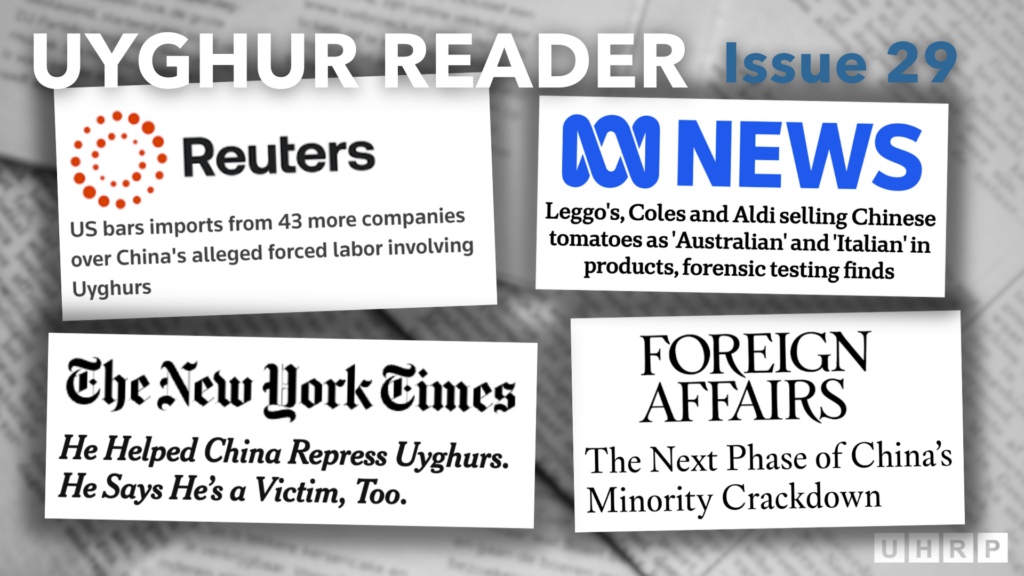
📌 The United States banned imports from companies over ties to Uyghur forced labor and other human rights abuses against Uyghurs, which the U.S. formally recognizes as genocide, report Karen Freifeld and Eduardo Baptista. The Department of Homeland Security added 43 companies to the Uyghur Forced Labor Prevention Act (UFLPA) Entity List, the largest expansion to date. The barred entities include companies from a variety of sectors, including pharmaceuticals, critical minerals, textiles, and agricultural products. The authors also note this is the first time companies have been added to the entity list under the Trump administration. US bars imports from 43 countries over China’s alleged forced labor involving Uyghurs, Reuters, July 31.
📌 China’s recently adopted ethnic unity law codifies Xi’s decade-long campaign to replace limited regional autonomy for Uyghurs, Tibetans, and Southern Mongolians with forced assimilation, write James Leibold and Tenzin Dorjee. The authors argue that, by putting this policy into law, the Chinese government has effectively eliminated the possibility of peaceful coexistence among diverse ethnic groups. By embedding policies of forced assimilation at every level of government, China has ensured that the crackdown will survive even if leadership priorities change. The Next Phase of China’s Minority Crackdown, Foreign Affairs, July 30.
📌 In “He Helped China Repress Uyghurs. He Says He’s a Victim, Too.,” Li Yuan profiles Zhang Yabo, who served for nine years as a police officer in the Uyghur Region before recently testifying before the German Bundestag. Zhang described conducting nighttime home raids, confiscating religious materials, interrogating and transporting detainees, investigating people for praying, and supervising forced labor in cotton fields. The article traces Zhang’s shift from believing government claims that detainees were dangerous terrorists to recognizing the camps’ true nature, leaving China, and seeking asylum in Germany. The author also examines Zhang’s controversial assertion that he, too, is a victim of China’s repression, having played only a minor role in a much larger campaign. New York Times, July 28.
📌 Adele Ferguson, Chris Gillett, and Madi Chwasta, report that forensic testing found Chinese tomatoes being sold by major Australian brands and supermarkets as Australian or Italian in origin. Of products tested from 39 brands, roughly one-quarter were found to come from China rather than the country stated on the label. Half of these Chinese-origin products were traced specifically to the Uyghur Region, where forced labor in agriculture is widely documented. The authors explain that these findings intensify ongoing concerns about hidden Uyghur forced-labor risk in Australian supply chains, coinciding with the Trump administration’s recent tariffs citing forced-labor risk. Experts and advocates called for regulators to investigate and penalize companies responsible for misleading consumers. Leggo’s, Coles and Aldi selling Chinese tomatoes as ‘Australian’ and ‘Italian’ in products, forensic testing finds, Australian Broadcasting Corporation, July 26.
📖 Keep reading/watching
- Jim Wormington and Yalkun Uluyol, Human Rights Watch, August 5, US Government’s Uyghur Forced Labor List Targets Aluminum
- Yalkun Uluyol, The Guardian, August 5, A moment that changed me: I found a forbidden novel – it led to a dangerous, lasting love
- Ana Swanson and Jeanna Smialek, New York Times, July 30, How Diamonds, Paprika and Fertilizer Won Relief From Trump’s Tariffs
- Benno Weiner and Qianyu Ma, Los Angeles Review of Books, July 30, The Fate of China’s Muslims
- The Telegraph, July 30, Miliband under pressure to accuse China of genocide
- Australian Broadcasting Corporation, July 30, The Chinese re-education camps for Muslim “extremists” | ASSASSINS
- Colin Hood, Radio Free Europe/Radio Liberty, July 29, Fears Mount In Kazakhstan As Beijing’s ‘Ethnic Unity Law’ Looms Across The Border
- Asiye Uyghur, Bitter Winter, July 28, July 28: Remembering the Yarkent Massacre
- Helen Reid and Casey Hall, Reuters, July 27, Shein’s Hong Kong IPO filing sidesteps Xinjiang cotton controversy
- Abdurehim Gheni Uyghur, Bitter Winter, July 24, The East Turkestan Flag at the World Cup
- Connor Stringer, The Telegraph, July 23, Trump punishes Britain for China ties with 10pc tariff
- Yerzhan Dosmukhamedov, Victoria Times Guardian, July 22, Opinion: BC’s Eby keeps silent on China’s treatment of Uyghurs
- Brian Hioe, New Bloom Magazine, July 22, Why Has China Targeted Educators with Sponsored Trips to Xinjiang?
📚 Research Papers and Reports
- Adrian Zenz and Muetter Tohti, Journal of Communist and Post-Communist Studies, July 22, “If You Fly to the Sky, I Can Catch You by Your Feet”: Beijing’s Transnational Authoritarian Control of Uyghur Diaspora Research and Documentation Efforts