The Uyghur Reader: Stories We’re Following (Issue 31)
Issue 31: August 20, 2026 – September 2, 2026
Welcome to the thirty-first issue of the Uyghur Reader, a biweekly content roundup curated by the staff of the Uyghur Human Rights Project.
Each issue features carefully selected articles, reports, and publications from media outlets, academic institutions, NGOs, and government sources. While we highlight urgent human rights issues, we also aim to reflect the breadth of the Uyghur experience, including politics, economics, history, and culture.
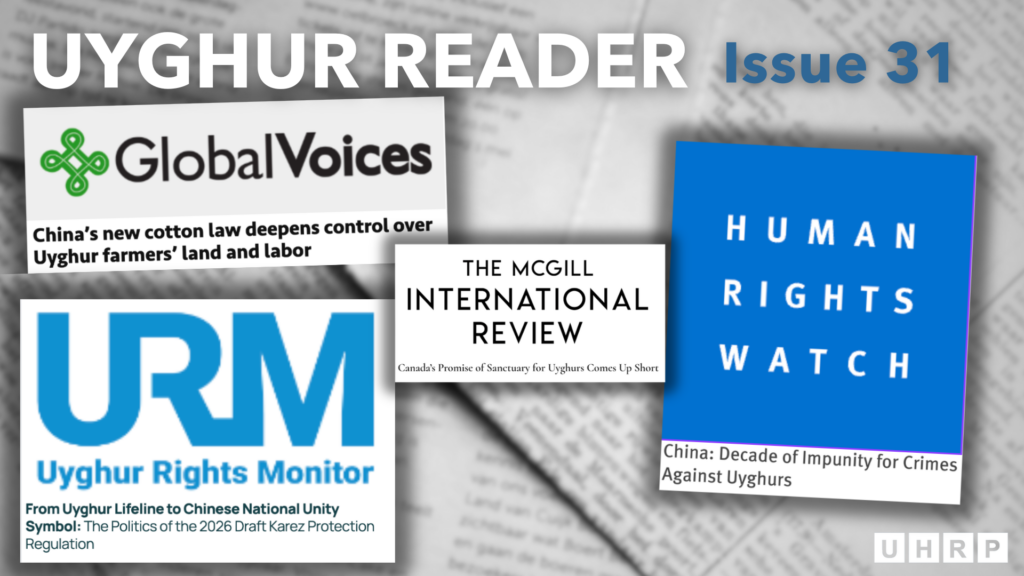
📌 Asiye Uyghur examines a new cotton regulation that introduces comprehensive traceability requirements while deepening state oversight of cotton production, land, and labor in the Uyghur Region. The regulation requires cotton to be traceable from individual farmers and plots of land through processing and sale, while existing land-transfer policies increasingly shift practical control over cultivation from Uyghur farmers to cooperatives and state-approved companies. Drawing on Chinese government documents, the article links land transfers and labor mobilization to broader campaigns of political control and “social stability,” arguing that farmers can lose control of their land while becoming wage workers on the same farms. The article concludes that greater supply-chain traceability does not itself address forced labor or economic coercion, and that the central issue remains whether Uyghurs retain meaningful control over their land, labor, and livelihoods. August 28, Global Voices, “China’s new cotton law deepens control over Uyghur farmers’ land and labor.”
📌 Human Rights Watch (HRW) marks a decade since the escalation of China’s repression in the Uyghur Region, documenting the continued use of arbitrary detention, imprisonment, mass surveillance, restrictions on religion and culture, and transnational repression despite Beijing’s efforts to project an image of normalcy. The organization argues that the international response has weakened even as hundreds of thousands remain imprisoned and state-imposed forced labor continues to affect global supply chains. HRW calls on the UN High Commissioner for Human Rights to intensify monitoring and follow-up to the UN’s 2022 assessment that abuses in the region may constitute crimes against humanity. It also urges governments to strengthen forced-labor import bans, impose targeted sanctions, and protect Uyghurs and other affected communities from Chinese transnational repression. August 27, “China: Decade of Impunity for Crimes Against Uyghurs.”
📌 Ablet Turdi of Uyghur Rights Monitor highlights proposed revisions to the Uyghur Region’s Karez Protection Regulation, arguing that Beijing is transforming the traditional irrigation system from an element of Uyghur oasis life into a symbol of Chinese national unity. The draft removes explicit references to individual ownership while incorporating Xi Jinping’s political concepts of cultural and ecological civilization and the “Chinese national community” into the regulation. Turdi argues that the reframing is part of a broader effort to preserve selected elements of Uyghur heritage while detaching them from Uyghur history and identity and incorporating them into a Chinese national narrative. August 26, “From Uyghur Lifeline to Chinese National Unity Symbol: The Politics of the 2026 Draft Karez Protection Regulation.”
📌 For The McGill International Review, Alex Bagdade writes about Canada’s failure to meet its 2023 parliamentary commitment to resettle 10,000 Uyghurs and other Turkic peoples, noting that fewer than 300 had arrived by March 2026. The article argues that delays leave Uyghurs in third countries vulnerable to detention, deportation, and coercion, while those who reach Canada remain exposed to Chinese transnational repression, including surveillance, threats, and pressure on relatives in China. Bagdade calls for faster resettlement, greater transparency, and coordinated support for Uyghurs facing intimidation within Canada. August 20, “Canada’s Promise of Sanctuary for Uyghurs Comes Up Short.”
📌 In an article for Reporters Without Borders, Gulchehra Hoja examines the growing presence of Chinese state media and pro-Beijing narratives in Türkiye, home to one of the world’s largest Uyghur diaspora communities. The article documents partnerships between Chinese and Turkish media organizations, as well as the use of social media and state broadcasters to portray China’s policies in the Uyghur Region as development and counterterrorism while dismissing reports of repression. RSF warns that Beijing’s expanding influence in Türkiye’s information environment risks marginalizing independent Uyghur voices and making it increasingly difficult for the public to hear accounts of persecution. August 19, “Chinese propaganda in Türkiye is designed to silence Uyghur voices.”
📖 Keep reading
- Uyghur Rights Monitor, September 1, URM Monthly Review — August 2026
- Uyghur Times, August 30, Abduweli Ayup: “Hozurum” and “Nazikum”: Two Forgotten Songs from Tarikh-i Ḥamidi
- Erk Altay, Uyghur Rights Monitor, August 28, No Accountability for China’s Uyghur Genocide
- Magnus Fiskesjö, August 28, Of Kings and Concentration Camps: Xinjiang and Norway — In honor of the late King Harald of Norway, censored when he wanted to speak up against China’s Uyghur atrocities
- Asiye Uyghur, Bitter Winter, August 26, How Beijing Turns Human Relationships Into Instruments of Power
- Ji Siqiin, Emma Ma, and Mandy Zuo, South China Morning Post, August 21, Despite US sanctions on Xinjiang cotton, China’s textile industry weathers the storm
- Patrick Poon, UCA News, August 20, How China turned the ‘war on terror’ against the Uyghurs
- Olivia Enos, Hudson Institute, August 20, A Test Case for US Resolve: Securing the Release of Uyghur Doctor Gulshan Abbas