The Uyghur Reader: Stories We’re Following (Issue 34)
Issue 34: October 27 – November 11, 2026
Welcome to the thirty-fourth issue of the Uyghur Reader, a biweekly content roundup curated by the staff of the Uyghur Human Rights Project.
Each issue features carefully selected articles, reports, and publications from media outlets, academic institutions, NGOs, and government sources. While we highlight urgent human rights issues, we also aim to reflect the breadth of the Uyghur experience, including politics, economics, history, and culture.
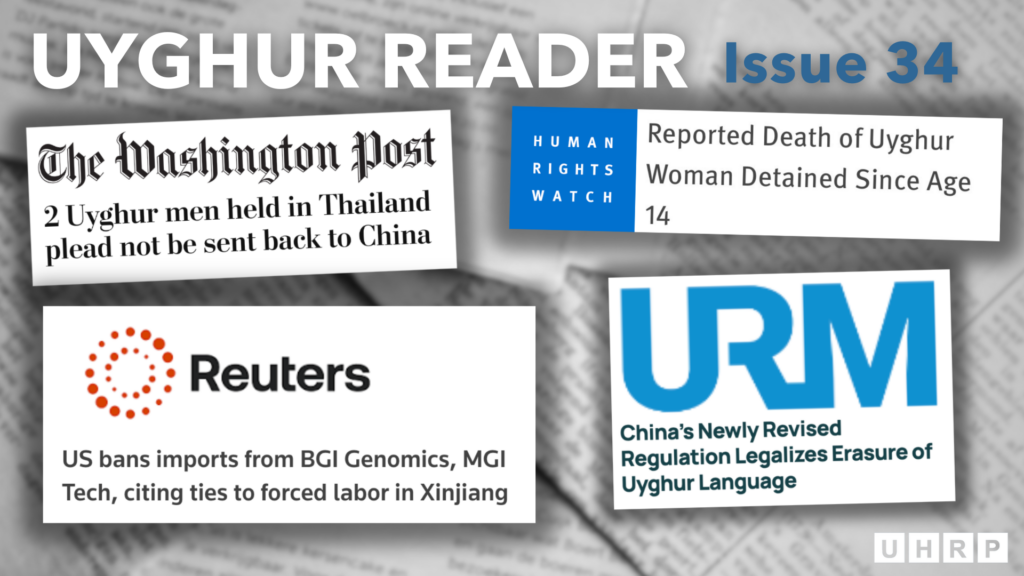
📌 Yalkun Uluyol of Human Rights Watch highlights the reported death of Rahile Omer, a Uyghur woman first detained in a Chinese “political re-education” camp at age 14, who reportedly died in prison at age 23. According to a November 6 investigation by Radio Free Asia Uyghur Service, Rahile was sentenced to 12 years in prison in 2021 after initially being detained in 2017, reportedly for “disturbing social order.” Chinese officials told RFA that she had been transferred from a re-education camp to prison after refusing to provide information about others and being caught praying in her dormitory. A 2022 BBC investigation identified Rahile as the youngest among hundreds of detainees whose photographs were leaked in the Xinjiang Police Files. While Human Rights Watch has not independently verified the reporting, Uluyol emphasizes the lack of transparency surrounding the fate of Uyghurs imprisoned in East Turkistan and calls on governments to press Beijing for answers about what happened to Rahile. November 11, “Reported Death of Uyghur Woman Detained Since Age 14.”
- Read the original Uyghur-language reporting by Shohret Hoshur for RFA Uyghur Service, November 6: 14 ياشتا لاگېرغا ئېلىپ كېتىلگەن راھىلە ئۆمەرنىڭ تۈرمىدە جان ئۈزگەنلىكى دەلىللەندى – ئۇيغۇر
📌 In a new report for Uyghur Rights Monitor, Ablet Turdi and Erk Altay examine China’s newly revised language regulation and its implications for the already-threatened Uyghur language. Adopted on September 23, 2026, and scheduled to take effect on January 1, 2027, the revised Regulation on Spoken and Written Language Work codifies the primacy of Mandarin across education, government, commerce, media, and public life in East Turkistan. While not an outright prohibition on the Uyghur language, the revised regulation removes previous guarantees of linguistic equality and directs government institutions, businesses, schools, and other organizations to promote Mandarin, effectively making linguistic assimilation a civic responsibility. Through a detailed comparison of the new regulation with the previous policy, Turdi and Altay argue that the changes violate China’s own constitutional protections guaranteeing ethnic minorities the freedom to use and develop their languages. The report warns that the regulation will further marginalize the Uyghur language, threatening its use in public life, cultural expression, and transmission to future generations. November 6, “China’s Newly Revised Regulation Legalizes Erasure of Uyghur Language.”
📌 Two Uyghur men detained in Thailand are pleading with authorities not to forcibly return them to China, where they fear torture and other abuses, write Huizhong Wu and Jintamas Saksornchai. The men told Thailand’s Office of the National Human Rights Commission that they do not consent to be sent back to China. Thai authorities stated that China would need to submit a formal extradition request to seek their return. The case raises renewed concerns over the safety of Uyghurs facing forced repatriation, particularly following Thailand’s deportation of 40 Uyghur men to China in February 2025, whose fate remains unknown. The article highlights the continuing threat of forced returns faced by Uyghurs abroad and the lack of transparency surrounding the treatment of those already returned to China. November 4, The Washington Post, “2 Uyghur men held in Thailand plead not be sent back to China.”
📌 The United States added three Chinese genomics companies—BGI Genomics, MGI Tech, and Shenzhen BGI Technology (BGI Group)—to the Uyghur Forced Labor Prevention Act (UFLPA) Entity List, barring their goods from entering the U.S. unless importers can demonstrate they were not produced with forced labor. The Department of Homeland Security said the companies facilitated forced labor involving Uyghurs and other ethnic minorities through genetic testing programs and helped support the Chinese government’s mass surveillance infrastructure in East Turkistan. The additions bring the total number of entities on the UFLPA Entity List to 190. Karen Freifeld, October 28, Reuters, “US bans imports from BGI Genomics, MGI Tech, citing ties to forced labor in Xinjiang.”
📖 Keep reading and listening:
- World Uyghur Congress, November 12, World Uyghur Congress Celebrates East Turkistan National Day
- Kelly McEvers, Embedded (NPR Podcast), November 11, The Black Gate: Vanished in the Night
- Sophia Charles, Lowry Institute, November 9, Beijing’s new “common language” law doesn’t sound so common
- Amy Hawkins, The Guardian, November 7, Uyghurs facing deportation by Thailand say they will be ‘like slaves’ in China
- Amnesty International, November 5, Thailand: Halt imminent forcible return of two Uyghur men to China
- Aekarach Sattaburuth, Bangkok Post, November 4, Opposition MP warns against deporting two Uyghur detainees to China
- Human Rights Watch, November 3, Thailand: Two Uyghurs at Risk of Return to China
- Nithin Coca, The Diplomat, November 3, Will New Laws Finally End Human Rights Abuses in Asia’s Factories?
- James Griffiths, The Globe and Mail, November 1, Twenty years on, supporters of jailed Canadian Huseyin Celil haven’t given up hope of freeing him from China
- Jilil Kashgary, Közet Uyghur Monitor, October 30, Book of 26 Uyghur testimonies launched at Washington conference on documenting abuses