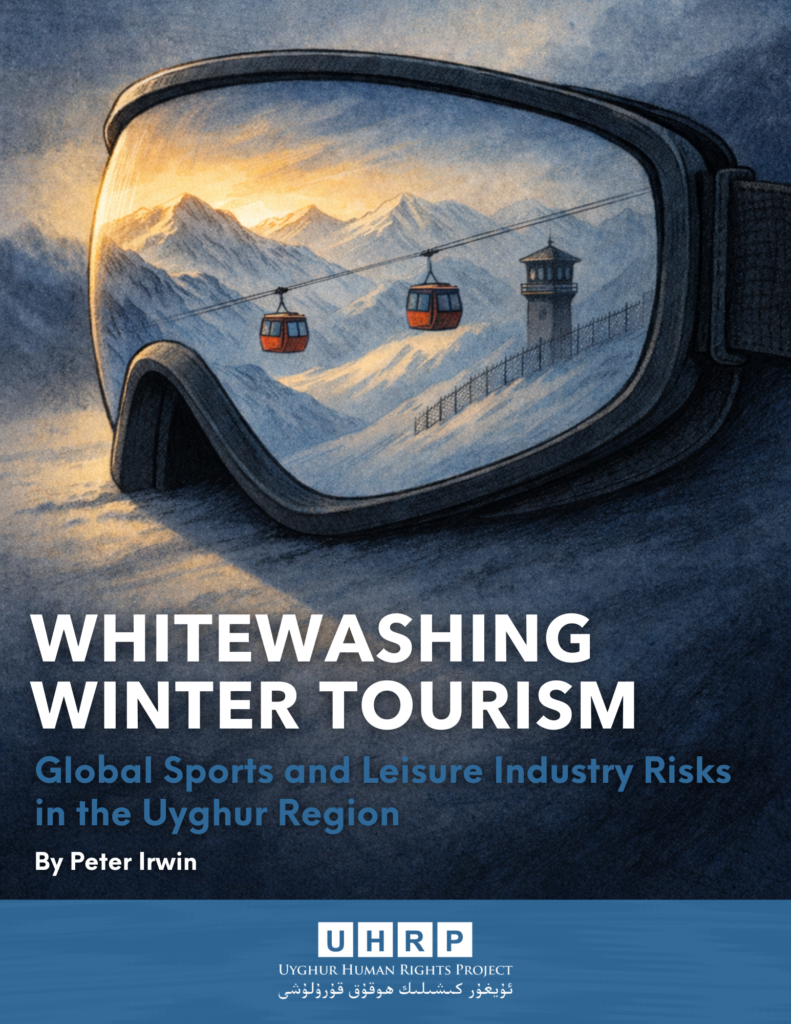
A Uyghur Human Rights Project report by Peter Irwin. Read our press statement on the report, download the full briefing in English, and read a printable, one-page summary of the report.

I. Key Takeaways
- Winter Sports and Leisure Activities as a State Tool: Since the 2022 Beijing Winter Olympics, China has invested heavily in ski resorts, hotels, and winter tourism in the Uyghur Region, linking “ethnic” and cultural branding to a state-led narrative of prosperity while suppressing Uyghur language, religion, and culture.
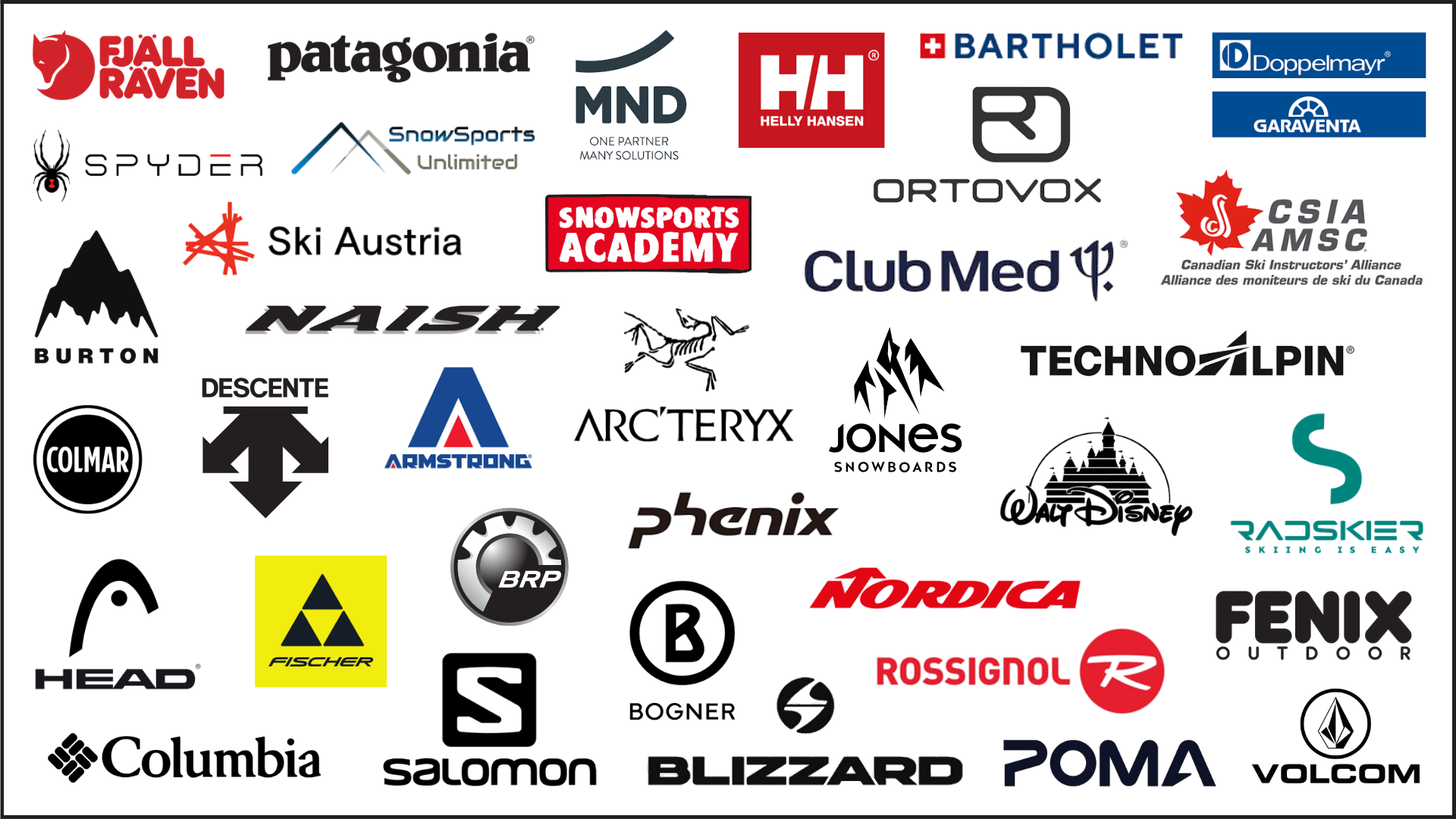
- Corporate Expansion in a High-Risk Context: More than 40 prominent global winter sports and apparel brands—including Burton, Arc’teryx, Columbia, and Rossignol—have opened stores in the region, some inside prominent ski areas, often omitting these locations from public listings, reducing transparency about their direct engagement.
- Sponsorships Advance Government Agendas: International companies—including Bombardier, Patagonia,1See Patagonia’s response to UHRP in Appendix II. Helly Hansen, and Oakley—have backed ski competitions, pop-up events, winter tourism expos, and marketing campaigns, actively supporting state efforts to normalize leisure and “ethnic-themed” tourism in a region under documented human rights abuses.
- Embedded Infrastructure and Equipment Supply: European and international firms, from gondola and lift providers to snowmaking companies, supply core ski infrastructure, directly embedding international corporate actors in state-led tourism expansion.
- Commitments vs. Reality: Many brands publicly emphasize human rights and ethical business practices, yet few demonstrate meaningful scrutiny or mitigation of operational risks in the Uyghur Region, revealing a persistent disconnect between corporate values and commercial actions.
II. Introduction
“If there are any human rights violations in Xinjiang, I don’t know, [it’s] not my expertise by any means, so I’m not going to judge.”
– Craig Smith, CEO, Burton China (January 2022)
In the years ahead of the 2022 Beijing Winter Olympics, China mounted a coordinated effort to brand itself as a global winter sports destination. That push went far beyond the Games, accelerating state investment in ski resorts, tourism infrastructure, and international marketing, particularly in the Uyghur Region. Since 2022, many of the same global winter sports brands, apparel companies, hotel chains, and equipment suppliers currently enmeshed in the Milan–Cortina Games have expanded their commercial presence in the region.
Just weeks before Craig Smith’s interview,2Robin Brant, “Winter Olympics: Snowboard company Burton defends working in Xinjiang,” BBC, January 18, 2022, online. the Uyghur Tribunal, an independent people’s tribunal set up to examine evidence regarding human rights abuses in the Uyghur Region, found China’s actions amounted to genocide and crimes against humanity.3Joel Gunter, “China committed genocide against Uyghurs, independent tribunal rules,” BBC, December 9, 2021, online. The judgement followed years of reporting from journalists and research from civil society making similar claims. In early 2021, dozens of genocide and atrocity prevention organizations and experts argued that China’s policies “meet the threshold of acts constitutive of genocide.”4“Open Letter of Concern to Governments on Crimes Against Humanity and Genocide Against Uyghurs in China,” Uyghur Human Rights Project, January 14, 2021, online. Human Rights Watch and Amnesty International called China’s treatment of Uyghurs crimes against humanity that same year.5Maya Wang, “‘Break Their Lineage, Break Their Roots’: China’s Crimes against Humanity Targeting Uyghurs and Other Turkic Muslims,” Human Rights Watch, April 19, 2021, online; Amnesty International, “’Like we were enemies in a war’: China’s Mass Internment, Torture and Persecution of Muslims in Xinjiang,” June 2021, https://xinjiang.amnesty.org.
While Smith’s comments may have backfired in the short term, given the negative publicity,6Bradley J. Strawser, “Burton Shreds Right and Wrong,”Compass Ethics, n.d., online. Smith was on a broader mission to promote Burton’s expansion into the Uyghur Region ahead of the 2022 Olympics, when all eyes were on a country not traditionally seen as a hub for winter sports.
Burton and a number of other companies learned a valuable PR lesson following the interview, and proceeded to quietly expand their presence in the region despite significant risks. Later that year, the UN, after an extensive investigation, concluded that China’s treatment of Uyghurs and other Turkic peoples could amount to crimes against humanity.7Office of the United Nations High Commissioner for Human Rights, “OHCHR Assessment of human rights concerns in the Xinjiang Uyghur Autonomous Region, People’s Republic of China,” August 31, 2022, online.
A new UHRP analysis has found more than 20 globally-recognized winter sports apparel and equipment brands that have opened stores and rental outlets at ski resorts and urban centers in the Uyghur Region, as well as brands that have participated in promotional events tied to winter tourism, in some cases partnering with government tourism offices. Major international hotel chains have also expanded into the region, developing ski-in/ski-out accommodations and other resort-adjacent properties to support the growing leisure market.8Peter Irwin and Henryk Szadziewski, “It Does Matter Where You Stay: International Hotel Chains in East Turkistan,” Uyghur Human Rights Project, April 17, 2025, online. Beyond retail and hospitality, a range of European companies have supplied essential ski infrastructure, including snowmaking systems, lifts, and gondolas, embedding themselves directly within the region’s ski resorts.
Tourism promotion is closely tied to Chinese state efforts to portray the Uyghur Region as open and prosperous while obscuring ongoing rights abuses.9Rian Thum, “Eight Years On, China’s Repression of the Uyghurs Remains Dire: How China’s Policies in the Uyghur Region Have and Have Not Changed.” Simon-Skjodt Center for the Prevention of Genocide, United States Holocaust Memorial Museum, February 2025, online. Since 2023, several UHRP investigations have examined links between tourism promotion, the erasure of Uyghur and Turkic identities, and the normalization of genocide and crimes against humanity.10Uyghur Human Rights Project, “Tourism,” online. In 2025, we documented a surge in hotel planning, construction, and openings by major international chains, showing how hospitality expansion reinforces propagandistic government narratives.11Peter Irwin and Henryk Szadziewski, “It Does Matter Where You Stay: International Hotel Chains in East Turkistan,” Uyghur Human Rights Project, April 17, 2025, online.
These developments are tightly linked to the regional government’s priorities articulated in state planning documents, which call for an integration of tourism with “culture,” and emphasize building distinctive tourism brands centered on “historical and cultural,” “folk,” and “ethnic” themes. This emphasis on packaging “ethnic” culture for tourism unfolds in parallel with policies that have curtailed Uyghur-language education, restricted religious practice, demolished or altered cultural sites, and detained intellectuals and cultural figures. The result is not organic cultural development, but a state-managed reconfiguration of identity in which acceptable forms of “ethnic culture” are preserved for display while independent expression is suppressed.
Such an explicit, state-directed linkage between tourism and culture—particularly so-called “ethnic minority” culture—positions tourism as a Party-state tool for shaping how Uyghur and other Turkic identities are curated and presented to domestic and international audiences.
Taken together, these developments between the 2022 Winter Games and the Milan–Cortina Games illustrate how international companies, from global winter sports brands to hotel chains and European equipment suppliers, have embedded themselves in the Uyghur Region. Some companies merely operate as retailers to the developing snow sports and leisure market, while others have more closely aligned themselves with a state-led tourism strategy unfolding amid credible findings of genocide and crimes against humanity.
III. Winter Sports Development in the Uyghur Region
Since the lead-up to the 2022 Winter Olympics, the Uyghur Region has experienced a rapid expansion of winter sports infrastructure as part of a broader domestic ski industry strategy.12Wang Zhuoqiong, “Winter sports in China eye white-hot growth,” China Daily, February 19, 2024, online. The China Ski Industry White Paper, published annually since 2016, shows the growth in both ski areas in the Uyghur Region and total visitors over the last ten years.13Wu Bin (Benny Wu), “2024-2025 China Ski Industry White Paper,” Beijing Snowpal Enterprise Management Co., Ltd., August 26, 2025, online. State media frequently highlight large‑scale investment in ski facilities and supporting hospitality, portraying these developments as drivers of tourism, economic growth, and regional integration.14Xinhua, “A glimpse into thriving ice and snow industry in Xinjiang,” January 30, 2024, online.
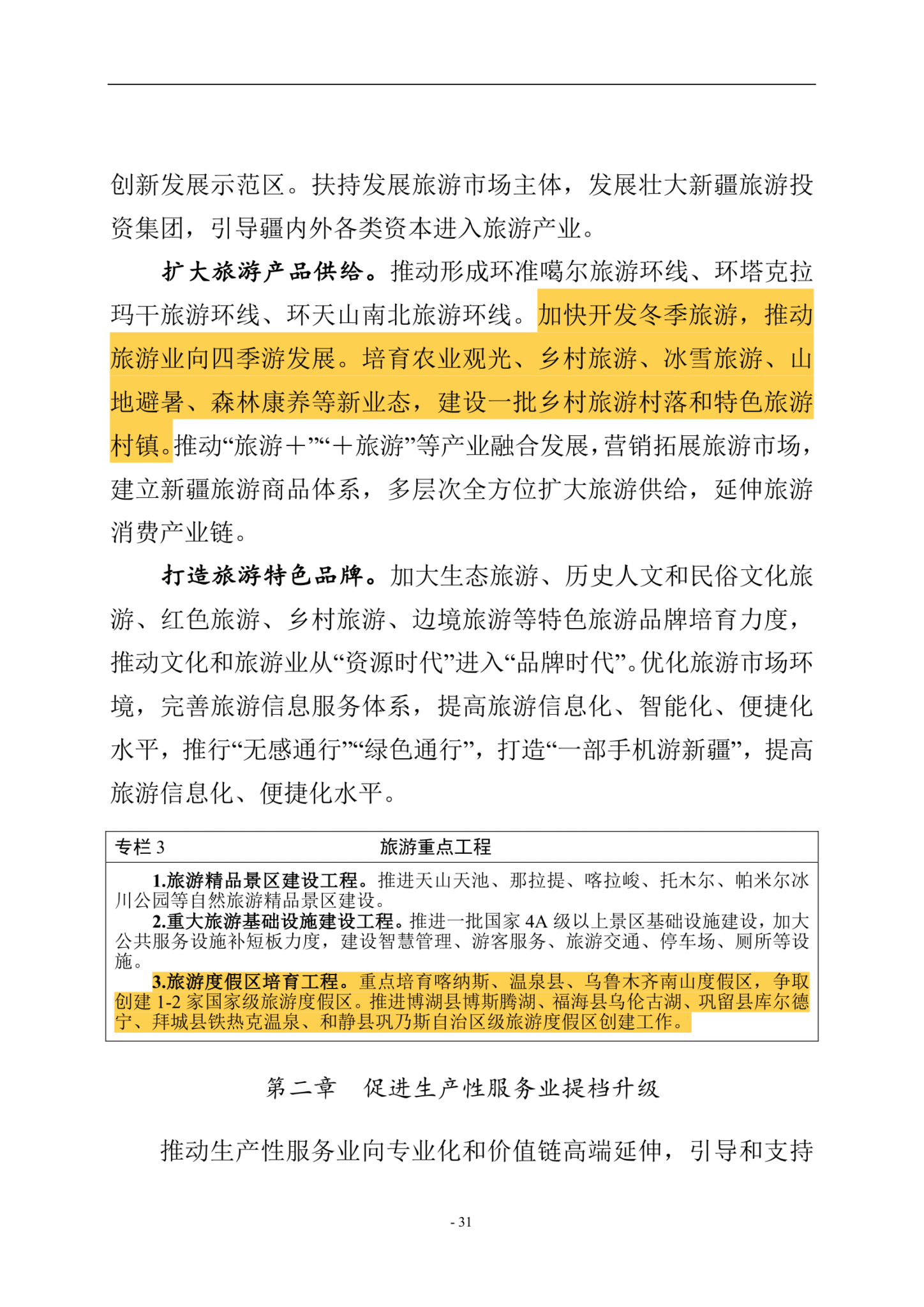
This rhetoric has also been backed by the Chinese government. The regional government’s 14th Five-Year Plan (2021–2025) puts an explicit focus on the importance of the tourism industry, a priority largely absent from the preceding 2016–2020 cycle, noting that authorities will “vigorously implement the strategy of revitalizing Xinjiang through tourism.”15新疆维吾尔自治区发展和改革委员会 [Xinjiang Uygur Autonomous Region Development and Reform Commission], “新疆维吾尔自治区国民经济和社会发展第十四个五年规划和2035年远景目标纲要” [The 14th Five-Year Plan for National Economic and Social Development and the Outline of Long-Term Goals for 2035 of Xinjiang Uygur Autonomous Region], April 11, 2022, online.
More recently, a 2025 white paper released by the central government, “The Successful Practice of the Party’s Strategy for Governing Xinjiang in the New Era,” (新时代党的治疆方略的成功实践) notes that, “Resources are now being channeled into developing the winter sports tourism sector, with 72 skiing venues and five national ski resorts established across the region by the end of 2024.”16“Full text: CPC Guidelines for Governing Xinjiang in the New Era: Practice and Achievements,” State Council of the People’s Republic of China, September 20, 2025, online.
Additionally, an implementation document released by the regional government in January 2025 instructs all government institutions from the regional to local levels to “promote Xinjiang’s ice and snow products and services to the world.”17印发《自治区关于以冰雪运动高质量发展 激发冰雪经济活力的实施方案》的通知 [The Autonomous Region issued the “Opinions on Promoting High-Quality Development of Ice and Snow Sports,” Notice on the Implementation Plan for Stimulating the Vitality of the Ice and Snow Economy], 新疆维吾尔自治区人民政府办公厅 [“General Office of the People’s Government of Xinjiang Uygur Autonomous Region”], 2024, online. The document calls on officials to, “Actively attract well-known domestic and international ice and snow enterprises” for the development of facilities in the region, and to “Strengthen cooperation and exchanges with […] leading ice and snow countries internationally through branded events.” The overall objective, according to the document, is to attract more than four million visitors annually by 2027 and reach an output value of 200 billion yuan (USD$28.6 billion) for the ice and snow industry by 2030.18新疆维吾尔自治区人民政府办公厅 [General Office of the People’s Government of Xinjiang Uygur Autonomous Region], “印发《自治区关于以冰雪运动高质量发展激发冰雪经济活力的实施方案》的通知” [“Notice on Issuing the Implementation Plan of the Autonomous Region on Stimulating the Vitality of the Ice and Snow Economy through High-Quality Development of Ice and Snow Sports”], December 29, 2024, online.
A network of ski areas now spans the region. In Altay Prefecture, Jiangjunshan International Ski Resort in Altay City, Jikepulin International Ski Resort in Hemu (MON: Kom-Kanas) Village, and Keketuohai International Ski Resort in Köktoqay County are among the major ski areas. Around Ürümchi, the Silk Road International Ski Resort and Tianshan Heaven Lake International Ski Resort have expanded access for winter sports, complemented by smaller areas like Baiyun and Wukesong Ski Resorts.
 Major Ski Areas in the Uyghur Region
In addition to promoting the region as a center for leisure and consumption,19China Daily, “Xinjiang transforms as cultural and tourism center,” September 25, 2025, online. state media repeatedly frame winter tourism in the Uyghur Region around carefully curated displays of “ethnic culture,” highlighting its scenic potential and visitor appeal while presenting local heritage as an exotic tourist experience.20China Daily, “Xinjiang attracts tourists with winter sports,” February 2, 2024, online. This portrayal stands in stark contrast to the lived realities of Uyghurs, including pervasive surveillance, arbitrary detention, restrictions on religious and linguistic expression, family separation, and coercive labor programs.
These state-driven investments and ambitious expansion plans have created an infrastructure primed for international participation. Western companies, from global winter sports brands to hotel chains and European equipment suppliers, have seized these opportunities, embedding themselves in the region’s ski resorts, retail spaces, and hospitality networks.
IV. Ski-in/Ski-out Resorts
While documenting the surge in international hotel chains opening properties in recent years in the Uyghur Region, UHRP researchers noticed a number of new “chalet-style” accommodations in proximity to—or in some cases, within—ski resorts.
This includes IHG’s Hotel Indigo Kanas Hemu, located within the Jikepulin Ski Resort, which promotes its “unique ethnic and cultural charm” on its website.21IHG, “Hotel Indigo Kanas Hemu,” n.d., online. The dual-branded Conrad Altay Hemu and Hilton Altay Hemu, also located within the resort, bills itself as a “serene stay inspired by culture.” In total, at least six hotels from major international brands—including Hilton, Hyatt, IHG, and TUI Group—are already open, with two additional Marriott properties and one Hyatt hotel slated to open in the Altay region.
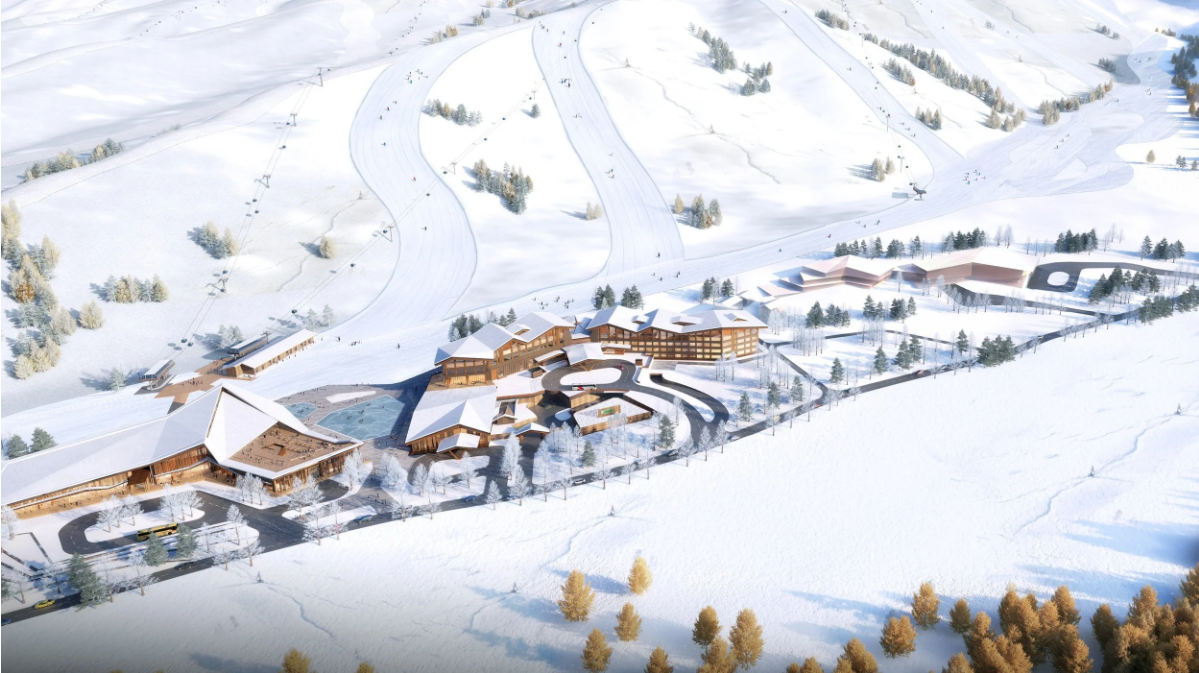
These developments also extend beyond the Altay Mountains to smaller ski areas south of Ürümchi, including Baiyun and Wukesong, consolidating Western hospitality presence across the region. The regional government’s 14th Five-Year Plan (2021–2025) explicitly mentions the Ürümchi Nanshan Resort area as a focus for “tourism resort development projects.”22新疆维吾尔自治区发展和改革委员会 [Xinjiang Uygur Autonomous Region Development and Reform Commission], “新疆维吾尔自治区国民经济和社会发展第十四个五年规划和2035年远景目标纲要” [The 14th Five-Year Plan for National Economic and Social Development and the Outline of Long-Term Goals for 2035 of Xinjiang Uygur Autonomous Region], April 11, 2022, online. The area encompasses two planned IHG hotels, the Holiday Inn Express Urumqi Silk Road Resort23IHG, “Holiday Inn Express Urumqi Silk Road Resort,” n.d., online. and a Crowne Plaza-branded hotel, which will operate in the vicinity of the Silk Road International Ski Resort, south of Ürümchi.
V. Winter Sports Gear and Infrastructure
Following the rapid development of winter sports infrastructure in the Uyghur Region, a growing number of international apparel and equipment companies have also embedded themselves in the local market. Leading international winter sports brands have opened stores and rental outlets in ski resorts and urban centers.
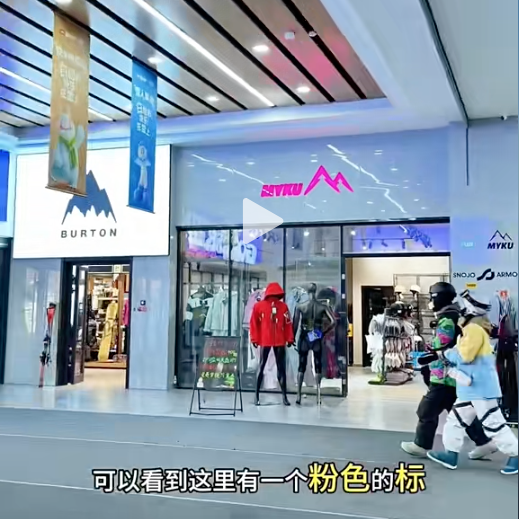
Burton Snowboards, for example, operates two retail stores in the region, one at the Jikepulin International Ski Resort and another at Jiangjunshan Ski Resort. Despite prominently listing physical storefronts around the world on its website, including stores across Asia and mainland China, Burton conspicuously omits the two locations in Altay from its list. Videos from Chinese users on Douyin from early 2026 clearly show the store located at the Jiangjunshan Ski Resort, and Baidu Maps lists both locations prominently.24Baidu Maps, “奈斯BURTON(禾木店),” accessed February 24, 2026, online; and Baidu Maps, “BURTON (将军山雪场店)” accessed February 24, 2026, online. A Chinese state media release also indicates that Burton also operates a store at the Silk Road International Ski Resort, though this could not be corroborated elsewhere.25中国日报网, [China Daily Online],“BURTON持续推动单板滑雪文化深耕中国” [ BURTON continues to promote snowboard culture in China], November 16, 2021, online.
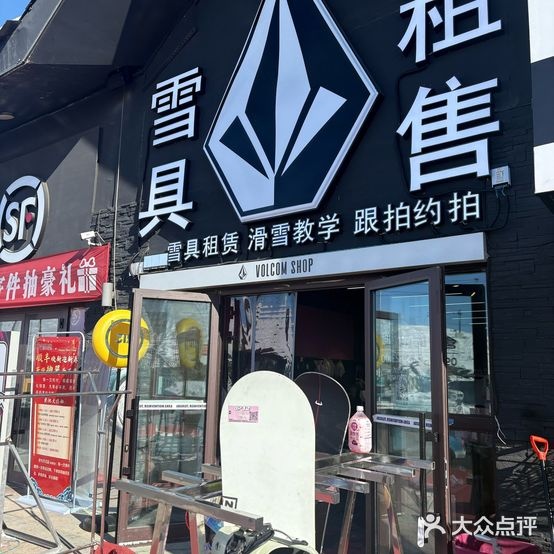
Volcom, a U.S.-based snowboarding brand with a global retail footprint, also maintains a visible commercial presence at Jiangjunshan International Ski Resort, where it operates a branded retail store and rental counter within the resort complex.26Baidu Maps, “Volcom雪具及租赁店(将军山店) accessed February 24, 2026, online. Volcom, although listing five stores in China on its website, omits its Jiangjunshan location.27Volcom, “Retail Stores,” n.d., online.
The Austrian ski company, Fischer, also has two dealers in the Uyghur Region, one at the Jiangjunshan International Ski Resort, and another at the Jikepulin International Ski Resort. Douyin videos posted by Fischer also show Fischer testing a new line of skis at the Keketuohai International Ski Resort.28Fischer Ski Resort, “十一月中,雪季全面来到!清晨在可可托海,享受 RC4 NOIZE ST PRO 在灯芯绒形态的雪道滑行。NOIZE CONTROL 从声乐中带来的智慧启发 #双板滑雪 #FISCHER #NOIZE #次世代RC4 #STpro” [Mid-November marks the full arrival of the ski season! Enjoy a morning in Koktokay, gliding the RC4 NOIZE ST PRO on the corduroy-patterned slopes. NOIZE CONTROL draws inspiration from the wisdom of sound. #Skiing #FISCHER #NOIZE #NextGenerationRC4 #STpro], Douyin, November 13, 2025, online.
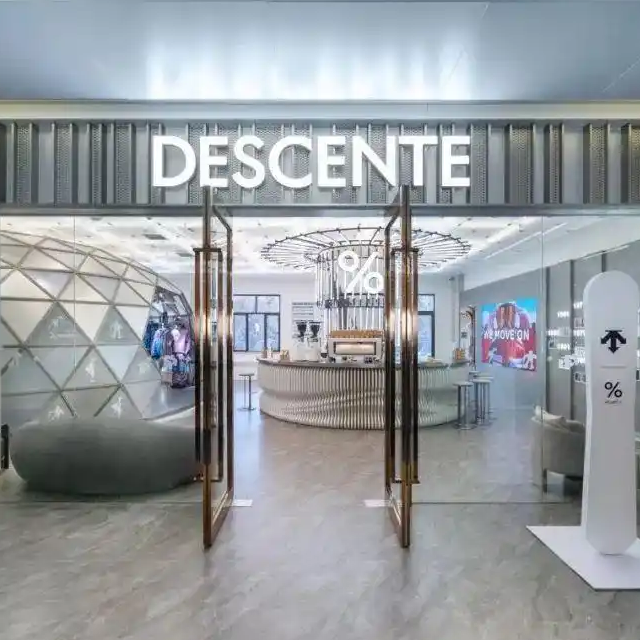
Descente, a Japanese sports clothing and accessories company, operates multiple stores across the region, including one at Jiangjunshan International Ski Resort and another two in Ürümchi. Descente also maintains a partnership with Jiangjunshan, where its logo is displayed prominently on chairlifts and in other areas. The Descente brand is operated in China through a joint venture with its Japanese parent company, Itochu Corporation, and Anta Sports.29Anta holds the majority stake (around 54%). A major investigation last year by Daniel Murphy with The Bureau of Investigative Journalism and journalists at The New York Times and Der Spiegel found that Anta directly owns production sites linked to Uyghur forced labor.30Daniel Murphy, “China’s economy runs on Uyghur forced labour,” The Bureau of Investigative Journalism, May 29, 2025, online.
This is not the first time Chinese apparel companies have been implicated in controversies surrounding winter sports. Ahead of the Beijing 2022 Winter Games, the International Olympic Committee (IOC) released a statement claiming to have conducted “third-party due diligence” on Anta and the Chinese apparel company, Hengyuanxiang Group (HYX Group), who supplied uniforms and other branded products for the Games.31International Olympic Committee, “IOC conducts third-party due diligence on its suppliers for Olympic Winter Games Beijing 2022,” January 19, 2022, online. Human Rights Watch and the Coalition to End Forced Labour in the Uyghur Region pushed back, noting that the IOC’s statement, “contained significant gaps, including inadequate transparency of audit results and lack of analysis of suppliers’ responsible sourcing practices.”32Human Rights Watch, “China: IOC Can’t Ensure Olympic Apparel Is Abuse-Free,” February 14, 2022, online.
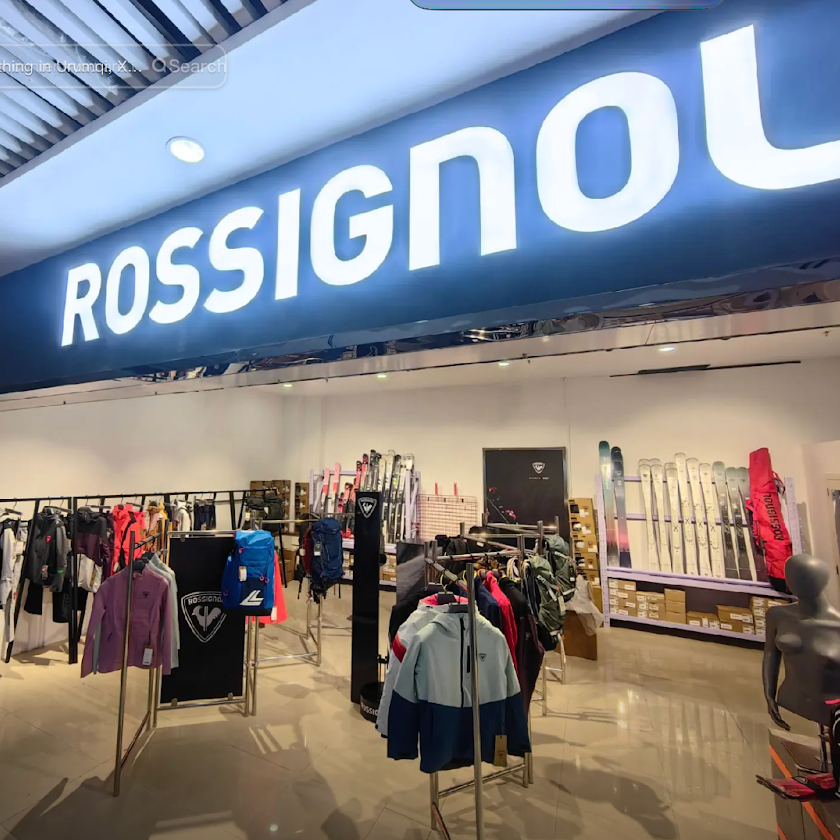
Many other companies have expanded into the Uyghur Region with stores, including Swedish outdoor apparel company, Fjällräven, which has opened at least six stores in Ürümchi.33Fjällräven, “西北 Store Info,” [Northwest Store Info], n.d., online. Similarly, Columbia Sportswear operates four stores in the city; Phenix, a Japanese ski apparel brand, has two; and Rossignol, a French ski equipment manufacturer, opened a store in late 2024 in Ürümchi. Blizzard, an Austrian ski equipment retailer, also operates a store at the Silk Road International Ski Resort.
Notable winter sports brands including Salomon, originally founded in Annecy, France, and Arc’teryx, founded in Vancouver, Canada, have also expanded their presence into the Uyghur Region, though both companies are now owned by Anta Sports. Salomon has opened at least three stores in Ürümchi including at the Huijia Times mall34Baidu Maps, 汇嘉时代广场 (Huijia Times Square), accessed February 24, 2026, online. (opened in 2024),35乌鲁木齐市团委 [Ürümchi Municipal Committee of the Communist Youth League], “2024 年新开 18 家全疆首店,乌鲁木齐人都在买什么?”[What are people in Ürümchi buying when 18 new stores opened in Xinjiang in 2024?], 维信 [Weixin], November 14, 2024, online. CCmall36Baidu Maps, SALOMON萨洛蒙(乌鲁木齐CC MALL店) , accessed February 24, 2026, online. (opened in 2024), and Tianshan Vanke Plaza mall.37Bacaoo.com, “乌鲁木齐萨洛蒙实体店地址,乌鲁木齐萨洛蒙专卖店地址查询” [Salomon physical store address in Ürümchi, Salomon specialty store address search in Ürümchi], May 7, 2024, online. Although Salomon lists all stores across China, the three in Ürümchi are excluded.38Salomon, “Stores in China,” n.d., online. Arc’teryx also operates two stores in Ürümchi, one at the Meimei Shopping Center39Baidu Maps, ARC’TERYX始祖鸟(美美购物中心店), accessed February 24, 2026, online. (opened in 2025),40929文化旅游广播电台 [929 Culture and Tourism Radio], “2025乌鲁木齐首店霸屏!近20家扎堆开,你种草了吗” [Ürümchi’s first stores are dominating headlines in 2025! Nearly 20 are opening in quick succession—are you tempted to check them out?], 维信 [Weixin], February 19, 2025, online. and another at the Huijia Times Department Store41Baidu Maps, ARC’TERYX始祖鸟(汇嘉时代广场店), accessed February 24, 2026, online. (opened in 2024). Similarly, Arc’teryx lists all of its stores in China, but excludes the two locations in the Uyghur Region.42Arc’teryx, “Stores in China,” n.d., online.
VI. Participation in Promotional Events
In December 2024, Descente and Burton, along with Bogner (Germany), Columbia (USA), Gore-Tex (USA), Helly Hansen (Norway), Oakley (USA), and Phenix (Japan), sponsored and participated in a popup promotional event at the Jiangjunshan International Ski Resort with Tmall, China’s largest online marketplace. The three-day promotional event, part of Tmall’s “Super Party Ice and Snow Season,” targeted winter sports tourists, aiming to promote Altay as a winter tourism destination.43Tmall, 天猫超级派对·冰雪季 [Tmall Super Party Ice and Snow Season], Decemebr 18, 2024, online. A poster for the event also includes non-sports or apparel brands like Peet’s Coffee, Lindt, and the skin care brand, Cetaphil, owned by Swiss company Galderma.
Several of the same international brands have also sponsored other winter sports events in the Uyghur Region, further embedding themselves in the Chinese state-led tourism push. In November 2021, Phenix partnered with JD Sports and the Altay Prefecture Bureau of Culture, Sports, Radio, Television and Tourism, a regional government body, to co-host the “Phenix Cup,” a national alpine ski competition at the Keketuohai International Ski Resort. Event materials show that sponsors of the event included Volcom, as well as the French ski equipment manufacturer Rossignol, the American-Austrian winter sports brand HEAD, the Italian ski equipment manufacturer Nordica, the U.S.-based ski apparel brand Spyder, and the Italian sportswear company Colmar.44新浪体育 [Sina Sports], “PHENIX(菲尼克斯)与京东运动,全新联动,完美谢幕!”[ PHENIX and JD Sports: A brand-new collaboration, a perfect farewell!], November 28, 2021, online.
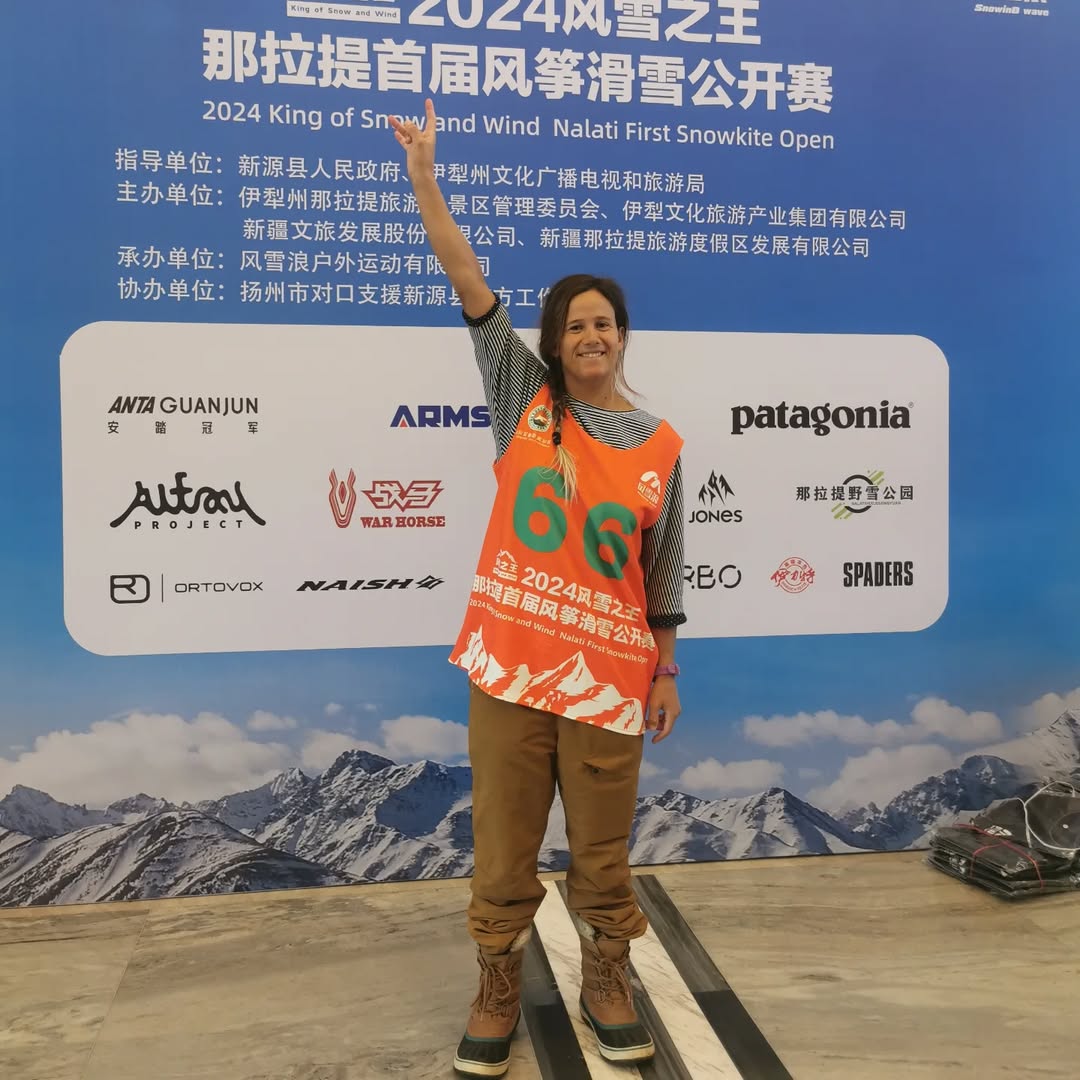
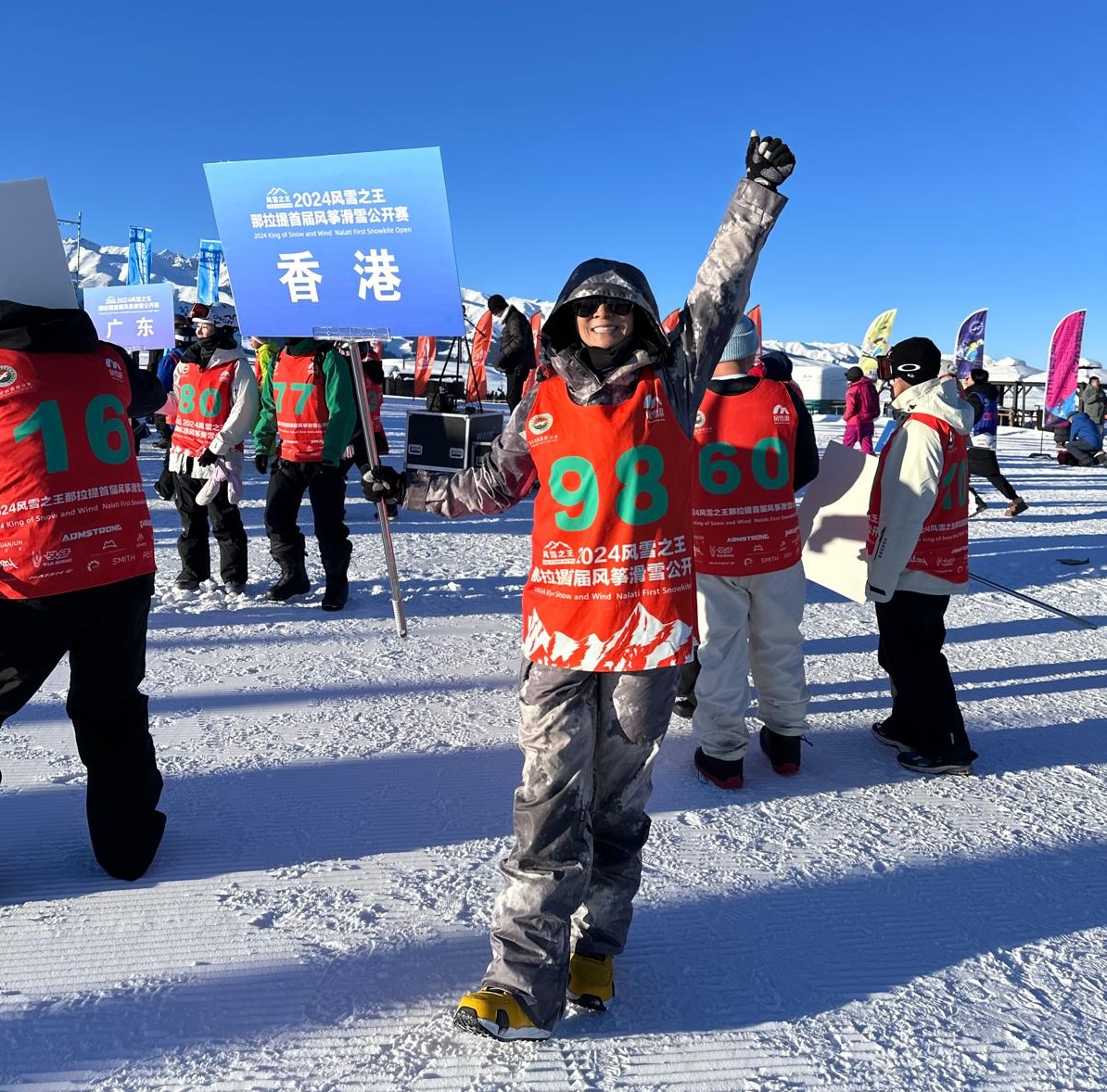
In December 2024, several international brands including Patagonia (USA),45See Patagonia’s response to UHRP in Appendix II. Ortovox (Germany),46See Ortovox’s response to UHRP in Appendix II. Naish (USA), Jones Snowboards (USA), K2 Snowboards (USA), Smith Optics (USA),47Owned by Safilo Group S.p.A., an Italian company. Backcountry Access (USA), Armstrong Foils (USA), and Bombardier Recreational Products (Canada) sponsored the first Nalati Kite Skiing Open (“King of Snow and Wind”) in Ili Prefecture.48Xinhua, “跟着赛事去旅行,2024 年“风雪之王”那拉提首届风筝滑雪公开赛12月28日邀您共赏!”[“Travel with the event! Join us on December 28, 2024 for the inaugural Narat Kite Skiing Open, the ‘King of Snow and Wind’!”], December 27, 2024, online. According to state media, the event was intended to “respond to the national call and promote the integrated development of culture, sports, and tourism in [Ili].”49新华网新疆频道 [Xinhua News Agency Xinjiang Channel], “跟着赛事去旅行,2024 年“风雪之王”那拉提首届风筝滑雪公开赛12月28日邀您共赏!”[Travel with the event! Join us on December 28, 2024 for the inaugural Narat Kite Skiing Open, the ‘King of Snow and Wind’!], December 27, 2024, online. Other Chinese media have noted that the purpose of the event was to “revitaliz[e] tourism businesses,” and construct infrastructure in order to “upgrad[e] winter tourism and create a high-quality tourist destination.”50伊犁零距离 [Yili Zero Distance], “冰雪胜境·魅力伊犁|2024年“风雪之王”那拉提首届风筝滑雪公开赛12月29日开赛” [Ili, a Winter Wonderland: The Inaugural Narat Kite Skiing Open, the “King of Snow and Wind” in 2024, will kick off on December 29th.], 维信 [Weixin], December 19, 2024, online.
Beyond apparel and equipment, other global companies provide key ski infrastructure and engineering services. Ropeway and mountain infrastructure companies such as Poma (France),51Tianshannet, “Booming winter tourism industry in NW China’s Xinjiang,” January 29, 2024, online. Bartholet Maschinenbau Flums (BMF) (Switzerland),52Bartholet Maschinenbau AG, “Happy Easter from Bartholet!…,” Facebook, April 17, 2025, online. and MND (France) have installed gondolas, lifts, and snowmaking systems in multiple ski areas across the Uyghur Region,53MND, “Loisirs outdoor : l’offre globale de MND” [Outdoor leisure: MND’s comprehensive offering], February 25, 2022, online. including in Nalati, where a new 8-seater gondola was built and promoted by BMF in collaboration with the Porsche Design Studio.54bartholet.swiss, “Enjoy the beautiful grassland of Nalati!” Instagram, June 21, 2023, online. TechnoAlpin,55TechnoAlpin, “What a view! Recently the ski resort of Keketuohai…” Facebook, September 30, 2020, online. a major Italian snowmaking company, which has participated in trade fairs56乌鲁木齐晚报 [Ürümchi Evening News],“冰雪盛会中共享发展机遇——第十七届新疆冬季旅游产业交易博览会亮点扫描” [Sharing Development Opportunities Amidst the Ice and Snow Extravaganza: Highlights of the 17th Xinjiang Winter Tourism Industry Trade Fair], December 25, 2023, online. and winter expos57任江 [Ren Jiang], “‘冬博会’ 热雪节” 热流滚滚” [The Winter Expo and the Snow Festival are generating a lot of buzz], 天山网-新疆日报 [Tianshannet-Xinjiang Daily], January 4, 2024, online. in the Uyghur Region, provides snowmaking systems to the Keketuohai International Ski Resort and other ski areas,58乌鲁木齐晚报 [Ürümchi Evening News], “冰雪盛会中共享发展机遇——第十七届新疆冬季旅游产业交易博览会亮点扫描” [Sharing Development Opportunities Amidst the Ice and Snow Extravaganza: Highlights of the 17th Xinjiang Winter Tourism Industry Trade Fair], December 25, 2023, online. according to state media. Austria’s Doppelmayr/Garaventa Group’s China subsidiary also participated in a trade fair in the region in 2024.59Tianshannet, “Booming winter tourism industry in NW China’s Xinjiang,” January 29, 2024, online.
Disney has also established preliminary procurement agreements with multiple ski resorts across the Uyghur Region, and showcased its products at the 2025 Xinjiang Winter Tourism Industry Trade Expo, where Disney characters “were featured on a range of snow sports equipment, including snowboards and ski apparel.”60Ren Jiang, “Disney IP products appear at the 19th Xinjiang Winter Tourism Industry Trade Expo,” Tianshannet, November 18, 2025, online. A company representative explained that their goal is to, “explore opportunities to secure operational rights for ski resorts, develop themed slopes and children’s zones, inject contemporary and trendsetting vitality into Xinjiang’s winter sports industry, and diversify its commercial offerings.”61Ibid.

Western and international ski instruction programs have also established a presence in the Uyghur Region, providing professional training and certification on-site. The Canadian Ski Instructors Alliance advertises opportunities for experienced instructors in China,62Canadian Ski Instructors Alliance, “CSIA International Resellers,” n.d., online. including with SnowSports Unlimited, which teaches courses in the Uyghur Region, according to social media posts.63snowsportsunlimited and xinjie_training, “Keketuohai Super Course in full effect! Just as much fun off the snow!” April 22, 2025, online. The French Club Med Ski Academy also operates in collaboration with Jiangjunshan International Ski Resort.64Tianshanet, “Foreign ski instructors invited to ski resorts in Altay to provide systematic and targeted training,” November 14, 2024, online.
In 2024, Ski Austria, partnering with a Chinese company, delivered a ski coach certification program at the Keketuohai International Ski Resort.65Ibid. Similarly, RADSkier GmbH, headquartered in Graz, Austria, with Snowsports Academy Austria, partnered with Keketuohai International Ski Resort in 202466Zhang Ting and Dong Shiju, “Foreign ski instructors invited to ski resorts in Altay to provide systematic and targeted training,” Shiliuyun-Xinjiang Daily, November 14, 2024, online. and with the Silk Road International Ski Resort in 2025 to provide professional instructor training.67Snowsports Academy Asia, “Partner Introduction | Silk Road Mountain Resort, Xinjiang, China,” LinkedIn, November 2025, online.
VII. Promotion of Leisure and Adventure Tourism
Engagement in infrastructure extends beyond ski areas, reaching other facets of winter leisure tourism, including recreational equipment and adventure sports. The 2025 Xinjiang Winter Tourism Industry Trade Expo, organized with the participation of the regional Department of Culture and Tourism, included Canadian manufacturer Bombardier Recreational Products (officially BRP Inc., a division of Bombardier),68张艳芳 [Zhang Yanfang], “第十九届新疆冬季旅游产业交易博览会全面启动”[ The 19th Xinjiang Winter Tourism Industry Trade Fair has officially commenced], 石榴云/新疆日报 [Shiliuyun/Xinjiang Daily News], November 14, 2025, online. where the company reportedly sold over 200 snowmobiles.69新疆日报 [Xinjiang Daily], “新疆冰雪游的“新”三重奏” [A New Trio for Xinjiang’s Ice and Snow Tourism], January 10, 2026, online. BRP has emphasized expanding sales and cultivating scenic “playgrounds” for riders in China, partnering with authorized dealers across China in an attempt to support “cultural tourism” exploration.70千龙网 [Qianlong.com], “顶尖玩家 巅峰相会 庞巴迪BRP硬核演绎户外动力新风潮” [Top players meet at the pinnacle of performance as Bombardier BRP delivers a new trend in outdoor powertrain technology], October 9, 2024, online.
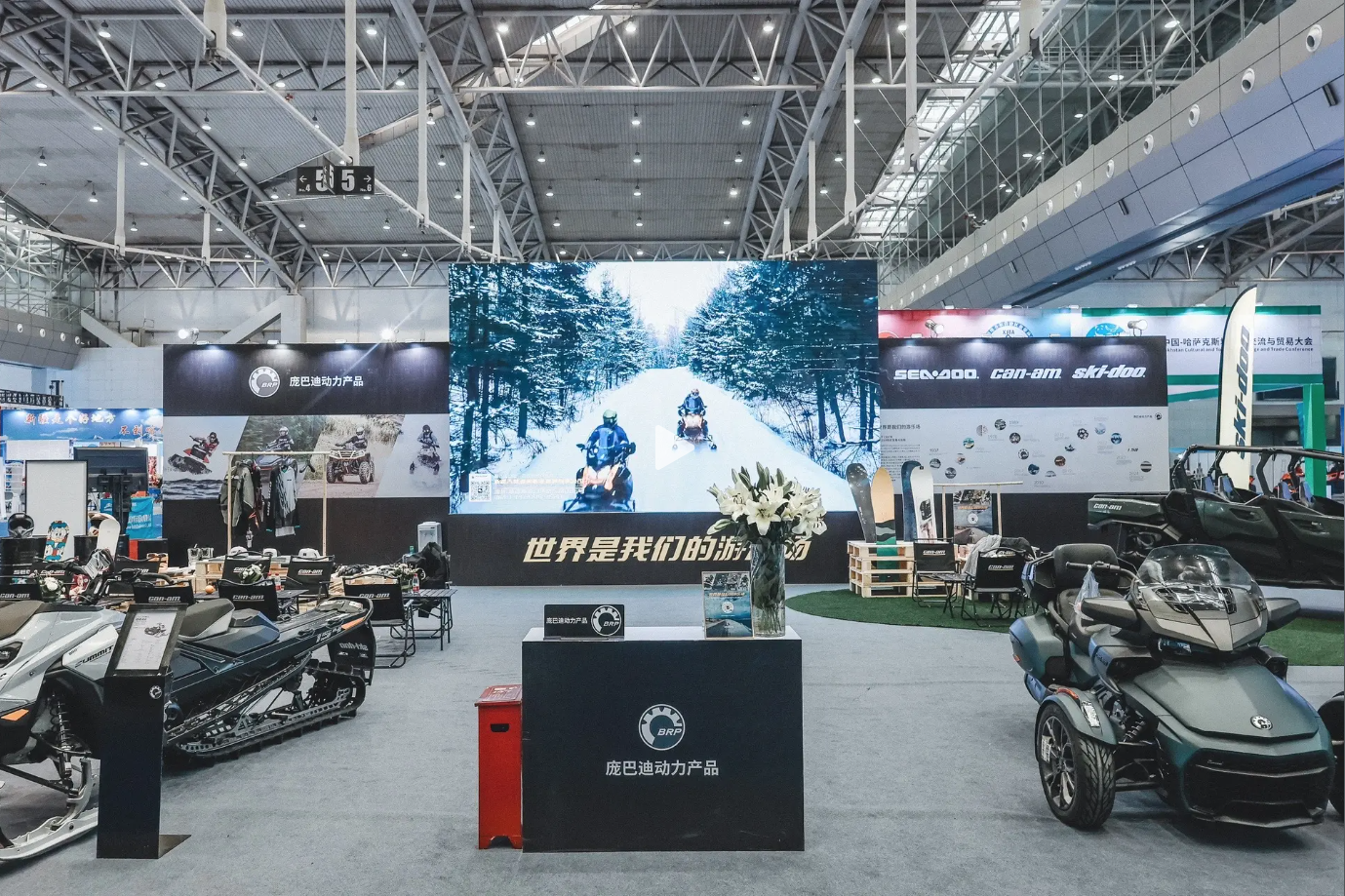
On at least two occasions, BRP has collaborated with Chinese singer, Hao Yun, in marketing events in the Uyghur Region. In a promotional video posted on Douyin, with the caption, “Let’s embark on an original ecological grassland journey,” the singer can be seen driving an ATV from one of BRP’s sub-brands, Can-Am, across the Nalati grasslands in Ili Prefecture.71庞巴迪BRP [Bombardier BRP], “共赴一场原生态的草原之旅…”[ Embark on a pristine grassland adventure…], Douyin, September 11, 2025, online. Another promotional event in the Kalajun Prairies shows the singer riding with a group through the nature park under the theme “Exploring New Ways to Go Wild.”72庞巴迪BRP [Bombardier BRP], 郝云 喀拉峻探索之旅 [Hao Yun’s Karajun Exploration Trip], Billibilli Video, online.
In February 2025 BRP, a major producer of snowmobiles, personal watercraft (PWCs), motorcycles, and ATVs, signed a strategic cooperation agreement with the China Tourism Association.73新浪体育 [Sina Sports], “庞巴迪BRP与中国风景名胜区协会开展战略合作”[Bombardier BRP and China Scenic Area Association Establish Strategic Cooperation], February 24, 2025, online. The agreement reportedly stipulated that the two parties will “work together to promote the deep integration of cultural tourism and outdoor dynamic sports, and drive the high-quality development of outdoor sports in scenic areas.” In 2024, BRP opened what appears to be its only authorized dealership and after-sales service center in Künas County, just west of the Nalati Airport.74Baidu Maps, 新疆庞巴迪动力产品BRP授权4S店 (Xinjiang Bombardier Power Products BRP Authorized 4S Store), accessed February 24, 2026, online.
On January 16, 2026, BRP General Manager Wang Yuan attended a China–Canada Trade and Investment Dinner with Canadian Prime Minister Mark Carney and Vice Premier of the State Council, He Lifeng, promoting bilateral trade and investment between the two countries. During his speech, He Lifeng directly refers to Bombardier75Bombardier Recreational Products (BRP), formerly part of Bombardier Inc., is an independent company. The Beaudier Group, the holding company of the Beaudoin family (descendants of Bombardier founder Joseph-Armand Bombardier), holds a minority economic stake, but maintains majority voting control through BRP’s multiple voting share structure. as a Canadian company developing its business in China.76Canada China Business Council, “CCBC Hosts Prime Minister Carney and Vice Premier He Lifeng in Beijing,” January 20, 2026, online. Wang Yuan has noted that China’s ice and snow tourism is shifting from “sightseeing” to “experience,” creating “a huge market space for top-tier global snow machinery and all-terrain vehicles.” She further notes that BRP will continue to deepen its presence in the Chinese ice and snow market in the future, underscoring the company’s strategic prioritization of China’s winter and outdoor recreation markets.77Ibid.
VIII. Contrast Between Values and Actions
Many apparel brands emphasize strong commitments to human rights and ethical business practices, but these commitments are most often articulated through the lens of supply-chain due diligence.
Burton, Patagonia, and Fenix Outdoor AB (Fjällräven’s parent company), however, are “Fair Labor Accredited Companies” with the Fair Labor Association, whose membership depends on compliance with the UN Guiding Principles on Business and Human Rights (UNGPs).78Fair Labor Association, “Fair Labor Accredited Companies,” n.d., online. The UNGPs require heightened due diligence in high-risk areas, which includes regions experiencing systematic human rights violations. Fjällräven states in its code of conduct that, “We are willing to take in consideration cultural differences and other factors that may vary from country to country, but we will not compromise on our basic requirements regarding safety and human rights.”79Fjällräven, “Fjällräven Code of Conduct,” August 5, 2013, online. Similarly, Descente has pledged to respect human rights in Japan and elsewhere in its operations.80Descente, “Descente Sustainability Policy,” n.d., online.
Patagonia, which sponsored the 2024 Nalati Kite Skiing Open, cited the Fair Labor Association’s March 2020 call81Fair Labour Association, “Forced labor risk in Xinjiang, China,” January 9, 2020, online. for an immediate end to forced labor and other human rights abuses targeting Uyghurs, and released a statement that month noting that they have been, “horrified by what we’ve read in the media regarding a systemic, planned effort to force the country’s population of ethnic minorities into lives of factory work and a program to change their basic beliefs.”82Patagonia, “Patagonia Statement on Xinjiang,” March 12, 2020, online. The statement goes on to say that the persecution of Uyghurs is “an unfolding tragedy the world, at every level, must care about.” Patagonia’s parallel business engagement in the Uyghur Region directly undermines this earlier statement.83The author emailed Patagonia about their sponsorship of the Nalati Kite Skiing Open on February 12, 2026. Patagonia representatives wrote back on February 25, 2026 noting that: “We support outdoor athletes and outdoor apparel stores in China, and we donated jackets and backpacks to be used as prizes for participants in the Nalati Kite Skiing Open, which we acknowledge was a mistake.” See their full response in Appendix II.
Although many apparel and equipment companies present at different levels in the Uyghur Region publicly profess adherence to high standards of human and labor rights conditions in supply chains, considerably less can be found about other forms of business exposure in high-risk regions. This creates a notable gap in transparency and accountability, and opens the door for corporate complicity in human rights abuses.
IX. Conclusion
Each international company noted in this analysis faces various levels of exposure to human rights risks. However, all of the companies present in the regional market benefit commercially from a tourism industry that is closely intertwined with Chinese state-led efforts to “revitalize” and promote the Uyghur Region—a region where UN bodies, tribunals, and leading human rights organizations have documented actions amounting to crimes against humanity and, in some cases, genocide. By embedding themselves in ski resorts, retail spaces, and tourism infrastructure, these firms profit from state-led development designed to project normalcy and prosperity while obscuring ongoing abuses.
Despite clear expectations under the UNGPs for heightened scrutiny in such contexts, there is no public evidence that these companies have taken meaningful steps to assess or mitigate operational human rights risks in the Uyghur Region. When confronted with these findings, companies have largely avoided engagement, exposing a disconnect between stated values and commercial behavior. Many firms should be aware that their presence in the region is ethically fraught, yet continue operations with minimal transparency.
As the Milan–Cortina Winter Games place many of these same brands back in the global spotlight, their growing presence in the Uyghur Region warrants close scrutiny. Craig Smith’s 2022 claim that human rights violations in Xinjiang were “not [his] expertise” increasingly reflects an industry stance: commercial opportunity continues to outweigh accountability, even amid atrocity crimes.
X. Recommendations
- End Participation in State-Led Tourism Promotion. Companies should immediately cease sponsorships, events, marketing campaigns, or partnerships with regional tourism bureaus in the Uyghur Region that support state-led promotions, “ethnic-themed” tourism, or propaganda. Firms must ensure their operations do not contribute to the normalization of human rights abuses, and reassess any ongoing collaborations in the region.
- Ensure Transparency and Accountability in Supply Chains and Business Relationships. Conduct and publish heightened human rights due diligence to determine whether any suppliers, contractors, or business partners are linked to state-imposed forced labor or other human rights violations.
- Recognize Operational Limits in High-Risk Areas. International companies should acknowledge that meaningful human rights due diligence is effectively impossible in the Uyghur Region due to pervasive state surveillance, repression, and documented crimes against humanity. Companies should avoid operations that rely on on-the-ground oversight and refrain from embedding themselves in state-led tourism projects.
- Strengthen Ethical Procurement and Infrastructure Practices. Suppliers of ski and tourism infrastructure should ensure that their products and services are not directly facilitating human rights violations, including coerced labor or the promotion of state-managed cultural narratives, and adopt mitigation strategies where risks are identified.
XI. Appendices
Appendix I.
Click to Expand: Global Winter Sports and Leisure Companies Present in the Uyghur Region
| Company | Operating Retail Store | Operating or Present at Ski Area | Participated in Tourism Promotion Activities | Other Exposure |
| Blizzard (Austria) | ✓ | ✓ | – Retail store at the Silk Road International Ski Resort. | |
| Doppelmayr/Garaventa Group (Austria) | ✓ | – Participated in a trade fair in the Uyghur Region 2024. | ||
| Fischer (Austria) | ✓ | ✓ | – Lists two dealers in the Uyghur Region, one at the Jiangjunshan International Ski Resort, and another at the Jikepulin International Ski Resort. – Douyin videos posted by Fischer also show Fischer testing a new line of skis at the Keketuohai International Ski Resort | |
| HEAD (Austria) | ✓ | – Sponsored the “Phenix Cup,” a national alpine ski competition at the Keketuohai International Ski Resort, in partnership with the Altay Prefecture Bureau of Culture, Sports, Radio, Television and Tourism, a regional government body. | ||
| RADSkier GmbH (Austria) | ✓ | – Partnered with Keketuohai International Ski Resort in 2024 and the Silk Road International Ski Resort in 2025 to provide professional instructor training. | ||
| Snowsports Academy Austria (Austria) | ✓ | – Partnered with Keketuohai International Ski Resort in 2024 and the Silk Road International Ski Resort in 2025 to provide professional instructor training. | ||
| Ski Austria (Austria) | ✓ | – Partnered with a Chinese company to deliver a ski coach certification program at the Keketuohai International Ski Resort. | ||
| Arc’teryx (Canada) | ✓ | – Operates two stores in Ürümchi. – Lists all stores in China, but excludes the two locations in the Uyghur Region. – Owned by Anta Sports. | ||
| Bombardier Recreational Products (Canada) | ✓ | ✓ | – Sponsored the Nalati Kite Skiing Open (“King of Snow and Wind”) in Ili Prefecture, an event which intended to “respond to the national call and promote the integrated development of culture, sports, and tourism in [Ili].” – Participated in the 2025 Xinjiang Winter Tourism Industry Trade Expo, organized with the participation of the regional Department of Culture and Tourism. – Opened an authorized dealership and after-sales service center in Künas County, just west of the Nalati Airport. – Emphasized expanding sales and cultivating scenic “playgrounds” for riders in China, partnering with authorized dealers across China in an attempt to support “cultural tourism” exploration. – Produced a promotional video driving ATVs from one of BRP’s sub-brands, Can-Am, across the Nalati grasslands in Ili Prefecture, as well as a promotional event in the Kalajun Prairies under the theme “Exploring New Ways to Go Wild.” – Signed a strategic cooperation agreement with the China Tourism Association where the parties will “work together to promote the deep integration of cultural tourism and outdoor dynamic sports, and drive the high-quality development of outdoor sports in scenic areas.” | |
| Canada Ski Instructors Alliance (Canada) | ✓ | – Advertises opportunities for instructors in China, including with SnowSports Unlimited, which teaches courses in the Uyghur Region. | ||
| SnowSports Unlimited (Canada) | ✓ | – Teaches ski instructor courses in the Uyghur Region. | ||
| Club Med (France) | ✓ | – Operates ski instructor courses in collaboration with Jiangjunshan International Ski Resort. | ||
| MND (France) | ✓ | – Installed gondolas, lifts, and snowmaking systems in ski areas in the Uyghur Region. | ||
| Poma (France) | ✓ | – Installed gondolas and lifts in ski areas in the Uyghur Region. | ||
| Rossignol (France) | ✓ | ✓ | – Operates a store in Ürümchi. – Sponsored the “Phenix Cup,” a national alpine ski competition at the Keketuohai International Ski Resort, in partnership with the Altay Prefecture Bureau of Culture, Sports, Radio, Television and Tourism, a regional government body. | |
| Salomon (France) | ✓ | – Operates at least three stores in Ürümchi including at the Huijia Times mall, CCmall, and Tianshan Vanke Plaza mall. – Excludes Uyghur Region stores from its website. – Owned by Anta Sports. | ||
| Bogner (Germany) | ✓ | – Sponsored a popup promotional event at the Jiangjunshan International Ski Resort with Tmall, China’s largest online marketplace, targeting winter sports tourists, and aiming to promote Altay as a winter tourism destination. | ||
| Ortovox (Germany) | ✓ | – Sponsored the Nalati Kite Skiing Open (“King of Snow and Wind”) in Ili Prefecture, an event which intended to “respond to the national call and promote the integrated development of culture, sports, and tourism in [Ili].” | ||
| TUI (Germany) | ✓ | – Operates a hotel at the Keketuohai International Ski Resort. | ||
| Nordica (Italy) | ✓ | – Sponsored the “Phenix Cup,” a national alpine ski competition at the Keketuohai International Ski Resort, in partnership with the Altay Prefecture Bureau of Culture, Sports, Radio, Television and Tourism, a regional government body. | ||
| Colmar (Italy) | ✓ | – Sponsored the “Phenix Cup,” a national alpine ski competition at the Keketuohai International Ski Resort, in partnership with the Altay Prefecture Bureau of Culture, Sports, Radio, Television and Tourism, a regional government body. | ||
| TechnoAlpin (Italy) | ✓ | – Participated in trade fairs and winter expos in the Uyghur Region. – Provides snowmaking systems to the Keketuohai International Ski Resort and other ski areas. | ||
| Descente (Japan) | ✓ | ✓ | ✓ | – Operates a store at the Jiangjunshan International Ski Resort and two in Ürümchi. – Maintains a partnership with Jiangjunshan International Ski Resort, where its logo is displayed prominently on chairlifts and in other areas. – Sponsored a popup promotional event at the Jiangjunshan International Ski Resort with Tmall, China’s largest online marketplace, targeting winter sports tourists, and aiming to promote Altay as a winter tourism destination. |
| Phenix (Japan) | ✓ | ✓ | ✓ | – Sponsored the “Phenix Cup,” a national alpine ski competition at the Keketuohai International Ski Resort, in partnership with the Altay Prefecture Bureau of Culture, Sports, Radio, Television and Tourism, a regional government body. – Sponsored a popup promotional event at the Jiangjunshan International Ski Resort with Tmall, China’s largest online marketplace, targeting winter sports tourists, and aiming to promote Altay as a winter tourism destination. |
| Armstrong Foils (New Zealand) | ✓ | – Sponsored the Nalati Kite Skiing Open (“King of Snow and Wind”) in Ili Prefecture, an event which intended to “respond to the national call and promote the integrated development of culture, sports, and tourism in [Ili].” | ||
| Helly Hansen (Norway) | ✓ | – Sponsored a popup promotional event at the Jiangjunshan International Ski Resort with Tmall, China’s largest online marketplace, targeting winter sports tourists, and aiming to promote Altay as a winter tourism destination. | ||
| Fjällräven (Sweden) | ✓ | – Operates six stores in Ürümchi. | ||
| Bartholet Maschinenbau Flums (Switzerland) | ✓ | – Installed gondolas and lifts in ski areas in the Uyghur Region. | ||
| Cetaphil (Switzerland) | ✓ | – Sponsored a popup promotional event at the Jiangjunshan International Ski Resort with Tmall, China’s largest online marketplace, targeting winter sports tourists, and aiming to promote Altay as a winter tourism destination. | ||
| Lindt (Switzerland) | ✓ | – Sponsored a popup promotional event at the Jiangjunshan International Ski Resort with Tmall, China’s largest online marketplace, targeting winter sports tourists, and aiming to promote Altay as a winter tourism destination. | ||
| Backcountry Access (USA) | ✓ | – Sponsored the Nalati Kite Skiing Open (“King of Snow and Wind”) in Ili Prefecture, an event which intended to “respond to the national call and promote the integrated development of culture, sports, and tourism in [Ili].” | ||
| Burton Snowboards (USA) | ✓ | ✓ | ✓ | – Operates two retail stores in the region, one at the Jikepulin International Ski Resort and another at Jiangjunshan Ski Resort, and omits these locations from its website. – Sponsored a popup promotional event at the Jiangjunshan International Ski Resort with Tmall, China’s largest online marketplace, targeting winter sports tourists, and aiming to promote Altay as a winter tourism destination. |
| Columbia Sportswear (USA) | ✓ | ✓ | – Sponsored a popup promotional event at the Jiangjunshan International Ski Resort with Tmall, China’s largest online marketplace, targeting winter sports tourists, and aiming to promote Altay as a winter tourism destination. | |
| Disney (USA) | ✓ | – Attended the 2025 Xinjiang Winter Tourism Industry Trade Expo. – Established preliminary procurement agreements with multiple ski resorts across the Uyghur Region. – Disney intends to, “explore opportunities to secure operational rights for ski resorts, develop themed slopes and children’s zones, inject contemporary and trendsetting vitality into Xinjiang’s winter sports industry, and diversify its commercial offerings.” | ||
| Gore-Tex (USA) | ✓ | – Sponsored a popup promotional event at the Jiangjunshan International Ski Resort with Tmall, China’s largest online marketplace, targeting winter sports tourists, and aiming to promote Altay as a winter tourism destination. | ||
| Hyatt (USA) | ✓ | – Operates a hotel, the UrCove Altay, adjacent to the Jiangjunshan International Ski Resort. | ||
| Hilton (USA) | ✓ | – Operates a dual-branded hotel (Conrad Altay Hemu Ski Resort, Canopy by Hilton Altay Hemu Ski Resort, and Hilton Hemu Ski Resort) at the Jikepulin International Ski Resort. | ||
| Jones Snowboards (USA) | ✓ | – Sponsored the Nalati Kite Skiing Open (“King of Snow and Wind”) in Ili Prefecture, an event which intended to “respond to the national call and promote the integrated development of culture, sports, and tourism in [Ili].” | ||
| K2 Snowboards (USA) | ✓ | – Sponsored the Nalati Kite Skiing Open (“King of Snow and Wind”) in Ili Prefecture, an event which intended to “respond to the national call and promote the integrated development of culture, sports, and tourism in [Ili].” | ||
| Marriott (USA) | ✓ | – Plans to open two hotels in Altay, the Four Points by Sheraton Altay City, and one other unnamed hotel. | ||
| Naish (USA) | ✓ | – Sponsored the Nalati Kite Skiing Open (“King of Snow and Wind”) in Ili Prefecture, an event which intended to “respond to the national call and promote the integrated development of culture, sports, and tourism in [Ili].” | ||
| Oakley (USA) | ✓ | – Sponsored a popup promotional event at the Jiangjunshan International Ski Resort with Tmall, China’s largest online marketplace, targeting winter sports tourists, and aiming to promote Altay as a winter tourism destination. | ||
| Patagonia (USA) | ✓ | – Sponsored the Nalati Kite Skiing Open (“King of Snow and Wind”) in Ili Prefecture, an event which intended to “respond to the national call and promote the integrated development of culture, sports, and tourism in [Ili].” | ||
| Peet’s Coffee (USA) | ✓ | – Sponsored a popup promotional event at the Jiangjunshan International Ski Resort with Tmall, China’s largest online marketplace, targeting winter sports tourists, and aiming to promote Altay as a winter tourism destination. | ||
| Smith Optics (USA) | ✓ | – Sponsored the Nalati Kite Skiing Open (“King of Snow and Wind”) in Ili Prefecture, an event which intended to “respond to the national call and promote the integrated development of culture, sports, and tourism in [Ili].” | ||
| Spyder (USA) | ✓ | – Sponsored the “Phenix Cup,” a national alpine ski competition at the Keketuohai International Ski Resort, in partnership with the Altay Prefecture Bureau of Culture, Sports, Radio, Television and Tourism, a regional government body. | ||
| Volcom (USA) | ✓ | ✓ | ✓ | – Operates a store at the Jiangjunshan International Ski Resort, and omits this location from its website. Sponsored the “Phenix Cup,” a national alpine ski competition at the Keketuohai International Ski Resort, in partnership with the Altay Prefecture Bureau of Culture, Sports, Radio, Television and Tourism, a regional government body. |
Appendix II.
Click to Expand: Official Replies from Companies
Fjällräven (Sweden)
1. Beyond its retail stores, what other operations, business relationships, or supply-chain activities does Fjällräven have, or has it had, in the Xinjiang Uyghur Region?
- Next to our sales distribution, Fjällräven is not aware of any other supply chain activities in that particular region.
2. What human rights due diligence has Fjällräven conducted to identify and address risks associated with operations, sourcing, or business relationships connected to Xinjiang?
- Since Fjällräven belongs to the Fenix Outdoor Group, it follows Fenix Outdoor’s human rights due diligence approach and aligns with the Fair Labor Association standards and our Supplier Code of Conduct, which prohibits forced labor. Given the heightened forced‑labor risk associated with Xinjiang, we adopted a precautionary approach in 2020: we do not approve manufacturing in Xinjiang for Fjällräven products and require suppliers to confirm—contractually and in writing—that production is not placed there, including through unauthorized subcontracting.
- To identify and address risks, we apply a risk‑based supplier assessment and ongoing monitoring, and where relevant we request traceability information and supporting documentation for key inputs. If we identify indications of elevated risk or insufficient evidence, we escalate the case with the supplier, require corrective actions and verification, and we may suspend or exit the business relationship
3. Does Fjällräven have policies or plans governing disengagement from regions where crimes against humanity or genocide are credibly documented? If so, how have these been applied in practice?
- Fjällräven does not operate with a single ‘genocide list’ of countries, but we do have a structured approach for high‑risk contexts and disengagement decisions. Under The Fenix Way, we run an internal approval process for business partners and countries: an internal list of red flags and approved partners/countries is maintained and frequently reassessed, and only approved countries and partners are allowed for Fenix Outdoor endeavors.
- If credible sources point to severe human rights risks in a region and we cannot prevent or mitigate those risks with meaningful leverage, we will not place business there and we may suspend or end the relationship. Our Supplier Code of Conduct requires corrective actions for non‑compliance, and repeated or unremedied violations can lead to early termination of contracts. Where disengagement is necessary, we commit to follow Fair Labor Association (FLA) recommendations when exiting a factory to mitigate adverse impacts on workers.
- In practice, we have applied this precautionary approach by restricting production placement in high‑risk regions and by putting business relationships on hold where partners do not demonstrate sufficient responsiveness and commitment to our requirements.
Ortovox (Germany)
1. Is Ortovox engaged in other business relationships in Xinjiang?
- ORTOVOX does not source products from Xinjiang. We monitor our supply chain carefully and publish our production facilities transparently via Open Supply Hub. Our most recent factory list (link: https://opensupplyhub.org/facilities?contributors=5944&sort_by=contributors_desc) confirms that we do not have production facilities in Xinjiang. We are committed to supply chain transparency and ongoing monitoring of our production partners in line with internationally recognized human rights standards.
2. What human rights due diligence has Ortovox conducted to identify and address risks associated with business relationships connected to Xinjiang?
- ORTOVOX is a member of the Fair Wear Foundation and is classified as a “Leader” brand in recognition of our human rights due diligence efforts at Tier 1 level. In addition, we have developed a comprehensive Tier 2 Monitoring Concept (link) to strengthen upstream supply chain oversight. This framework supports systematic risk assessment and prioritization and is available as an open-source resource so it can be used by other brands as well. We conduct structured risk scoping for our Tier 2 suppliers to allocate financial resources to areas with the highest potential human rights risks. As ORTOVOX does not source from Xinjiang, the region is not part of our current supply chain footprint.
3. Does Ortovox have policies or plans governing disengagement from regions where crimes against humanity or genocide are credibly documented?
- ORTOVOX does not maintain a region-based disengagement policy. However, we take concerns raised by civil society organizations seriously and are currently reviewing our governance approach in this regard.
- Regarding the 2024 Nalati Kite Skiing Open, our understanding is that local activities were supported by our distribution partner in China. As a mountain safety brand, ORTOVOX’s mission is to protect mountaineers by promoting avalanche awareness and safety education. Where safety trainings are conducted, they are intended to strengthen responsible mountain practices and risk awareness.
Patagonia (USA)
We take human rights seriously—it’s core to who we are as a company. We have reviewed multiple reports identifying credible evidence of forced labor and human rights violations, including those from the United Nations Office of the High Commissioner for Human Rights. We have engaged with independent experts for several years now, including the Uyghur Human Rights Project, which we hold in high regard. In accordance with guidance from the Fair Labor Association, we exited fiber sourcing and manufacturing in Xinjiang in 2020. The policy remains in effect. We support outdoor athletes and outdoor apparel stores in China, and we donated jackets and backpacks to be used as prizes for participants in the Nalati Kite Skiing Open, which we acknowledge was a mistake. We agree with the concerns raised by the Uyghur Human Rights Project. Supporting this event undermined our commitment to human rights. As a result, we are revising our internal policies to prevent any association with events that are misaligned with our brand.
The following companies did not return our requests for comment:
Blizzard (Austria)
Doppelmayr/Garaventa Group (Austria)
Fischer (Austria)
HEAD (Austria)
RADSkier GmbH (Austria)
Snowsports Academy Austria (Austria)
Ski Austria (Austria)
Arc’teryx (Canada)
Bombardier Recreational Products (Canada)
Canada Ski Instructors Alliance (Canada)
SnowSports Unlimited (Canada)
Club Med (France)
MND (France)
Poma (France)
Rossignol (France)
Salomon (France)
Bogner (Germany)
TUI (Germany)
Nordica (Italy)
Colmar (Italy)
TechnoAlpin (Italy)
Descente (Japan)
Phenix (Japan)
Armstrong Foils (New Zealand)
Helly Hansen (Norway)
Bartholet Maschinenbau Flums (Switzerland)
Cetaphil (Switzerland)
Lindt (Switzerland)
Backcountry Access (USA)
Burton Snowboards (USA)
Columbia Sportswear (USA)
Disney (USA)
Gore-Tex (USA)
Hyatt (USA)
Hilton (USA)
Jones Snowboards (USA)
K2 Snowboards (USA)
Marriott (USA)
Naish (USA)
Oakley (USA)
Peet’s Coffee (USA)
Smith Optics (USA)
Spyder (USA)
Volcom (USA)
XII. About the Author
Peter Irwin is the Associate Director for Research and Advocacy at the Uyghur Human Rights Project. He leads the organization’s communication strategy, advocacy at the UN and other multilaterals, and engages with governments and civil society. He has authored and edited numerous human rights reports as well as opinion articles for Foreign Policy, The Guardian, The Independent, and other publications. His research has been cited in the BBC, Financial Times, Associated Press, and other outlets.
XIII. Acknowledgements
The author would like to thank UHRP Research Director, Dr. Henryk Szadziewski, for his research contributions and substantive reviews of earlier drafts of the report, as well as UHRP Program Assistant, Adaire Criner, for proofreading and editing.
© 2026 Uyghur Human Rights Project. Please share materials freely, with appropriate attribution, under Creative Commons Attribution 4.0 International (CC BY 4.0).
Redirected Risk: Uyghur Forced Labor and the Enforcement Gap in Australia and Japan
Whitewashing Winter Tourism: Global Sports and Leisure Industry Risks in the Uyghur Region
Fading Ties: Uyghur Family Separation as a Tool of Transnational Repression
Manifest Risk: New “Air Silk Road” Cargo Flights Carry Risk of Uyghur Forced Labor into Europe
FEATURED VIDEO
Atrocities Against Women in East Turkistan: Uyghur Women and Religious Persecution
Watch UHRP's event marking International Women’s Day with a discussion highlighting ongoing atrocities against Uyghur and other Turkic women in East Turkistan.