A Uyghur Human Rights Project report by Dr. Henryk Szadziewski. Read our press statement on the report, download the full briefing in English, and read a printable, one-page summary of the report.
Read coverage of the report in The New Humanitarian.

I. Key Takeaways
- The Chinese government employs family separation and enforced isolation as deliberate strategies to suppress international advocacy and impose psychological pressure on the Uyghur diaspora.
- The Chinese government has systematically disrupted communication between Uyghur diaspora members and their families in East Turkistan through surveillance, coercion, and intimidation, resulting in prolonged disconnection for a decade or longer in some cases.
- The emotional and psychological toll includes unresolved grief, intergenerational trauma, and isolation from cultural expression.
- Chinese state-enforced restrictions on travel for Uyghurs in China and Uyghur diaspora members further obstruct family reunification.
II. The Human Cost of Broken Family Ties
“As for the problem of the lack of contact between the overseas Chinese of Xinjiang nationality and their relatives in Xinjiang, the freedom of communication of Chinese citizens is protected by law.”
– Elijan Anayat, Spokesperson of the People’s Government of the Xinjiang Uyghur Autonomous Region, June 2021.1Embassy of the People’s Republic of China in the United States of America, “The 11th Press Conference by Xinjiang Uygur Autonomous Region on Xinjiang-related Issues in Beijing,” June 20, 2021, online.
Chinese state media has shaped a narrative that foregrounds stability, modernization, and flourishing cultures in the Uyghur Region as a result of government policies.2Henryk Szadziewski and Anonymous, Meet the New Uyghurs: CGTN’s Role in Media-Washing Genocide, Uyghur Human Rights Project, December 21, 2021, online. This discourse exists despite evidence the Chinese state is committing genocide and crimes against humanity targeting Uyghurs and other Turkic peoples.3Rian Thum, “Eight Years On, China’s Repression of the Uyghurs Remains Dire,” Simon-Skjodt Center for the Prevention of Genocide, United States Holocaust Memorial Museum, February 2025, online. As part of promoting the Uyghur Region as open for tourism and investment,4Peter Irwin and Henryk Szadziewski, “It Does Matter Where You Stay: International Hotel Chains in East Turkistan,” Uyghur Human Rights Project, April 17, 2025, online; Henryk Szadziewski, “Genocide Tours: International Travel Companies in East Turkistan,” August 30, 2023, Uyghur Human Rights Project, online. state officials claim that Uyghurs are free to contact their relatives overseas.5Embassy of the People’s Republic of China in the United States of America, “2nd Press Conference by Xinjiang Uygur Autonomous Region on Xinjiang-Related Issues; Chinese Embassy in the United States,” January 13, 2021, online; Embassy of the People’s Republic of China in the United States of America, “11th Press Conference by Xinjiang Uygur Autonomous Region on Xinjiang-Related Issues,” June 20, 2021, online; Embassy of the People’s Republic of China in the United Kingdom, “Embassy Spokesperson’s Letter to BBC on Its Report about Xinjiang,” August 4, 2023, online; China Daily Hong Kong, “Rumors about human rights status in Xinjiang, debunked,” July 3, 2020, online. However, this research finds that contact between Uyghur family members is far from open, and state actions, often going back decades, continue to deny normal communications.6Umar Farooq, “Uighurs Abroad Cut Off from Relatives in Chinese Detention,” Los Angeles Times, September 17, 2018, online; Shohret Hoshur and Richard Finney, “Uyghur Man Draws 15-Year Prison Term for Contacting Uncles Overseas,” Radio Free Asia, September 8, 2021, online; Amnesty International, “The Nightmare of Uighur Families Separated by Repression,” March 19, 2021, online; Cate Cadell, “Overseas Uyghurs struggle to locate relatives in Xinjiang prisons,” Reuters, September 21, 2021, online.
Beginning in 2016–17 and accelerating sharply through 2018–19, Uyghurs abroad experienced a sudden and near-total collapse in communication with relatives in the Uyghur Region as the Chinese government expanded surveillance, mass detention, and transnational repression. Dr. Memet Imin, a New York-based scholar who researches the effects of family separation on the Uyghur diaspora, documented a dramatic decline in communication between 2016 and 2019, estimating that about 70 percent of Uyghurs in the United States lost contact with their families.7Dr. Memet Imin, in discussion with the author, November 4, 2025.
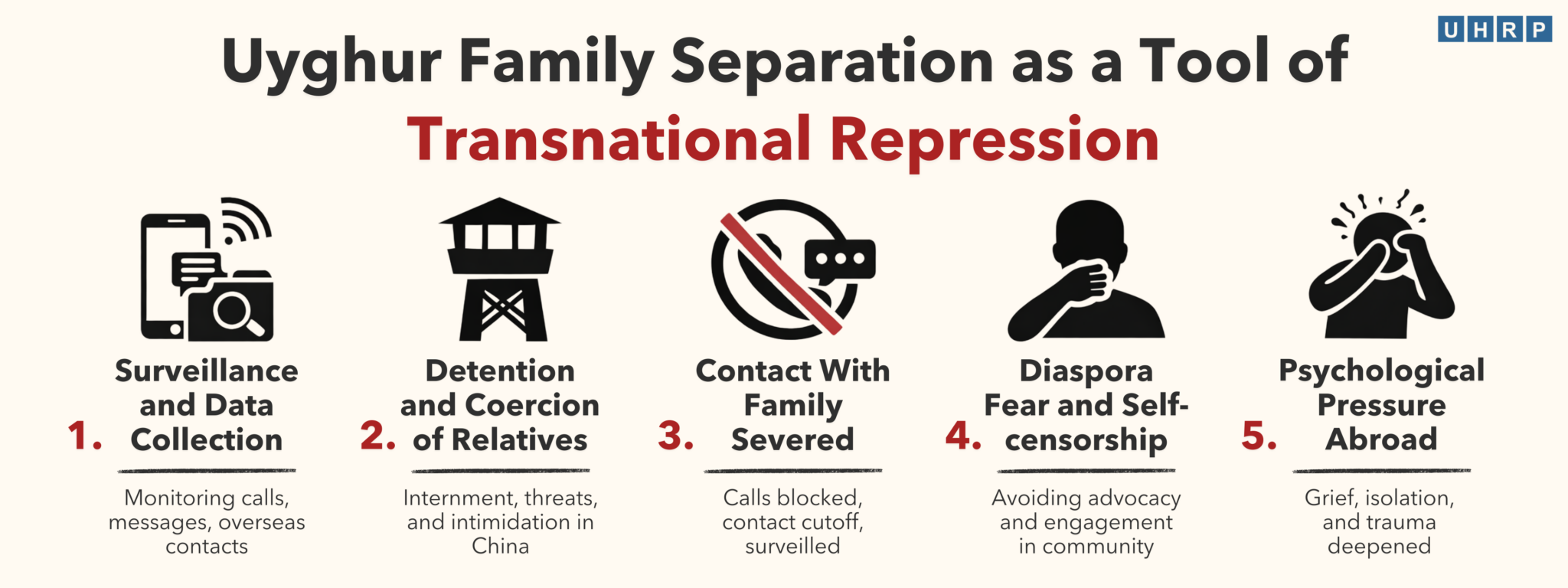
Media reporting from 2018 to 2019 reflects the same pattern. In 2018, Mahmut, a Uyghur living in Scandinavia, told Foreign Policy that following the detention of family members his parents became too afraid to speak to him on the phone beginning in 2017.8Martin de Bourmont, “China’s Campaign Against Uighur Diaspora Ramps Up,” Foreign Policy, April 3, 2028, online. Further testimonies confirm how communication was progressively shut down. In 2019, The Guardian described Uyghur families abroad who could no longer reach relatives despite Chinese government claims that their detained relatives had been “released.”9Kate Lyons, “‘This isn’t true’: Uighur families angered by China claim relatives freed,” The Guardian, August 1, 2019, online. By 2018–19, fear had turned ordinary family communication into a source of risk, leaving many Uyghurs abroad with no knowledge of whether their parents, siblings, or children were safe, detained, or even alive. This abrupt collapse in family communication was not merely a domestic consequence of repression within China, but formed part of a broader pattern of transnational repression, in which the Chinese government’s actions inside the Uyghur Region were deliberately designed to intimidate, silence, and control Uyghurs living abroad.
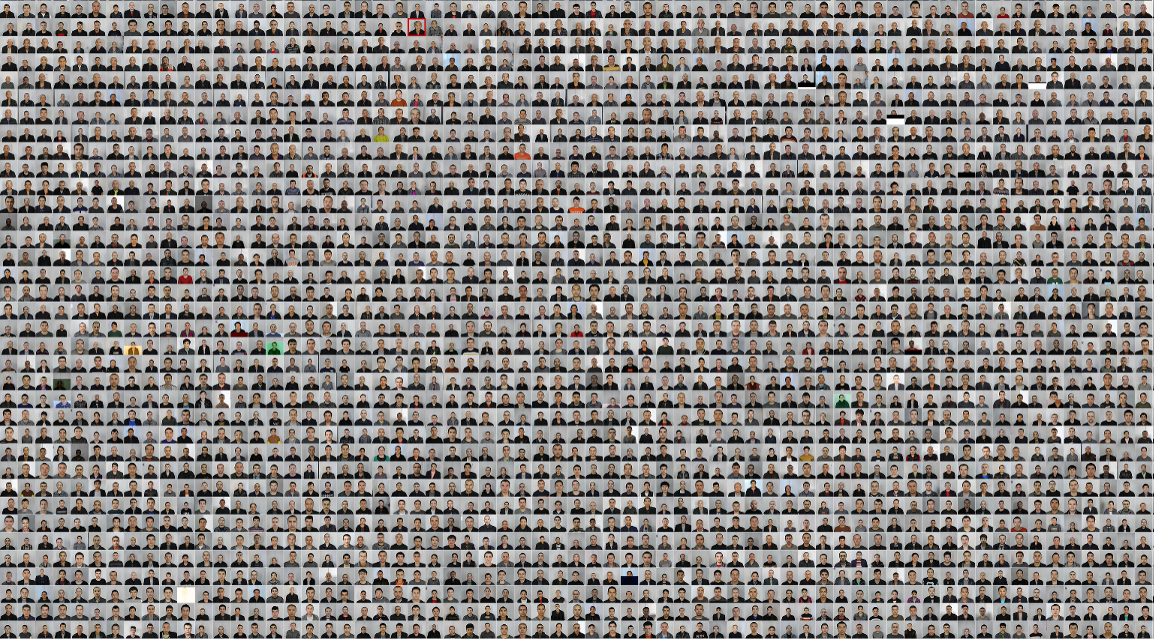
Chinese state retaliation is a major factor in Uyghurs’ decision to not contact relatives outside of China. In 2020, a leaked Chinese government database cited Uyghurs’ “overseas communications” with relatives as a cause for internment.10Elise Anderson, Nicole Morgret, and Henryk Szadziewski, “‘Ideological Transformation’: Records of Mass Detention from Qaraqash, Hotan,” Uyghur Human Rights Project, February 18, 2020, online. Similarly, between 2018 and 2025, Amnesty International and Human Rights Watch reported that Uyghurs living abroad feared contacting relatives in the region, knowing that doing so could expose their family members to state retaliation.11Amnesty International, “Up to one million detained in China’s mass ‘re-education’ drive,” September 24, 2018, online; Human Rights Watch, “‘Break Their Lineage, Break Their Roots’: China’s Crimes against Humanity Targeting Uyghurs and Other Turkic Muslims,” April 19, 2021, online; Yalkun Uluyol, “China: Travel for Uyghurs Heavily Restricted,” Human Rights Watch, February 3, 2025, online. As of October 2025, the Xinjiang Victims Database, an independent documentation project that compiles verified testimonies and evidence of Uyghur and other Turkic peoples’ detentions, disappearances, and rights abuses, lists 8,228 individuals with relatives or friends overseas. Among them, in 304 cases, the reason for detention in camps is explicitly recorded as “having relatives abroad.” The database also notes that 1,414 individuals have not been heard from for more than a year, underscoring the enduring communication blackout imposed by Chinese authorities.12Xinjiang Victims Database, accessed October 2, 2025, online.
By 2018–19, fear had turned ordinary family communication into a source of risk, leaving many Uyghurs abroad with no knowledge of whether their parents, siblings, or children were safe, detained, or even alive.
This report examines the impact of family separation imposed by the Chinese government on Uyghurs living in the diaspora, highlighting the experiences of individuals who have been unable to communicate with close relatives in East Turkistan for years, sometimes decades. Interviews and corroborating media and NGO accounts reveal that to this day Chinese state authorities employ systematic measures to disrupt familial bonds, including surveillance, detention, coercion, controlled communications, and denial of travel documents. Despite Chinese government claims to the contrary, families are prevented from normal communications both directly, through intimidation and monitored calls, and indirectly, through fear of reprisals for attempting to maintain contact. The testimonies consistently demonstrate that this is a deliberate strategy designed to isolate Uyghurs, suppress advocacy abroad, and exert psychological pressure to coerce compliance.
The loss of contact has profound emotional, social, and cultural consequences. Interviewees report long-term grief over missed family milestones, delayed news of deaths or marriages, and trauma potentially transmitted across generations, particularly affecting children who grow up without connections to grandparents or extended families. Media and NGO accounts reinforce these findings, documenting the additional obstacles posed by travel restrictions, which undermines diaspora efforts to contact relatives.
The separation of Uyghur families is neither incidental nor temporary, but rather a deliberate strategy of transnational repression.
This report underscores that the separation of Uyghur families is neither incidental nor temporary, but rather a deliberate strategy of transnational repression. The denial of communication rights violates international human rights standards, including the right to family life and privacy as recognized under the International Covenant on Civil and Political Rights (ICCPR). International attention, advocacy, and targeted interventions are critical to mitigating the ongoing psychological and social harms inflicted on Uyghur communities abroad.
III. Six Diaspora Testimonies
“Chinese government officials say people like me have betrayed China; however, it is these officials that have betrayed us. They betrayed their own humanity.”
– Yusup, July 2025.
This report presents the experiences of six Uyghurs in the diaspora, Perhat, Ablajan, Enver, Yusup, Meryem, and Reyhangül, who have been unable to communicate with close family members in East Turkistan since 2016–18, and one of them for nearly three decades. Their testimonies illustrate the systemic nature of enforced family separation, restrictions on communication, and the psychological and social consequences of these practices. The author gathered accounts through semi-structured interviews in 2025.
(i) Family Ties in the Homeland
For all interviewees, family ties in East Turkistan remain central to their lives, even as repression has turned these connections into sources of fear and uncertainty. Perhat’s parents, brother, uncle, and grandmother were all in Ghulja when he last spoke with his mother in 2018; she was detained that same year and spent six years in a camp before being released in 2024. Ablajan’s parents, sister, and brother also remain in Khotan, as do Enver’s mother and two brothers. He left for Turkey two decades ago.
For Yusup, the stakes are also high as his entire immediate family—his parents, younger brother, and younger sister—still live in Kashgar, and many of them are currently in detention. Meryem, whose mother and siblings now live outside the Uyghur Region, remains closely connected to extended relatives in Ürümchi, including her mother’s brother, sister-in-law, and cousins. Reyhangül’s family, too, has long been affected by state repression. Her two sisters and two brothers continue to live in Ghulja, and one brother was detained in 1998 and given a life sentence the following year on falsified charges.
Together, these ties illustrate how deeply each individual remains connected to family members who continue to live, often precariously, within the region.
(ii) Last Communication
For all interviewees, the loss of contact with relatives began no earlier than 2016, except in one case where communication was severed in 1998. These last communications were shaped by fear of state repercussions, such as internment of family members in East Turkistan, as well as by state coercion and intimidation. For Perhat, unfettered contact with his family ceased in January 2018. Soon after, his mother was detained and other relatives were coerced into monitored calls that functioned less as connection than as instruments of state intimidation. Ablajan’s last conversations with his parents and siblings occurred in 2017, ending when his mother explicitly instructed him not to call again, fearing that any communication could result in punishment for the family members remaining in East Turkistan.
[Enver] last spoke with his mother and brothers in February 2017, when Chinese security services approached him abroad with an offer; they would arrange a family reunion in a third country in exchange for information about the Uyghur diaspora.
Enver’s experience highlights the transnational dimension of China’s coercion. He last spoke with his mother and brothers in February 2017, when Chinese security services approached him abroad with an offer; they would arrange a family reunion in a third country in exchange for information about the Uyghur diaspora. Enver recalled, “I rejected them.” The episode demonstrates how contact with relatives has become entangled with coercive demands. Yusup lost contact in early 2018, shortly after his family returned from Malaysia, when mass arrests in East Turkistan cut even indirect lines of communication. Since then, he has relied solely on occasional images appearing on social media to know anything about his loved ones.
Meryem last communicated with relatives in East Turkistan during a family reunion in Turkey in 2016; since then, all contact has been severed. In some cases, separation stretches back decades. Reyhangül’s family faced persecution long before the intensification of state repression in 2017. She last saw her imprisoned brother in 1993 and spoke to him for the final time in 1998. Her last communications with her older sister were in 2015, with her younger sister in 2016, and with her second brother in 2012, who instructed her not to call him anymore.
(iii) Deliberate State Disruption of Family Life
Across the testimonies, a clear pattern emerges: the disconnection between Uyghurs abroad and their families is not incidental, but the result of direct, deliberate state intervention. Perhat recalls that police actively blocked communication as a form of psychological pressure and to weaken family cohesion. In 2020, he reports, his father and brother were forced to call him only to relay scripted messages from Ghulja police, explicitly urging him to remain silent. Similarly, Ablajan describes his mother’s warnings in 2017 about constant surveillance in their home, noting that even years later, indirect communication continued to provoke state scrutiny. In 2025, his father-in-law in Khotan was questioned by security agents after a seemingly innocuous exchange.13Radio Free Asia has reported on instances of Uyghurs facing retaliatory state actions due to contact with relatives overseas, including long prison sentences. Imanem Nesrulla and Ayhan Memet received 15 years and Yalkun Isa received 20 years. Eli Juma was interned in a camp for speaking to two of his uncles. See: Shohret Hoshur, “China sentences mother of Uyghur Dutch airman to 15 years for visiting him abroad,” Radio Free Asia, November 17, 2022, online; Shohret Hoshur, “Brother of ex-World Uyghur Congress president serving 20-year sentence in Xinjiang,” Radio Free Asia, February 28, 2025, online; Shohret Hoshur and Richard Finney, “Uyghur Man Draws 15-Year Prison Term for Contacting Uncles Overseas,” Radio Free Asia, September 8, 2021, online.
Enver’s account of a Chinese state attempt at coercion in 2017, in which security agents approached him abroad offering a reunion with relatives in a third country in exchange for reporting on diaspora activities, reflects a strategy of leveraging familial bonds to suppress dissent. “The Chinese government uses our families to put psychological pressure on Uyghurs, to keep us quiet,” he said. His refusal to comply led Chinese authorities to sever his contact with his family. Yusup similarly observes that the arrests of his relatives beginning in 2018 and the systematic disruption of communication serve a dual purpose; to silence him overseas and to prevent advocacy from reaching loved ones. “If I call my family, there will be problems,” he said.
Uyghurs living abroad also avoid indirect or mediated forms of communication with family members due to fear of repercussions. Meryem explains that her family in the United States fears making any connection at all, concerned that even minimal communication could provoke punitive measures against relatives in Ürümchi. Reyhangül reports extensive surveillance of her family in Ghulja, including frequent police visits and monitoring of the few calls she could make. She notes that the state views her family as politically suspect due to past activism, demonstrating how prior engagement with civic or cultural work can exacerbate the risks of contact.
“The Chinese government uses our families to put psychological pressure on Uyghurs, to keep us quiet.”
Taken together, these accounts illustrate a systematic strategy. Chinese authorities deliberately exploit familial relationships as instruments of intimidation, a pattern seen in other vulnerable communities, such as Tibetans.14Lobsang Gelek, “Tibetans tell relatives abroad not to call them during Tibetan New Year,” Radio Free Asia, February 23, 2023, online. Surveillance and coercion extend the reach of repression beyond East Turkistan, making ordinary communication a source of fear and further isolating Uyghurs abroad from the people they care about most.
(iv) Emotional Impact
The loss of communication with family members in East Turkistan has inflicted emotional and psychological consequences on Uyghurs living in the diaspora. Perhat, for example, struggles to convey the depth of his anguish caused by years of silence and the deaths of close relatives without the opportunity to say farewell. He explains, “I feel guilty all the time because I have caused problems for my family,” reflecting a pervasive sense of personal responsibility and helplessness imposed by the state’s interference in family life. Similarly, Ablajan describes the long-term cognitive and emotional toll of disconnection, noting that after eight years without contact, he finds it difficult to even recall his parents’ voices or faces. “I don’t even know if my parents are dead or alive,” he shared, a statement that underscores the uncertainty and anxiety experienced by diaspora members whose families remain under surveillance or in detention.
“While I am living my life, I know that my brothers and sisters are alive somewhere, but there is no way for me to speak with them.”
The emotional burden extends beyond individual grief to affect broader family dynamics and intergenerational relationships. Enver speaks to the challenge of building a new life abroad under the conditions of separation, aware that his family in China continues to live under threat. Yusup emphasizes that the consequences extend to the next generation. His children have never met their grandparents, creating a break in cultural transmission and family cohesion. For Meryem, the trauma manifests through her mother, whose 2021 brain hemorrhage was compounded by fear for her brother’s fate. Her mother’s grief is expressed through persistent crying, nightmares, and the resurfacing of past traumas, illustrating the layered psychological impact that separation imposes on both immediate and extended family networks.
Even those who have created structured lives in the diaspora cannot fully escape the emotional weight over loss of contact with relatives. Reyhangül explains, “I’m glad I have a busy life now. Having kids, a husband, and work means I don’t feel lonely. However, while I am living my life, I know that my brothers and sisters are alive somewhere, but there is no way for me to speak with them.” Her statement highlights a recurrent theme among interviewees: the coexistence of resilience and ongoing sorrow, of daily life continued while separated from family. The Chinese government’s disruption of communication between Uyghurs abroad and their families in East Turkistan not only fractures families but also generates sustained psychological trauma, unresolved grief, and intergenerational dislocation.15Similar disruption of intergenerational transfer of knowledge appears inside the Uyghur Region. In September 2023, UN Special Rapporteurs on minority issues, cultural rights, and education warned that China’s forced separation of Uyghur children and the imposition of Mandarin-only education in state boarding schools risk severing their connection to familial, religious, and linguistic traditions, threatening the transmission of Uyghur cultural and linguistic identity. See: OHCHR, “China: Xinjiang’s forced separations and language policies for Uyghur children carry risk of forced assimilation, say UN experts,” September 26, 2023, online.
(v) Delayed and Indirect News of Family Events
For Uyghurs living abroad, news of critical family events rarely arrives in a timely or complete manner. When information does reach them, it often comes indirectly, leaving them with partial knowledge and enduring uncertainty. Perhat, for example, only learned of his grandmother’s death in 2021 and his father’s passing in 2023, years after the events occurred, and without the opportunity for direct communication. Ablajan similarly relies on sporadic updates from his father-in-law, who conveys that the family is “doing well,” though the details remain scarce and unverifiable. Enver recalls the slow, fragmented transmission of his father’s death, which he learned about two weeks later. Yusup has only learned fragmentary information about family members’ illnesses and detentions, often through secondhand accounts. The indirect nature of these communications leaves Yusup unable to provide comfort in times of need.
Delayed, fragmented, or heavily mediated news is not merely an administrative inconvenience; it is a deliberate tool that isolates families, amplifies psychological distress, and reinforces the broader strategy of transnational repression.
Meryem, too, discovered years later that her uncle had been taken to a camp, and she lives with the constant fear that seeking further information could further endanger him. Even when direct contact is possible, it is often constrained by fear and state-imposed restrictions. Reyhangül’s experience illustrates this vividly. When her mother, who lived with Reyhangül in exile, died in 2016, she was able to call her younger sister to share the news, but only in cryptic terms, saying simply that she “felt sad” instead of directly reporting the passing of their mother. The family immediately instructed her not to call again. She describes the brief exchange as one of the most terrible experiences of her life, reflecting the tension between the need to communicate and the pervasive fear of consequences.
The interviewees clearly conveyed that prolonged uncertainty and grief deprives them of closure and perpetuates anxiety. Delayed, fragmented, or heavily mediated news is not merely an administrative inconvenience; it is a deliberate tool that isolates families, amplifies psychological distress, and reinforces the broader strategy of transnational repression.
(vi) State Control of the Diaspora
China’s deliberate actions to sever family ties extend the reach of state repression beyond its borders, functioning as a mechanism of collective punishment that denies participation in family milestones and silences diaspora advocacy. For Perhat, this enforced separation has denied him the ability to attend mourning rituals, leaving grief unresolved and compounding the emotional weight of his relatives’ vulnerability to state coercion. Ablajan describes a similar sense of helplessness, noting that the loss of contact has prevented both him and his wife from sharing important cultural rites of passage with their families, deepening the isolation imposed by distance and political pressure.
For Uyghurs like Enver, activism comes with a heavy burden: even efforts to raise awareness about human rights abuses risk further endangering family members. In his case, silence provides no real protection, yet the loss of contact is itself a tool used to extract compliance and enforce control. Yusup emphasizes how the deprivation of communication reverberates across generations; his children grow up without the presence of extended family, and he is unable to offer or receive comfort in moments of crisis. “I don’t understand why it came to this,” Yusup reflects. “Why can’t our family be left in peace? Sure, there are ‘bad’ people among Uyghurs, but this is punishing a whole nation. All I want to do is to speak to my parents, share their pain. I wish one day to speak to them again.”
Meryem shares how the family in the United States is cut off from offering solace to relatives in East Turkistan when it is most needed. Throughout her interview, she repeatedly asserts, “It is hard to be a Uyghur,” capturing a pervasive sense of vulnerability. Reyhangül shares another dimension of the control. Although she retains the phone numbers of her siblings, she has avoided attempting contact since 2016, after a failed call convinced her that silence is the safest course. “This is the Chinese government’s revenge and punishment for my living abroad and activism,” she explains. “The aim is to isolate me, which has destroyed any chance of a normal relationship with my family in East Turkistan.”
IV. Media and NGO Reports 2024–25
Between 2024 and mid-2025, a body of reports from international media and NGOs has documented the loss of contact experienced by Uyghur families across borders. Rizwangul NurMuhammad, a New Zealand citizen of Uyghur heritage, publicly urged Prime Minister Christopher Luxon during his first official visit to China in June 2025 to advocate for the release of her brother, arbitrarily detained since 2017. Her plea, “If not now, when?” highlights the plight of diaspora members who know basic details of relatives’ locations but are obstructed from making contact due to Chinese government pressure, forcing them to resort to public appeals as a last means of reconnection.16Laura Walters, “‘If not now, when?’ – Uyghur woman asks PM to help get her brother back,” newsroom., July 17, 2025, online.
Media accounts, such as a March 2024 article in The Diplomat, illustrate the painful search for missing family members. Yalkun Uluyol, for instance, lost contact with his father, Memet Yaqup, in 2018, only discovering after two years that his father had been sentenced to 16 years in prison.17Ruth Ingram, “The Uyghur Diaspora’s Desperate Search for Family Members in China,” The Diplomat, March 19, 2024, online. Similarly, Amnesty International’s June 2025 article by Jewher Ilham reflects on marking Father’s Day without her imprisoned father, Ilham Tohti, relying on memory-based storytelling as a way to maintain connection when communication is impossible.18Jewher Ilham, “Opera, ice cream, activism – daughter of jailed Uyghur scholar shares Father’s Day memories,” Amnesty International, June 13, 2025, online.
Diaspora communities have also undertaken public actions to draw attention to family separations. In Amsterdam, Abdurehim Gheni Uyghur, who has lost contact with up to 19 immediate family members since 2017, has staged lone protests to highlight the ongoing disappearance of relatives in East Turkistan.19Abdurehim Gheni Uyghur, “Amsterdam’s ‘Lonely Uyghur,’ the Court of the Citizens of the World, and Xi Jinping’s Genocide,” Bitter Winter, Jnauary 2, 2025, online. Zilala, whose family in the United States has also been cut off from relatives in East Turkistan, organized a walk to the Kazakh border to symbolically see her homeland from afar.20Kathy Hovis, “Documenting Uyghur history for the sake of the future,” The College of Arts and Sciences, Cornell University, February 19, 2025, online.
Beyond diaspora testimony, investigative reporting has highlighted how digital tools have allowed Uyghurs to uncover the fates of missing relatives in China, including the Xinjiang Police Files, a database derived from leaked Chinese government files documenting the detention, sentencing, and locations of Uyghurs. Mahmud Tohti, an 81-year-old Uyghur in Istanbul, used the tool to learn the status of his sons, who had been imprisoned for their religious beliefs, and discovered he now has 17 grandchildren, information previously inaccessible due to Chinese government obstruction.21Tasnim Nazeer, “Uyghurs Find Out What Happened to Missing Loved Ones in Xinjiang,” Byline Times, March 2, 2023, online. The Rights Practice and NPR have similarly documented diaspora families’ struggles, emphasizing that official channels for communication with relatives are blocked or heavily monitored, leaving individuals reliant on informal networks, hacked databases, and international advocacy to piece together their family histories.22The Rights Practice, “Disappeared by the State: Tracing Uyghur Relatives in China,” July 2023, online; Emily Feng, “Embedded: The Black Gate,” NPR, December 24, 2024, online.
In an age of cheap and convenient transnational communication, many Uyghurs find themselves completely cut off from the lives of their loved ones. The loss of communication is neither incidental nor temporary, but sustained by deliberate state actions aimed at suppressing family ties. The experiences in these six testimonies and in recent media and NGO reporting illustrate an ongoing pattern of state-enforced family separation, as well as psychological harm among Uyghurs in the diaspora.
As the authors of an April 2024 journal article conclude, “Worry for family members in XUAR living life under arbitrary, discriminatory restrictions, as well as those who have been detained, is a constant stress for Uyghurs in the diaspora. This stress is compounded by infrequent or no contact with family members for extended periods, or superficial communication that provides no details on the safety of loved ones back home.”23Semire Erkuygur, “Challenges and Opportunities for Uyghur Mental Health and Psychosocial Support Programming,” Intervention Journal of Mental Health and Psychosocial Support in Conflict-Affected Areas, April 2024, online. In an interview with the author, Dr. Memet Imin also highlighted the psychological toll, including increased suicidal thoughts and depression, particularly among members of the Uyghur diaspora aged between 25 and 45. Dr. Mehmet emphasized the challenges in addressing mental health issues due to cultural taboos, suggesting that education and awareness are crucial for resilience and coping mechanisms.24Dr. Memet Imin, in discussion with the author, November 4, 2025.
V. State Barriers to In-person Reunions
Besides loss of communication with family members over digital platforms, Uyghurs are also prevented from returning to their homeland for in-person reunions. In February 2025, Yalkun Uluyol at Human Rights Watch found that Uyghurs abroad faced heavy restrictions on their ability to travel to East Turkistan, including family visits. Visa applications were blocked, and passports were allowed to expire without renewal. As a result, only carefully controlled group tours or interventions via intermediaries permitted brief reunions under surveillance. These visits came attached with conditions, such as no activism and no mention of detention.25Yalkun Uluyol, “China: Travel for Uyghurs Heavily Restricted,” Human Rights Watch, February 3, 2025, online.
Despite some easing of restrictions, the government maintains severe limitations that violate Uyghurs’ internationally protected right to leave the country to see Uyghur family members overseas. According to the report, Uyghurs applying for international travel must provide detailed personal information and an invitation from a family member abroad. Travel permissions come with strict conditions, including prohibitions on engaging with activists or speaking critically about the Chinese government. In some cases, travelers must provide a “guarantor,” typically a state official who validates the individual’s capacity to meet the conditions for travel permission. Failure to meet these requirements may initiate punitive measures against their relatives.26Ibid.
The loss of communication is neither incidental nor temporary, but sustained by deliberate state actions aimed at suppressing family ties.
Professor Erkin Emet of Ankara University explains that when applying for a passport, Uyghurs in China are required to submit a range of documents, including their ID card, household registration, passport photos, passport application form, receipt from a tourist company, and a guarantor letter from the same company. Applicants must also provide a blood sample and fingerprints. In addition, they must have no politically oriented criminal record within three generations, meet the requirements of public security organizations, and be in good health.27Correspondence with the author, December 16, 2025. See also: Taylor Uyghur, “Uyghur Woman Exposes China’s Passport Restrictions on Uyghurs with Detained Family Members,” Uyghur Times, January 7, 2026, online.
As Yalkun Uluyol notes, “Uyghurs are facing stringent conditions and requirements if they want to briefly reunite or even just to communicate with family members in China…Being able to contact or visit loved ones abroad shouldn’t be a privilege granted to a few Uyghurs, but is a right that the Chinese government is obligated to respect.”28Yalkun Uluyol, “China: Travel for Uyghurs Heavily Restricted,” Human Rights Watch, February 3, 2025, online.
VI. Uyghur Human Rights Project Reports
The Uyghur Human Rights Project has consistently highlighted the systemic barriers preventing Uyghur families from maintaining contact across borders, demonstrating how state policies directly undermine family unity. Reports such as “The Government Never Oppresses Us”: China’s Proof-of-Life Videos as Intimidation and a Violation of Uyghur Family Unity (February 2021) document how the Chinese government uses forced “proof-of-life” videos to intimidate relatives abroad while simultaneously obstructing authentic communication.29Emily Upson, “‘The Government Never Oppresses Us’: China’s proof-of-life videos as intimidation and a violation of Uyghur family unity,” Uyghur Human Rights Project, February 2, 2021, online. Similarly, research calling on China to return and renew Uyghurs’ passports from April 2020 and August 2020 show that restricting travel documents prevents diaspora Uyghurs from visiting or reuniting with family members, effectively severing ties and creating enduring uncertainty.30Henryk Szadziewski, “Uyghurs to China: ‘Return our relatives’ passports,’” Uyghur Human Rights Project, August 6, 2020, online; Henryk Szadziewski, “Weaponized Passports: the Crisis of Uyghur Statelessness,” Uyghur Human Rights Project, April 1, 2020, online.
VII. Chinese Government Responses
Chinese state media and officials have contested widespread reports that Uyghur diaspora members are unable to contact relatives in East Turkistan. These defenses, issued primarily in 2021, consistently frame allegations of communication restrictions as either defamatory or misinformed and often attribute the problem to external malign actors or lawful criminal processes.
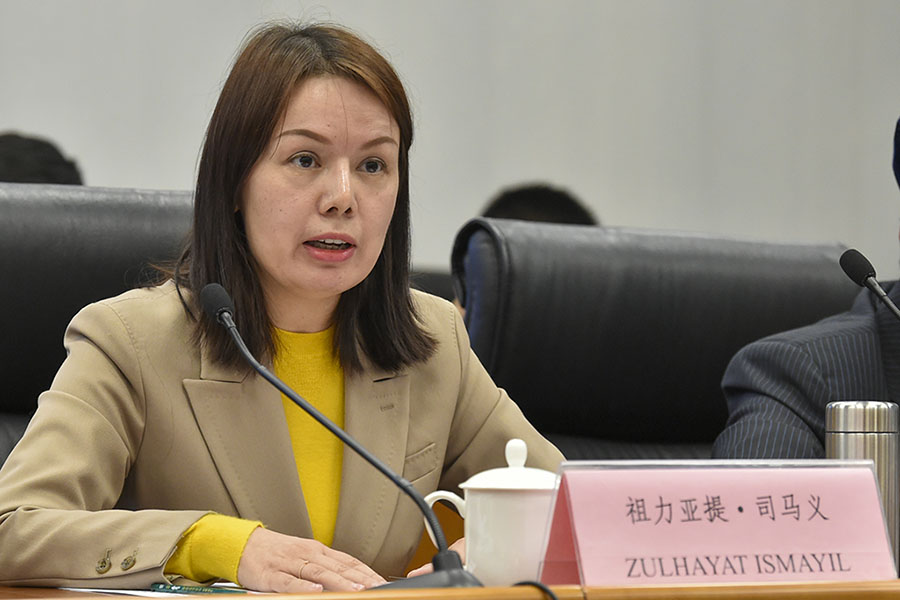
At a January 2021 press conference, Zulhayat Ismayil, spokesperson for the regional Information Office, claimed that “the communication between people of all ethnic groups in Xinjiang and their relatives abroad is free and normal.” Zulhayat goes on to suggest that any breakdown in communication is due to factors such as Uyghurs cutting ties with family members overseas due to involvement with “separatist” groups, family members in China being detained for alleged criminal offenses, changed or forgotten phone numbers, and deliberate fabrication of such claims under outside influence.31Embassy of the People’s Republic of China in the United States of America, “2nd Press Conference by Xinjiang Uygur Autonomous Region on Xinjiang-Related Issues; Chinese Embassy in the United States,” January 13, 2021, online.
At a second press conference held in Beijing in June 2021, Elijan Anayat, also a spokesperson for the regional government added, “As for the problem that some overseas Chinese can’t get in touch with their relatives in Xinjiang, they can get in touch with Chinese embassies and consulates, and Xinjiang will actively do a good job.”32Embassy of the People’s Republic of China in the United States of America, “The 11th Press Conference by Xinjiang Uygur Autonomous Region on Xinjiang-related Issues in Beijing,” June 20, 2021, online. In a “Fact Check” article, China Daily, reposting Xinhua, highlighted the allegation of incommunicado families as a lie, claiming those reported unreachable are living normal lives and that “separatist” groups have misused personal information and photos to spread disinformation.33“Fact Check: Lies on Xinjiang-related issues versus the truth,” China Daily, February 5, 2021, online.
Such defenses share a similar structure: rebutting the claims of Uyghur individuals abroad with vague assurances of normality, shifting blame to “separatists,” or assertions that family members may have forgotten phone numbers. No such rebuttal articles have been published between 2024 and 2025, the period under review. However, UHRP documented, in a 2021 report on Chinese state media, how propaganda narratives had moved from defense against allegations of human rights violations to the success of Chinese state policies in the region. As the report concludes this “influence campaign [is] meant to convince a worldwide public that the Uyghurs and the Uyghur Region have been politically cleansed through reeducation, and that the region is now open for state-approved cultural tourism.”34Henryk Szadziewski and Anonymous, “Meet the New Uyghurs: CGTN’s Role in Media-Washing Genocide,” Uyghur Human Rights Project, December 21, 2021, online.
VIII. The Right to Communicate with Family
The right to communication with family members is outlined in Article 12 of the Universal Declaration of Human Rights, which states, “No one shall be subjected to arbitrary interference with his privacy, family, home or correspondence, nor to attacks upon his honour and reputation. Everyone has the right to the protection of the law against such interference or attacks.”35United Nations, Universal Declaration of Human Rights, online.
In 1988, the UN Human Rights Committee General Comment No. 16 on Article 17 of the International Covenant on Civil and Political Rights (ICCPR) reinforced the “right of every person to be protected against arbitrary or unlawful interference with his privacy, family, home or correspondence.”36UN Human Rights Committee, CCPR General Comment No. 16: Article 17 (Right to Privacy), The Right to Respect of Privacy, Family, Home and Correspondence, and Protection of Honour and Reputation, April 8, 1988, online. The General Comment, published before mass communication via the internet, nevertheless adds, “Compliance with article 17 requires that the integrity and confidentiality of correspondence should be guaranteed de jure and de facto. Correspondence should be delivered to the addressee without interception and without being opened or otherwise read. Surveillance, whether electronic or otherwise, interceptions of telephonic, telegraphic and other forms of communication, wire-tapping and recording of conversations should be prohibited.”37UN Human Rights Committee, “CCPR General Comment No. 16: Article 17 (Right to Privacy), The Right to Respect of Privacy, Family, Home and Correspondence, and Protection of Honour and Reputation,” April 8, 1988, online.
When individuals refrain from communicating with family members due to credible fear that doing so will trigger retaliation against loved ones, such enforced silence constitutes both an indirect interference with the right to correspondence and a form of transnational repression.
Given the evolution of mass communication technologies, interpretations of Article 17 have been updated to reflect contemporary methods of contact.38American Civil Liberties Union, “Privacy Rights in the Digital Age: A Proposal for a New General Comment on the Right to Privacy under Article 17 of the International Covenant on Civil and Political Rights,” March 2014, online; OHCHR, “OHCHR and privacy in the digital age,” online. However, evolving interpretations of Article 17 should extend beyond direct state interference to include situations in which individuals refrain from communicating with family members or others out of fear that doing so could expose them to state-inflicted harm or transnational repression. Any future engagement on Uyghur human rights must recognize enforced loss of communication as both a method of coercion and a human rights violation that affects individuals, families, and communities across generations. When individuals refrain from communicating with family members due to credible fear that doing so will trigger retaliation against loved ones, such enforced silence constitutes both an indirect interference with the right to correspondence and a form of transnational repression, in which state power is exercised extraterritorially through coercion and intimidation.
IX. Recommendations for the International Community
- Advocate for Family Reunification: Governments and international bodies should prioritize diplomatic and humanitarian channels to facilitate communication and reunification of Uyghur families, and ensure they can exercise their internationally recognized rights to family unity under the ICCPR.
- Strengthen Legal Protections: Governments should encourage enforcement of international standards protecting the right to family life and freedom of correspondence, including through UN mechanisms and treaty bodies.
- Protect Uyghurs Fleeing Persecution: Governments should prioritize the processing, protection, and safe resettlement of Uyghurs escaping repression in China.
- Monitor and Document Transnational Repression: Governments, NGOs, and intergovernmental organizations should systematically track interference with communication, travel, and diaspora freedoms.
- Support Diaspora Mental Health and Cultural Continuity: Fund programs that address psychological trauma, cultural preservation, and intergenerational connection for Uyghur communities abroad.
- Counter State Propaganda: Support independent media, research, and advocacy to expose misinformation and highlight the realities of enforced family separation in East Turkistan.
- Engage UN Special Procedures: The UN Special Rapporteur on the right to privacy should urge China to end state surveillance and coercive monitoring of communications between Uyghur diaspora members and their families, ensuring that all individuals can communicate freely without fear of reprisals or collective punishment.
X. Methodology
For this report, the author interviewed six Uyghurs (two females and four males) residing in either Turkey or the United States who have lost contact with family members. The interviews took place in June and July 2025. The interview transcripts were uploaded to a Computer Assisted Qualitative Data Analysis (CAQDAS) platform and analyzed through an iterative process of coding so that dominant themes emerged.
Because Uyghurs overseas are highly vulnerable to China’s transnational repression, and Uyghurs in China are subjected to repression due to links to overseas Uyghurs, all identifying details have been removed.
Secondary sources on loss of contact between Uyghurs overseas and family members in the Uyghur Region were gathered from open sources and the search was limited to texts from the beginning of 2024. The search yielded fourteen texts, which were analyzed through an adapted critical discourse analysis. The text analysis comprised two steps: the first, an initial reading to record basic information (title, URL, date, and source), and the second, a critical reading to note core claims, keywords, and any standout quotes.
XI. About the Author
Dr. Henryk Szadziewski is Director of Research at the Uyghur Human Rights Project. He leads research projects, engages global stakeholders, and publishes widely on Uyghur issues. A Fulbright scholar with a Ph.D. in Geography, he contributes expert analysis to academic journals, media outlets, and international organizations on human rights and China.
XII. Acknowledgements
The author wishes to thank the six interviewees and UHRP Executive Director, Omer Kanat for facilitating contact with interviewees. The author is grateful to UHRP Associate Director for Research & Advocacy, Peter Irwin for substantive reviews of early drafts, as well as his dedicated work on the production process. The author also wishes to thank Adaire Criner, UHRP Program Assistant, for her careful review and proofreading of the text.
Cover art by YetteSu. © 2026 Uyghur Human Rights Project. Please share materials freely, with appropriate attribution, under Creative Commons Attribution 4.0 International (CC BY 4.0).
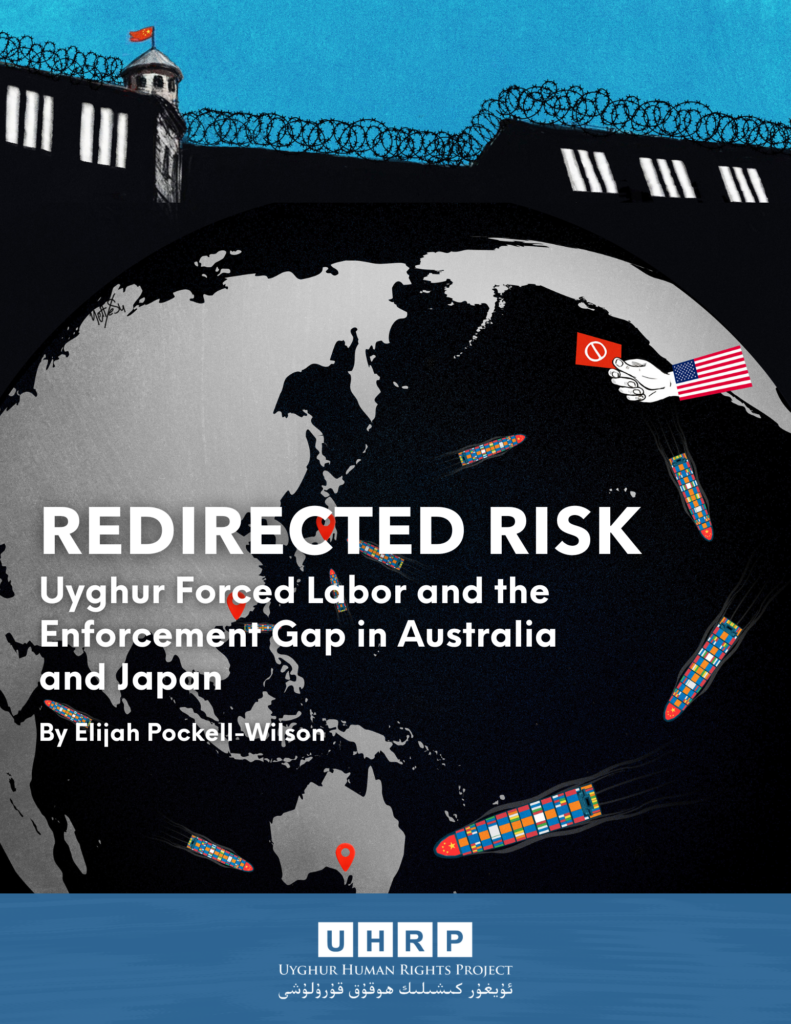
Redirected Risk: Uyghur Forced Labor and the Enforcement Gap in Australia and Japan

Whitewashing Winter Tourism: Global Sports and Leisure Industry Risks in the Uyghur Region
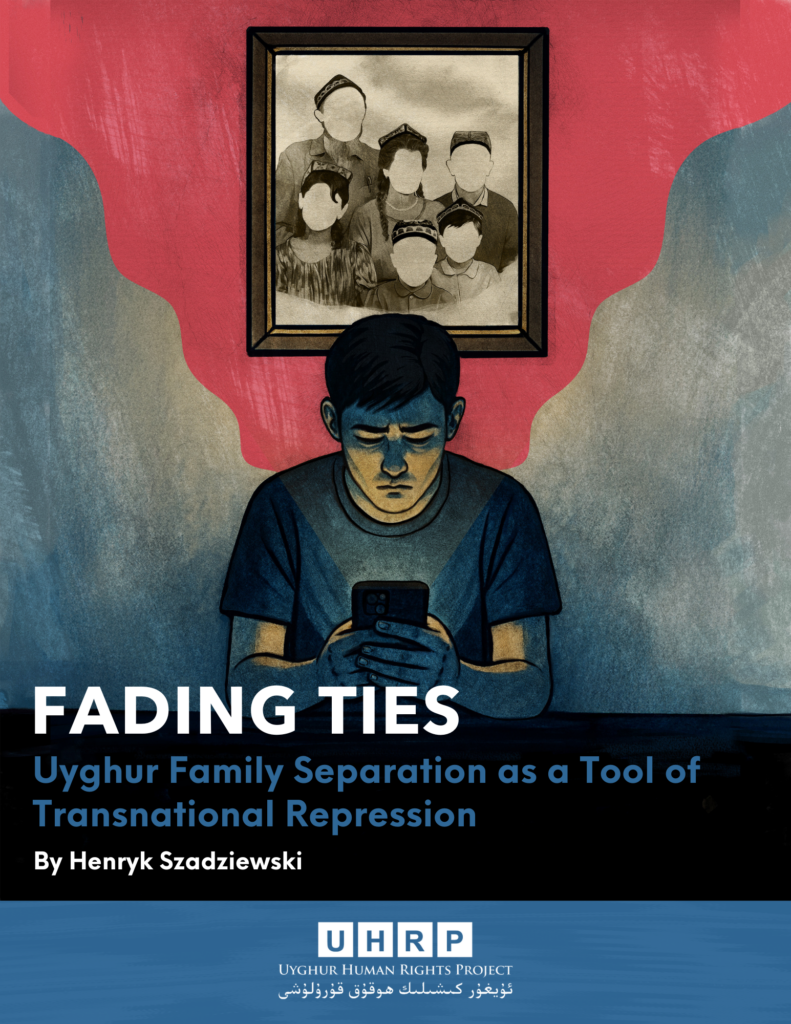
Fading Ties: Uyghur Family Separation as a Tool of Transnational Repression
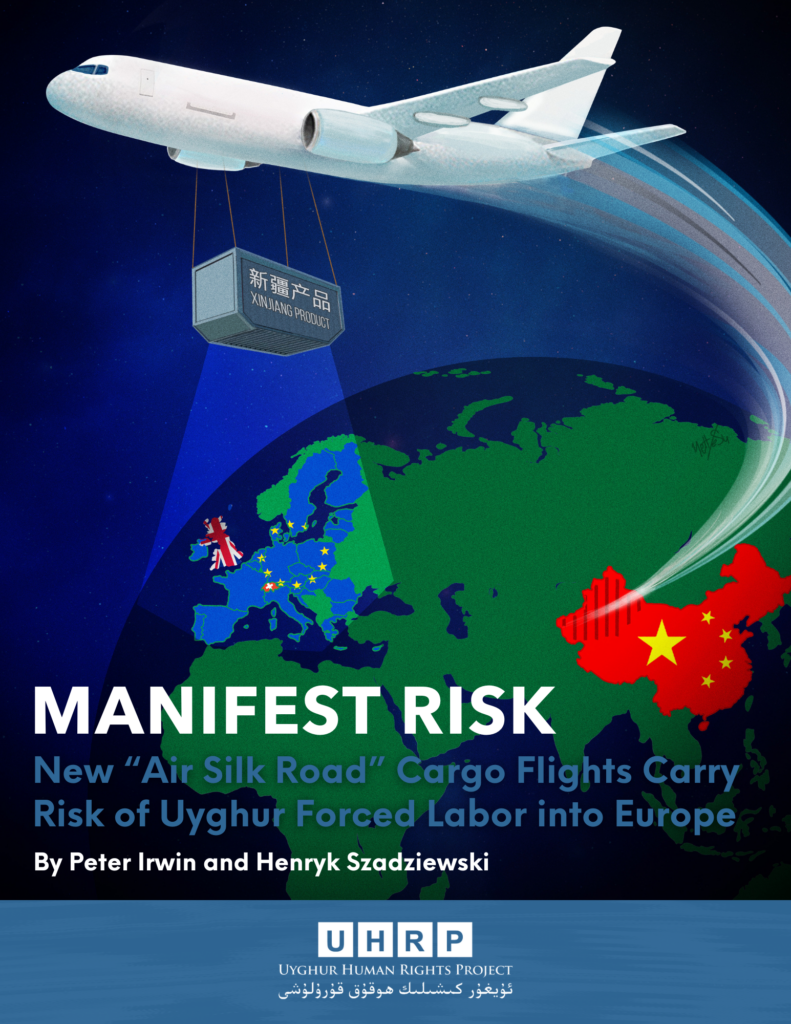
Manifest Risk: New “Air Silk Road” Cargo Flights Carry Risk of Uyghur Forced Labor into Europe
FEATURED VIDEO
Atrocities Against Women in East Turkistan: Uyghur Women and Religious Persecution
Watch UHRP's event marking International Women’s Day with a discussion highlighting ongoing atrocities against Uyghur and other Turkic women in East Turkistan.